
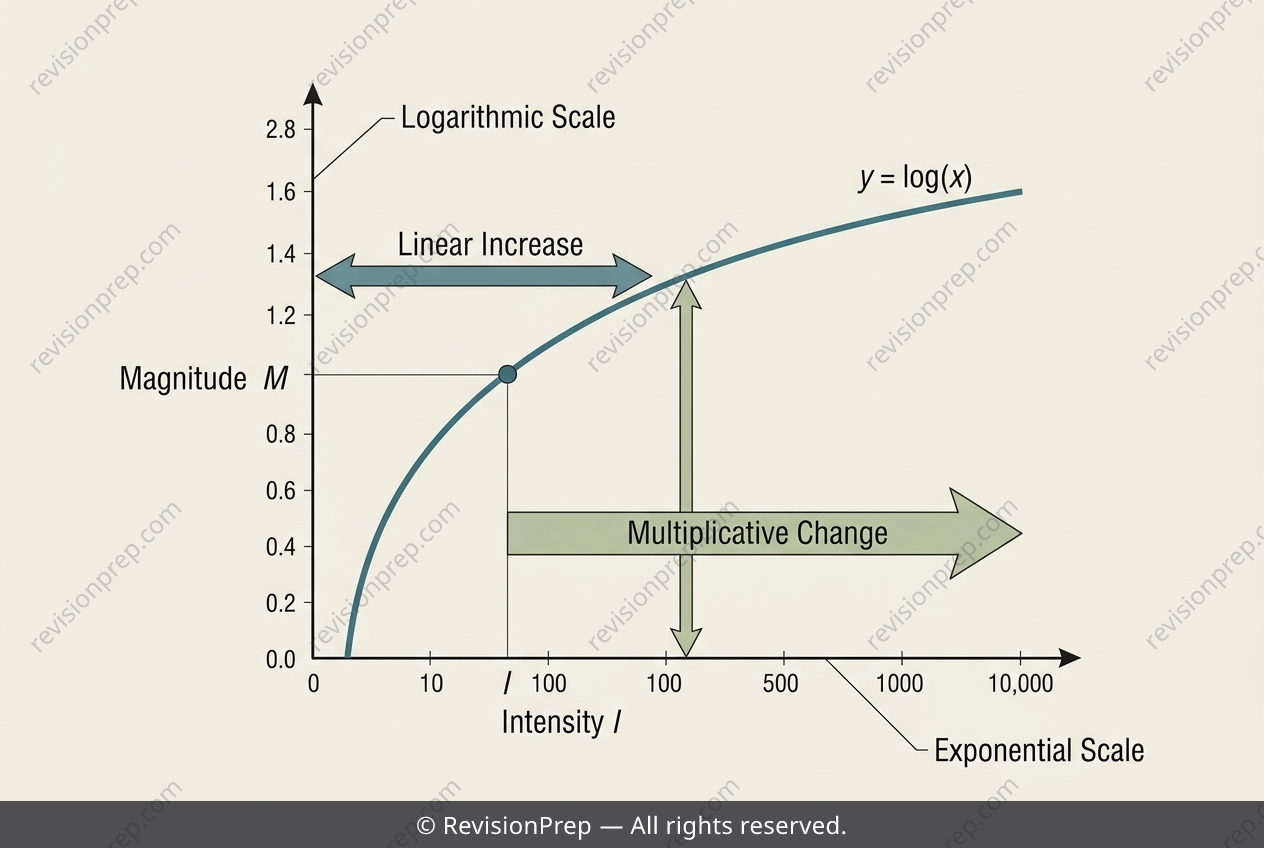
Maths: How Logs and Exponentials Measure Earthquakes
Logarithms and exponentials are inverse functions, and nowhere is that relationship more visible than in the Richter scale, where magnitude is defined as M = log₁₀(I / I₀). Because the logarithm converts multiplicative changes in intensity into additive changes in magnitude, equal steps on the scale correspond to vastly unequal jumps in physical energy released. This matters because real-world scales — sound in decibels, acidity in pH, earthquake strength — are built precisely so that human-sized numbers can describe enormous ranges. The mechanism linking the two sides is the log subtraction law: subtracting two magnitudes gives the logarithm of the ratio of intensities, so a magnitude difference of 2 translates directly into an intensity ratio of 10². Recognising that structure lets you move fluently between a magnitude and its intensity, whether you are scaling an existing value upward or converting a raw intensity back into a magnitude.
Start practising IB questions today
150,000+ IB-styled questions, criteria-mapped and instantly accessible.