
Maths: When a Bounce Becomes a Geometric Model
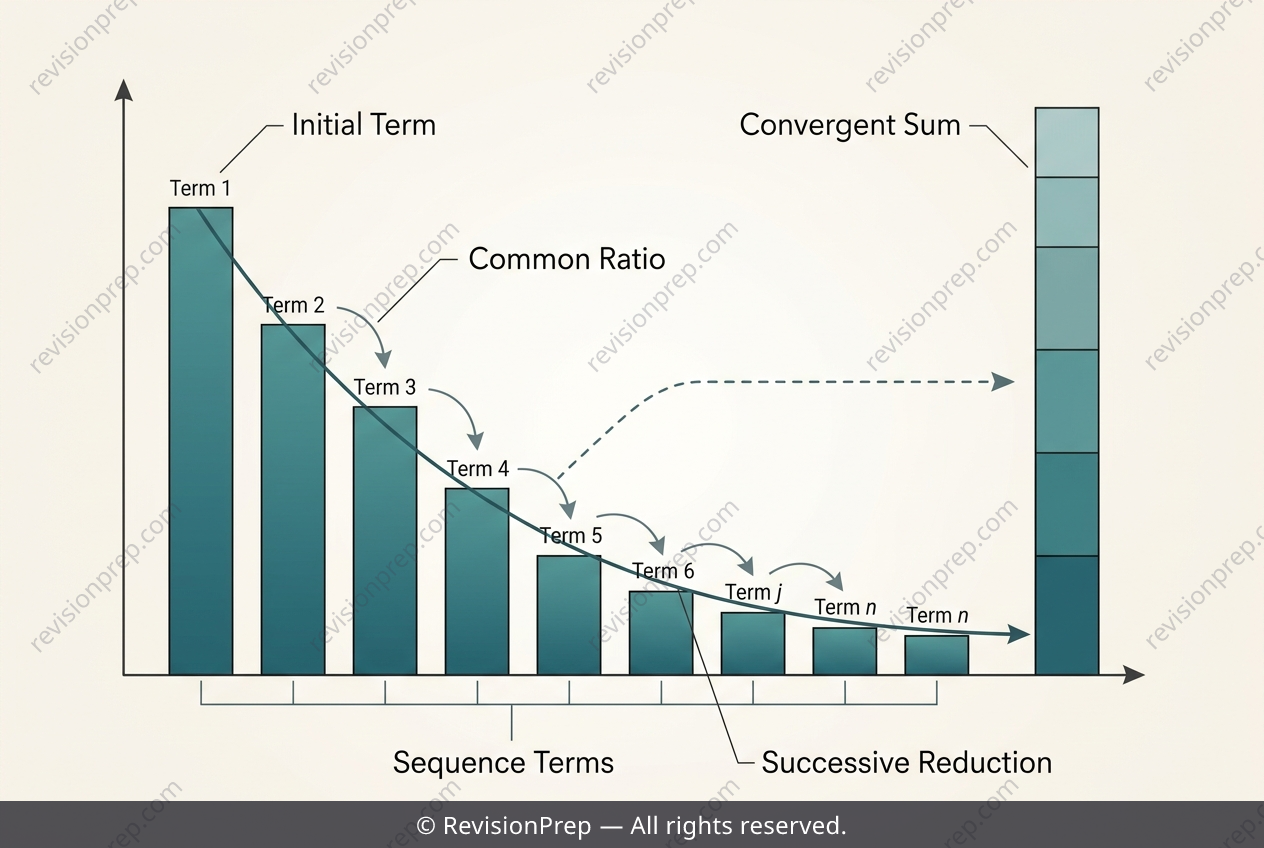
Geometric sequences describe quantities that change by a constant multiplier at every step, and they appear everywhere from population growth to the bouncing of a ball. In this problem, each bounce reaches 60% of the previous height, so the bounce heights form a geometric sequence with first term u₁ = 2.5 × 0.6 and common ratio r = 0.6. Recognising this structure lets you generate any term directly using uₙ = u₁r^(n−1), or equivalently 2.5 × 0.6ⁿ, and it also connects the individual terms to their cumulative behaviour. That connection is what makes geometric series so powerful. The sum of the first n bounce heights is given by Sₙ = u₁(1 − rⁿ)/(1 − r), which allows the total distance travelled to be calculated rather than added bounce by bounce. Inequalities such as u₁r^(n−1) < 0.01, solved using logarithms, identify when the sequence first drops below a threshold, while the sum formula captures everything that happened before that point — together turning a physical process into a compact mathematical model.
Start practising IB questions today
150,000+ IB-styled questions, criteria-mapped and instantly accessible.