
Maths: When Infinite Series Have a Finite Answer
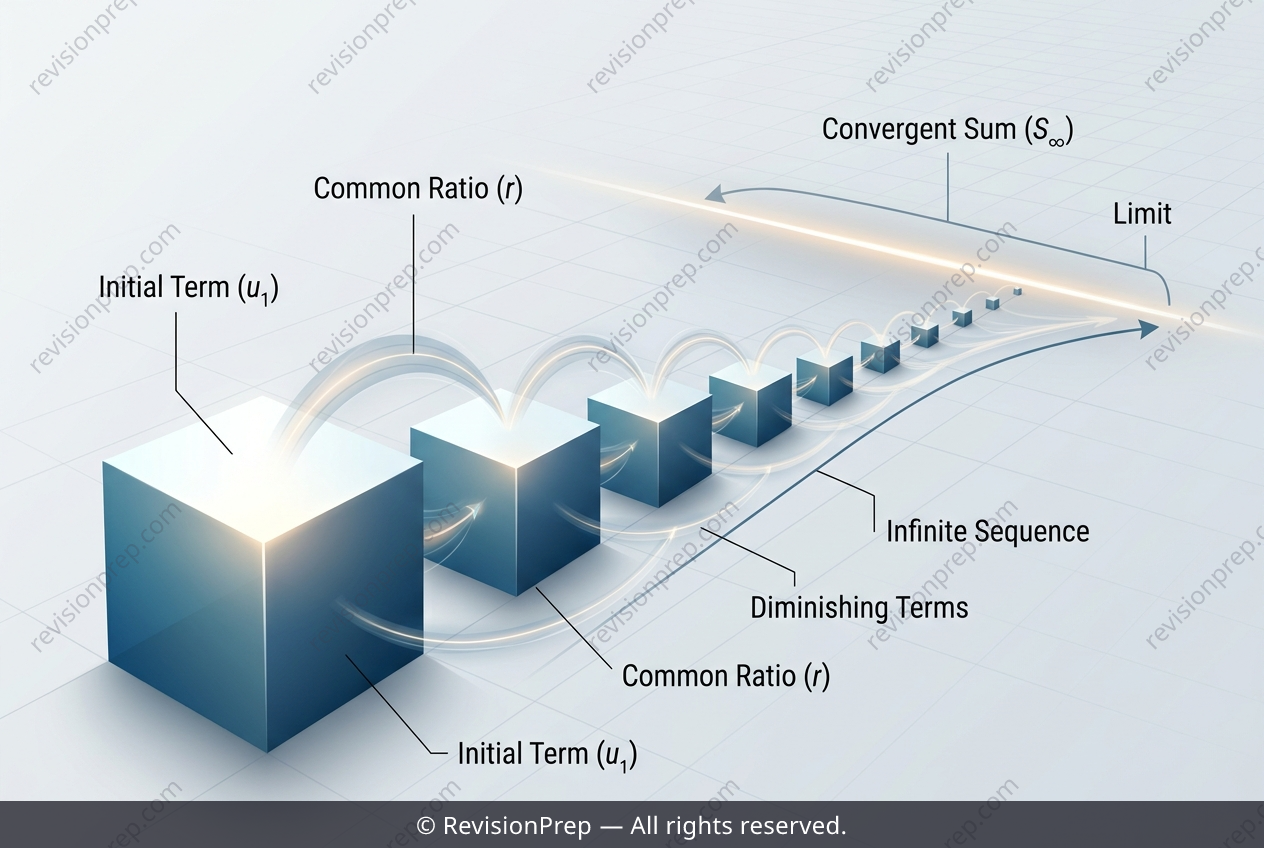
The sum to infinity of a geometric series captures what happens when infinitely many terms are added but their total stays finite. This only works when the common ratio r satisfies |r| < 1, so each term shrinks toward zero, and the series converges to S∞ = u₁ / (1 − r). Recognising this condition is the key step in deciding whether an infinite sum has a limiting value at all. This idea matters because many real processes — bouncing balls, repeated percentage changes, diminishing oscillations — produce quantities that accumulate in a geometric pattern. The skill lies in spotting the structure: identifying the first term u₁, finding the constant multiplier r between successive terms, and confirming the terms decay. In the bouncing-ball scenario, each bounce contributes an up-and-down pair of distances, and these pairs form a geometric sequence whose sum gives the total distance travelled after the first impact. Adding the initial drop then yields the full journey to rest.
Start practising IB questions today
150,000+ IB-styled questions, criteria-mapped and instantly accessible.