
Maths: Why a Small pH Shift Means a Big Change
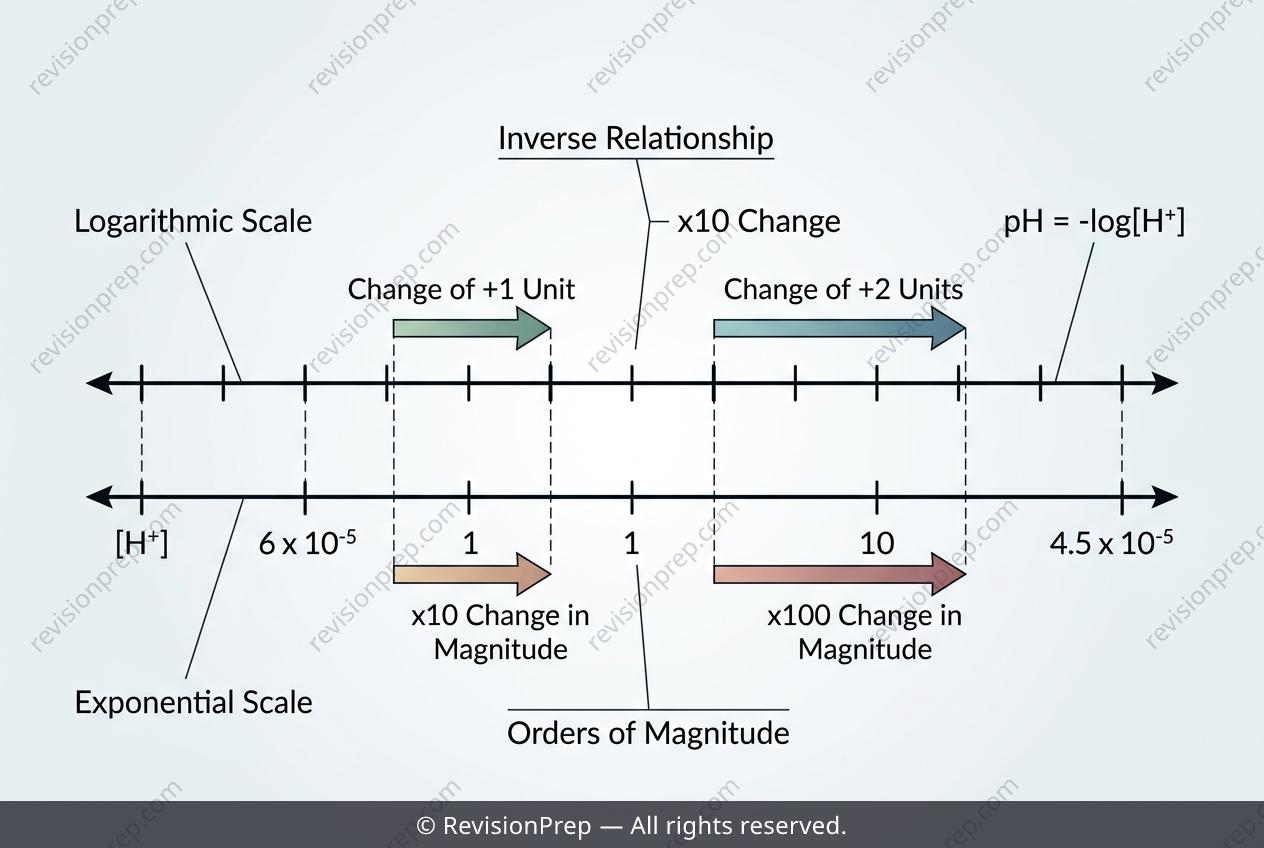
Logarithmic scales let us compress vast ranges of physical quantities into manageable numbers. The pH scale is a classic example: pH = −log₁₀[H⁺], where [H⁺] is the hydrogen ion concentration in mol L⁻¹. Because hydrogen ion concentrations can span many orders of magnitude, a logarithmic scale turns multiplicative changes into additive ones, making it far easier to compare solutions. This matters because a small shift in pH corresponds to a dramatic change in concentration. Applying log laws to pH = −log₁₀(4.5 × 10⁻⁵) splits the expression into log₁₀ 4.5 plus log₁₀ 10⁻⁵, showing how the exponent and coefficient separate. When two solutions differ by a fixed number of pH units, subtracting their pH expressions gives log₁₀ of the concentration ratio, so that difference becomes the exponent of 10. This relationship between additive pH changes and multiplicative concentration changes is the heart of the concept.
Start practising IB questions today
150,000+ IB-styled questions, criteria-mapped and instantly accessible.