
Maths: Why Growth Rate Always Wins Long-Term
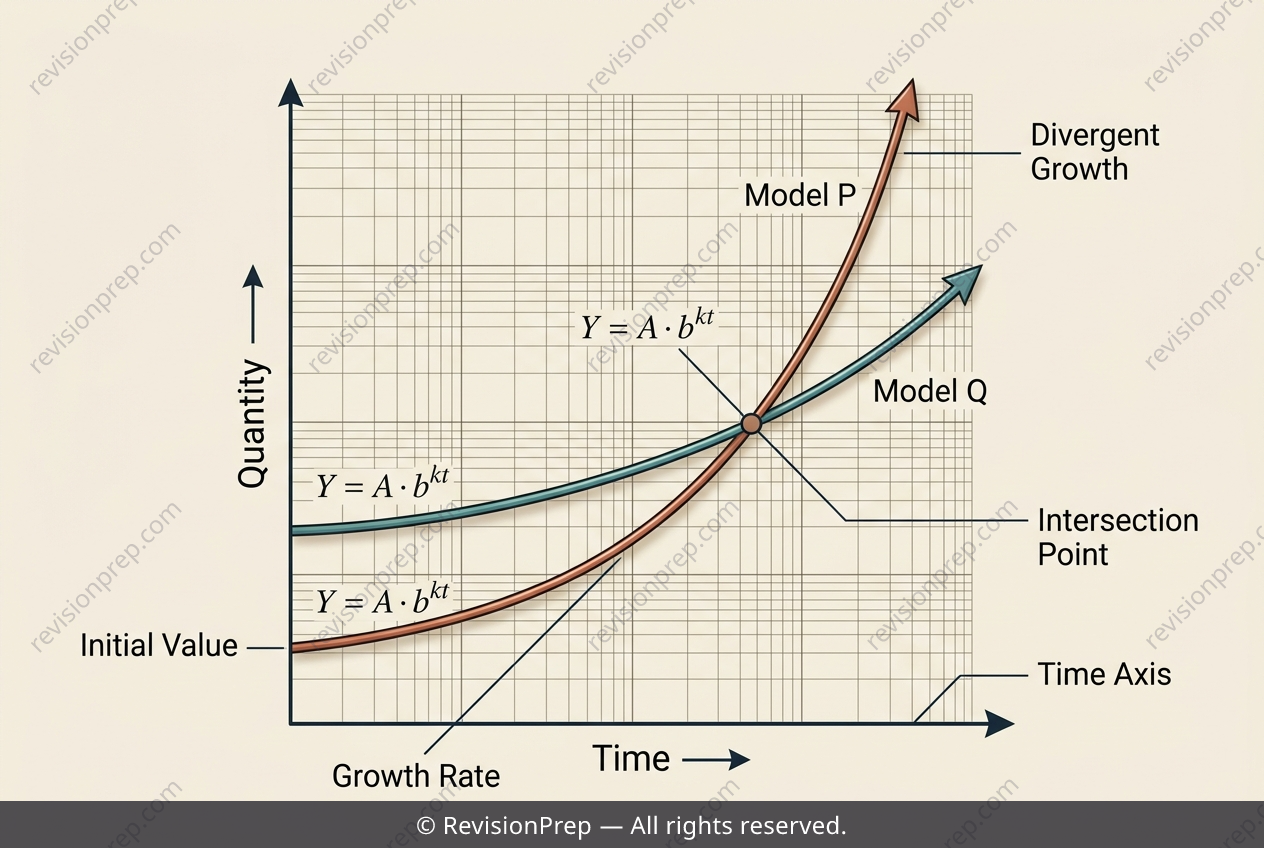
Exponential models are among the most powerful tools in Number and Algebra, describing quantities that grow or decay by a constant factor over equal time intervals. A function of the form P(t) = a × b^(kt) captures this behaviour: the initial value a sets the starting point, while the base and exponent rate k together govern how quickly the quantity changes. Such models underpin population growth, radioactive decay, compound interest, and more. Comparing two exponential functions deepens this understanding. Setting P(t) = Q(t) and dividing through isolates the ratio of the starting values, reducing the problem to a single exponential equation such as b^(kt) = c, which is solved using logarithms — often via the change of base identity log₂ x = ln x / ln 2. The relative sizes of the exponents then determine which function eventually dominates, since a larger growth rate guarantees a higher long-term value regardless of initial conditions.
Start practising IB questions today
150,000+ IB-styled questions, criteria-mapped and instantly accessible.