
Ecology and Environment
MYP 2 Sciences: ecosystems, energy flow, biomes and pollution — the essentials before your assessment
Quick facts
Ecology and Environment is one of the most exam-friendly MYP 2 Sciences topics — because it's really testing one repeatable skill: can you trace a cause-and-effect chain between living and non-living parts of an ecosystem? This topic covers ecosystems and biomes, biotic vs abiotic factors, energy flow through trophic levels, and pollution effects like eutrophication. Data-response questions using tables, graphs and scenario-based ecosystems appear constantly in Criterion A and C assessments, so understanding the mechanism behind each concept — not just naming it — is what earns full marks. This blog highlights the five ideas examiners return to again and again. For the complete breakdown with worked examples, definitions and practice, the full revision note has you covered.
What you’ll be able to do
Ecosystem Scales: From Organism to Biosphere
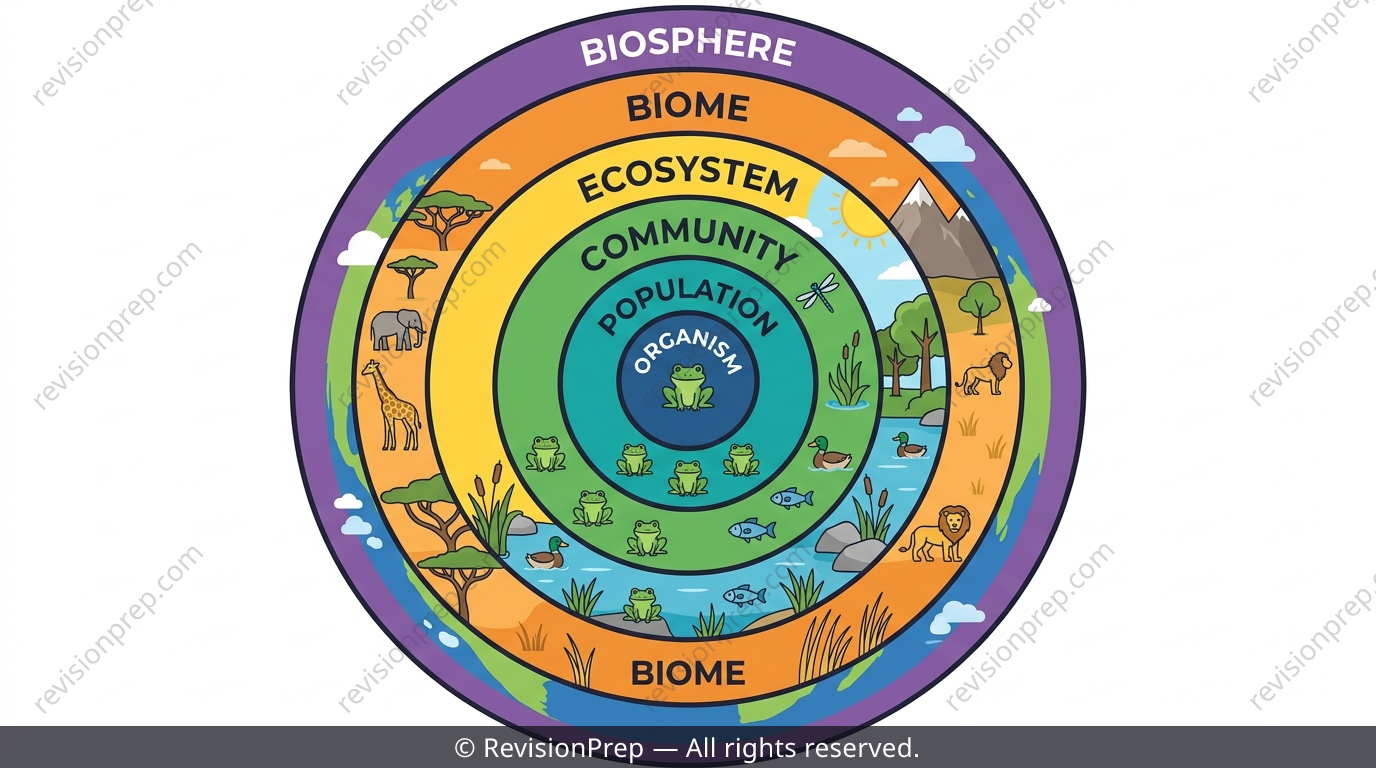
Ecology operates at nested scales: one frog is an organism, all frogs in a pond form a population, every species in that pond forms a community, and the community plus the abiotic environment (water, mud, sunlight) together form the ecosystem. Biomes are large regions grouped by climate — this is the scale examiners test first, so always identify the scale before answering.
Exam tip
If a question mixes up 'population' and 'community', check whether it's talking about one species or many — that's the fastest way to avoid losing an easy identify mark.
Common mistake
Treating 'habitat' and 'ecosystem' as the same thing. Habitat is the address (where an organism lives); ecosystem is the whole neighbourhood — that place plus every organism and abiotic factor interacting in it.
Mini summary
Habitat → Population → Community → Ecosystem → Biome → Biosphere: each scale adds more organisms or more of the environment.
Biotic vs Abiotic Factors
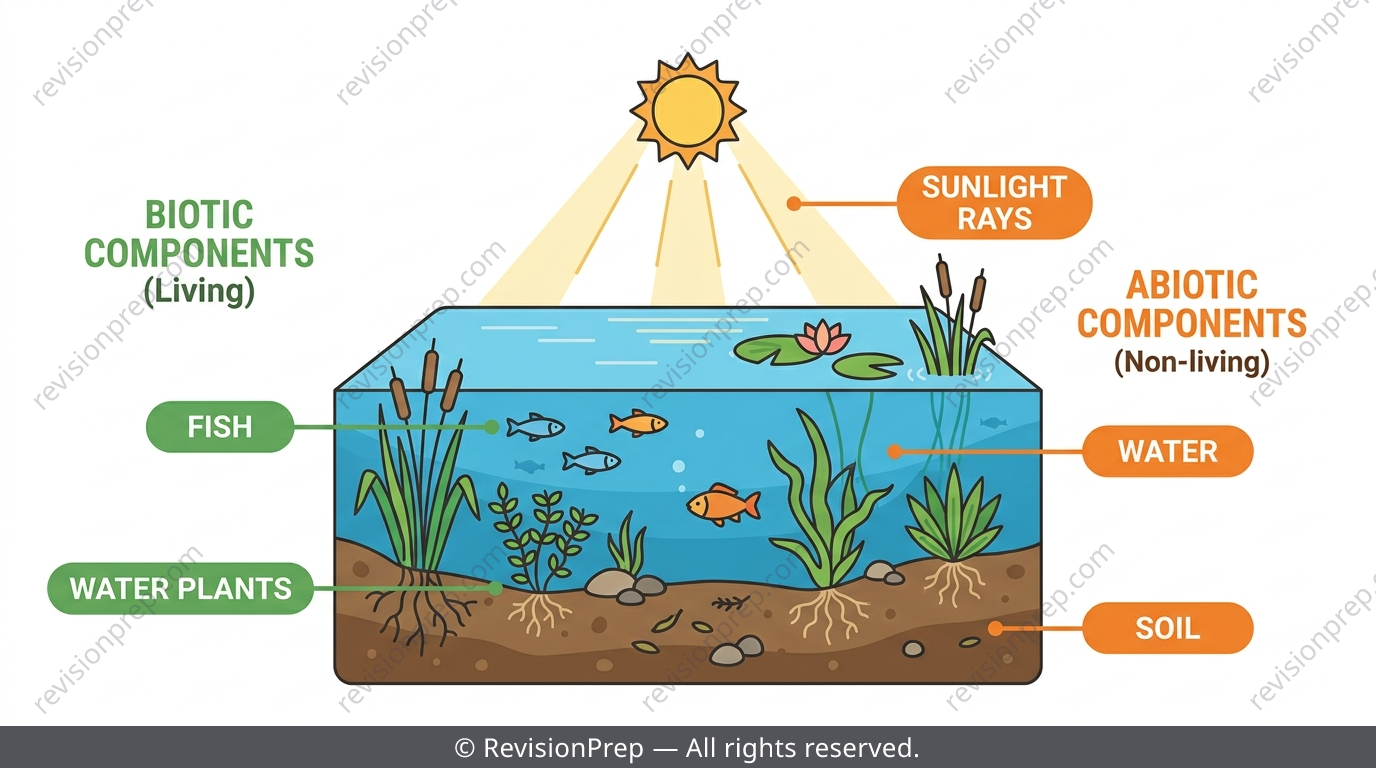
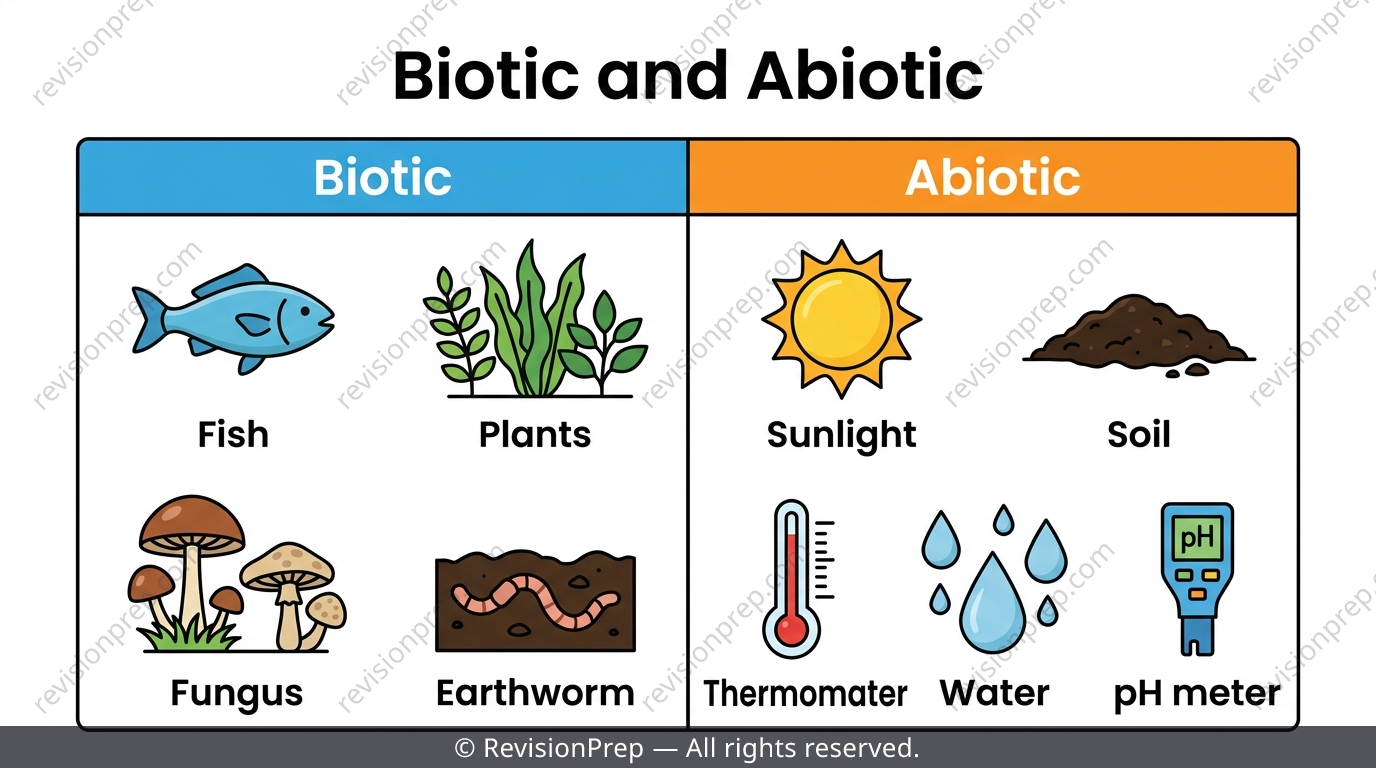
A biotic factor is any living or once-living component that affects other organisms — predators, competitors, food supply. An abiotic factor is a non-living physical or chemical component like temperature, light, water, pH or soil type. The quickest test: is it alive or performing life processes right now? Dead organic matter and physical/chemical factors both count as abiotic.
Exam tip
For 'explain how a biotic component depends on an abiotic one' questions, always name a process word — respire, photosynthesise, absorb — not just a restated fact.
Common mistake
Writing something like 'fish need water to swim in' for an explain question. That restates an obvious fact with no mechanism, so it won't score the explain mark.
Mini summary
Biotic = alive or life-process-active; abiotic = non-living physical/chemical factor — including dead matter.
Biomes Are Climate Zones, Not Countries
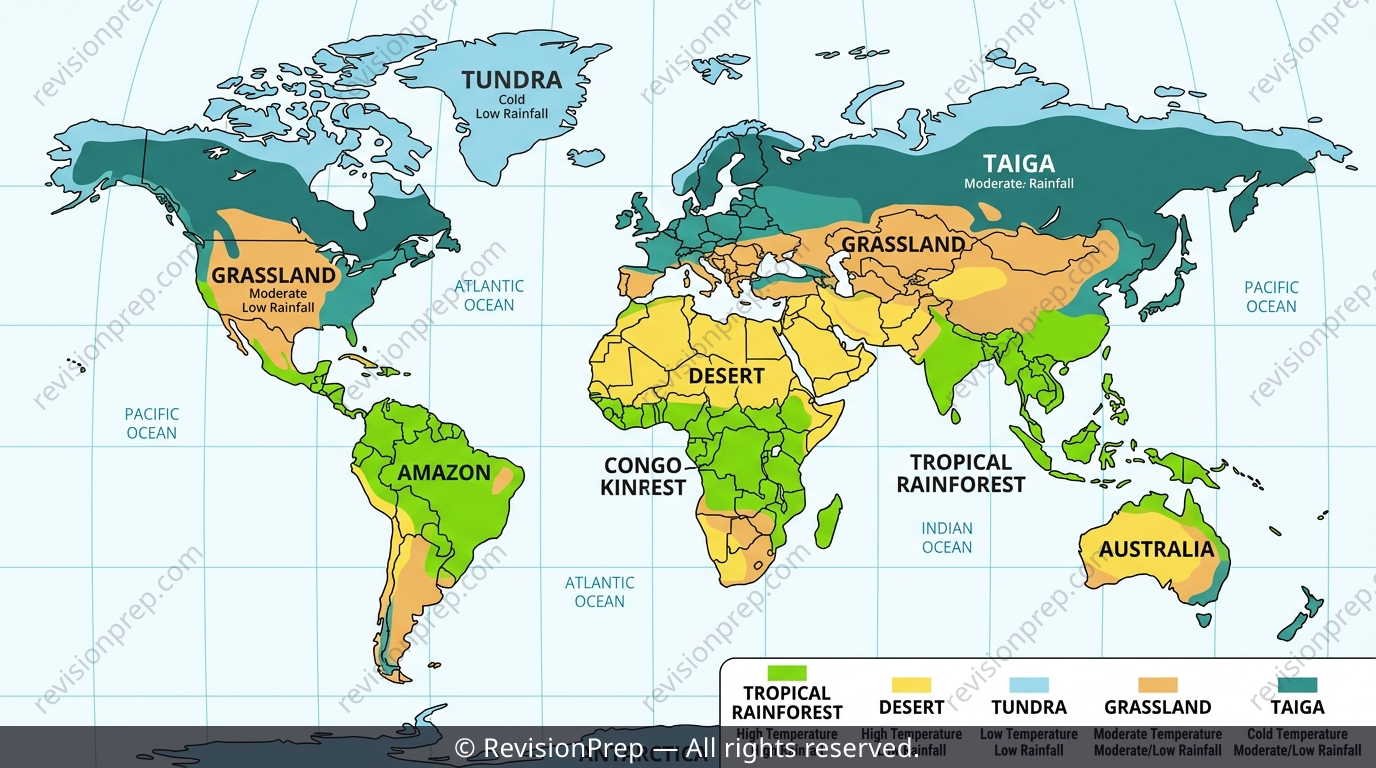
Biomes are classified by average temperature and rainfall pattern, not by geographic location — the Amazon and Congo rainforests are the same biome despite being on different continents. Major biomes include tropical rainforest (hot, wet), desert (very dry), tundra (cold, low rainfall), grassland/savanna (seasonal rainfall) and taiga (cold winters, conifers), while aquatic biomes are defined by salinity and depth instead.
Common mistake
Matching a biome to a country's name instead of its climate data — always check temperature and rainfall pattern, not location on a map.
Mini summary
Biomes = climate + vegetation type, matched globally, not tied to one country or continent.
Energy Flow and the 10% Rule
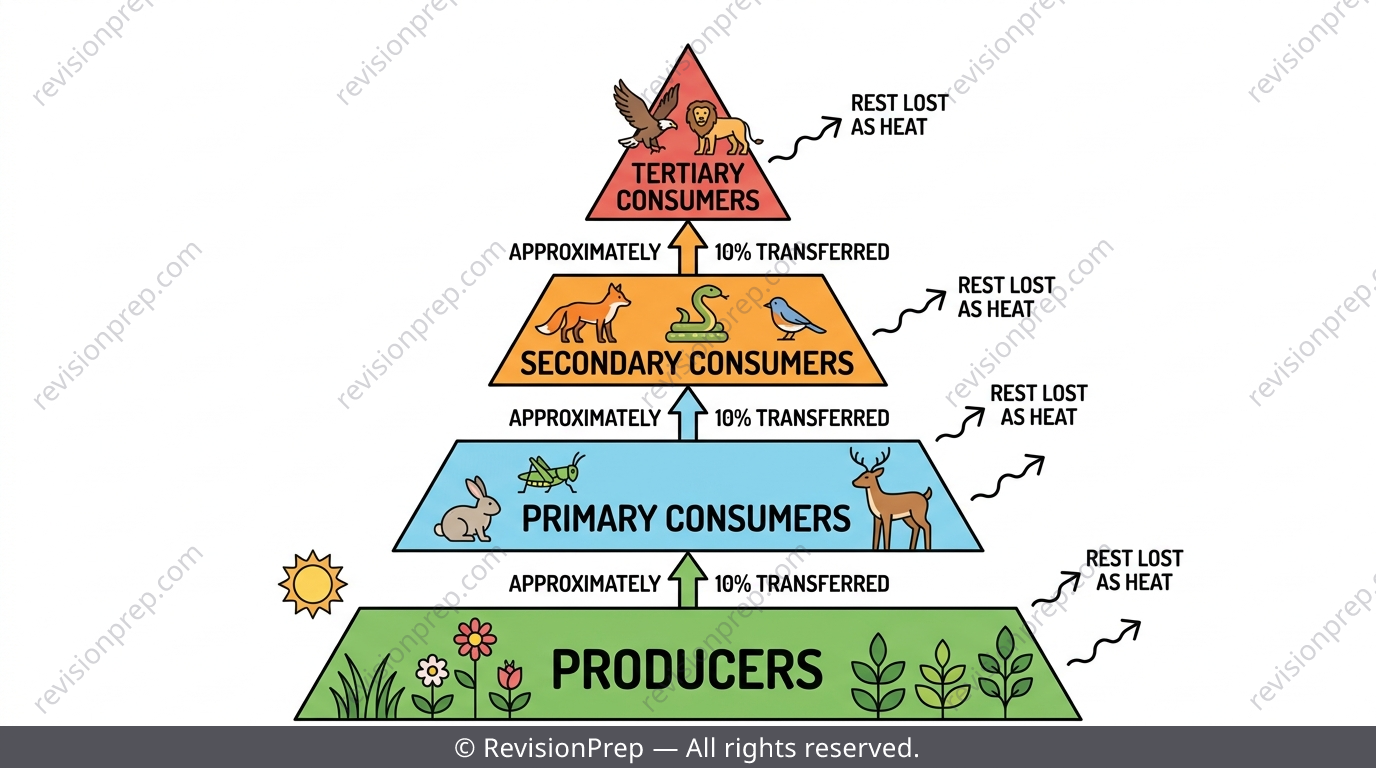
Energy enters ecosystems as sunlight, gets captured by producers, then flows one way through trophic levels — producers, primary consumers, secondary consumers, tertiary consumers — never recycling back to the sun. At each transfer, only about 10% of consumed energy is built into new tissue and passed on; the rest is lost as heat from respiration, used for movement, or lost as undigested waste, which is why food chains rarely exceed 4–5 levels.
Exam tip
When asked why energy decreases up a food chain, name where it goes — heat, movement, undigested waste — writing 'energy is lost' alone scores zero.
Common mistake
Multiplying by 0.10 an extra time by treating producers as the first transfer instead of the starting point — always count transfers, not levels.
Mini summary
Roughly 10% of energy passes to each next trophic level; the rest leaks away as heat, movement and waste.
Pollution and Eutrophication
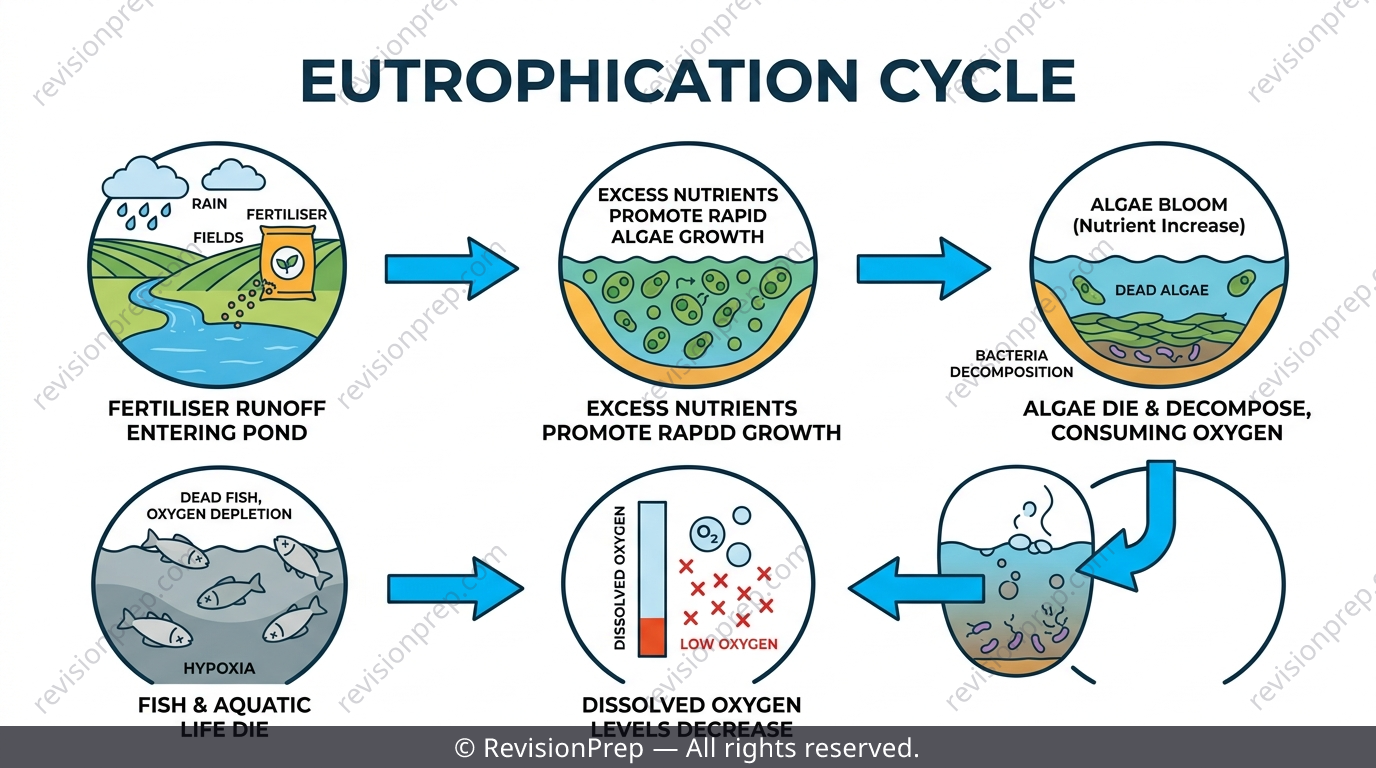
Pollution is any substance or energy entering the environment faster than it can be safely absorbed, causing harm to living things — examples include fertiliser runoff, sewage, plastic waste, and pesticide build-up. Eutrophication happens when excess nutrients cause explosive algal growth, which eventually depletes dissolved oxygen and kills aquatic life. Indicator species and bioaccumulation (chemicals building up in tissue, increasing at higher trophic levels) reveal how pollution effects spread through an ecosystem.
Exam tip
Pollution questions test whether you can trace the full causal chain step by step — human activity → immediate effect → knock-on effect on organisms — not just list pollution types.
Mini summary
Eutrophication: excess nutrients → algal bloom → oxygen depletion → death of aquatic organisms.
Quick formula sheet
Practice questions
- Define 'ecosystem' and give one example of a biotic and one abiotic component within it.
- Put these terms in order from smallest to largest scale: community, organism, population, ecosystem.
- State two abiotic factors that could affect a pond ecosystem.
- Explain why a dead leaf on a forest floor is classified as abiotic while a living oak tree is classified as biotic.
- A grassland biome and a desert biome differ mainly in two climate factors — name them and explain their effect on vegetation.
- Explain, step by step, how fertiliser runoff into a pond can lead to fish dying.
- Producers in a grassland fix 1,000,000 kJ of energy per year. Using the 10% rule, calculate the energy available to tertiary consumers and explain why top carnivores are always rare.
- A student claims ecosystems with more producers always have more consumers. Using given population data for two ecosystems, evaluate whether the data supports or contradicts this claim.
- Explain how bioaccumulation could cause a pesticide to reach dangerous concentrations in a top predator, even if the pesticide was applied at a low concentration.
Frequently asked questions
What's the difference between a habitat and an ecosystem?+
A habitat is simply the physical place an organism lives, like 'under a log'. An ecosystem is broader — it's the community of organisms living there plus all the abiotic factors (water, temperature, soil) they interact with.
How do I know if something is biotic or abiotic?+
Ask: is it alive or performing life processes right now? If yes, it's biotic. Dead organic matter (like a fallen leaf) and physical/chemical factors (temperature, pH, sunlight) are both abiotic.
Why does energy decrease as you move up a food chain?+
At each trophic level transfer, roughly 90% of energy is lost as heat from respiration, used for movement, or lost as undigested waste — only about 10% is passed on to build new tissue at the next level.
Why are top predators always rare in an ecosystem?+
Because energy decreases by roughly 90% at each trophic transfer, there's very little energy left by the fourth or fifth level — not enough to support a large population of top predators.
What causes eutrophication in a pond?+
Excess nutrients, often from fertiliser runoff, cause algae to grow explosively. When the algae die and decompose, dissolved oxygen in the water is depleted, which can kill fish and other aquatic organisms.
Are biomes defined by country or climate?+
Biomes are defined by climate — mainly average temperature and rainfall pattern — not by country. That's why the Amazon and Congo rainforests, on different continents, are classified as the same biome.
Master Ecology and Environment for MYP 2 Sciences
Related articles