
Patterns, Sequences & Algebraic Thinking
Diagnose the pattern type first, then let the formula do the work — the IB MYP 2 way.
Quick facts
Every 'staircase' or 'dot pattern' question in IB MYP 2 Maths is really testing one skill first: can you diagnose the pattern type before reaching for a formula? Arithmetic sequences and geometric sequences look similar in a list of numbers, but the subtraction test and division test tell them apart instantly. Once you know the type, the nth-term formula lets you jump straight to Pattern 50 without drawing 49 pictures. This teaser walks through the five ideas examiners test most — arithmetic vs geometric sequences, nth-term formulas, reverse-engineering unknown terms, turning picture patterns into algebraic rules, and the named number patterns (square, triangular, Fibonacci). Master the trap and the second-differences test here, then head to the full revision notes for every worked example, trap, and mock question.
What you’ll be able to do
Arithmetic vs Geometric Sequences: Run the Test First
Before touching any formula, subtract consecutive terms: , then . If both match, it's arithmetic and that value is the common difference — even sequences like with count. If the subtractions differ, try dividing instead: if equals , it's geometric with common ratio , which can grow, shrink, or alternate sign.
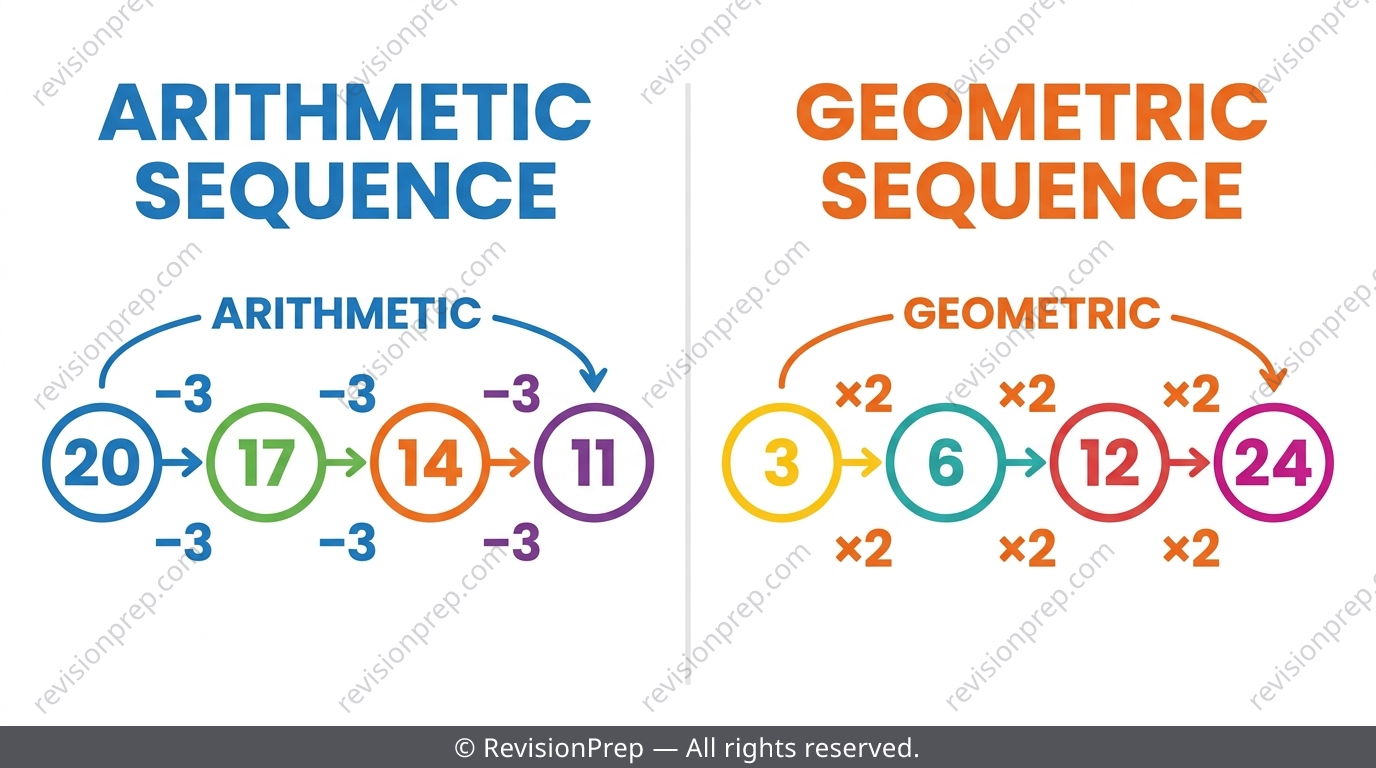
| Feature | Arithmetic Sequence | Geometric Sequence |
|---|---|---|
| Constant value | Common difference, | Common ratio, |
| Found by | Subtracting consecutive terms | Dividing consecutive terms |
| nth-term formula |
Exam tip
Never name a sequence arithmetic or geometric from just one subtraction or division — check two different pairs of terms before you commit.
Common mistake
Assuming the type after a single calculation, then applying the wrong formula when the pattern actually changes elsewhere.
Mini summary
Subtract first, divide second — the test you run determines which nth-term formula you're allowed to use.
nth-Term Formulas and the (n−1) Trap
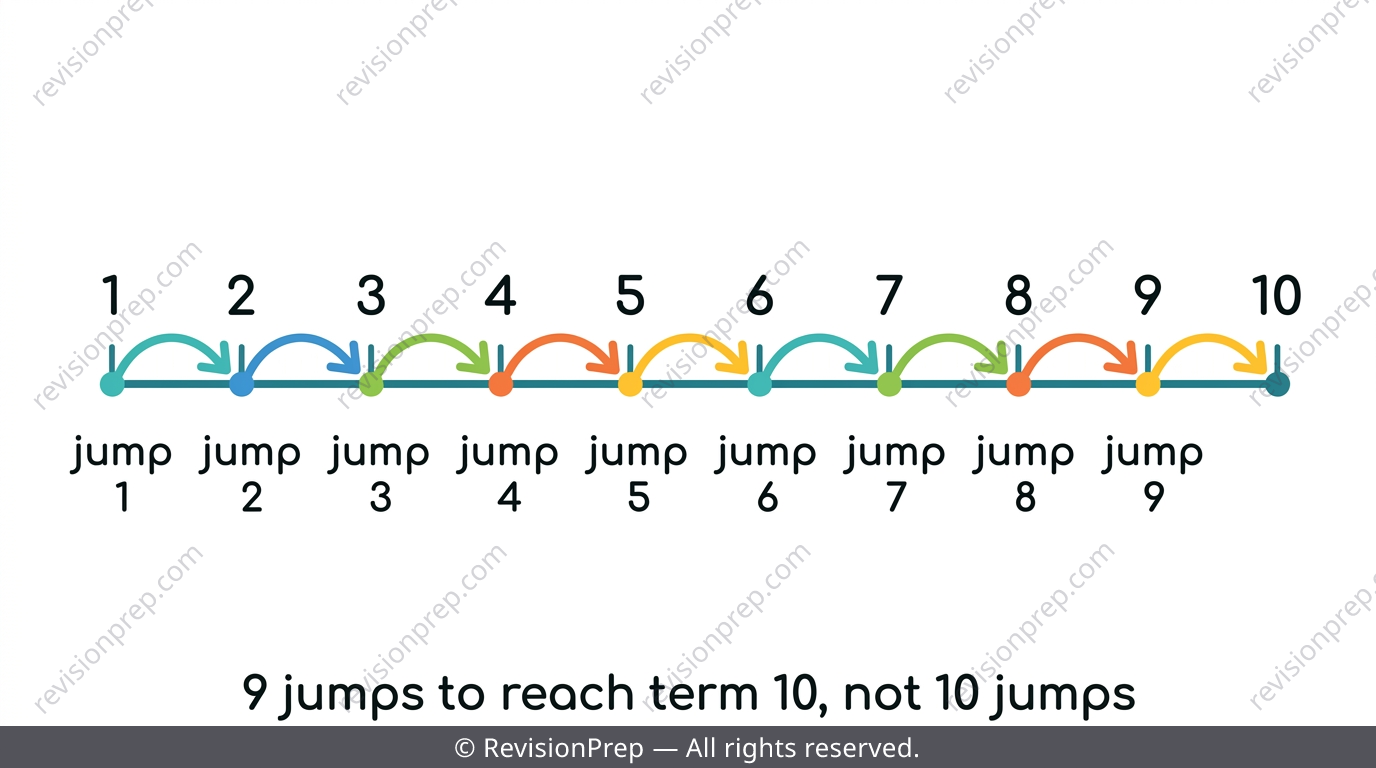
Once the type is confirmed, generates any arithmetic term and does the same for geometric sequences. The single biggest scoring error is counting terms instead of jumps: getting from term 1 to term takes exactly steps, never steps.
Exam tip
Write the formula with the actual numbers substituted in before simplifying — the method mark is awarded for correct substitution even if arithmetic afterwards slips.
Common mistake
Writing (or ) and computing one jump too many, landing on the wrong term entirely.
Mini summary
Count jumps, not terms: is the number of steps from the first term to term .
Reverse-Engineering: Finding a₁ and d from Two Terms
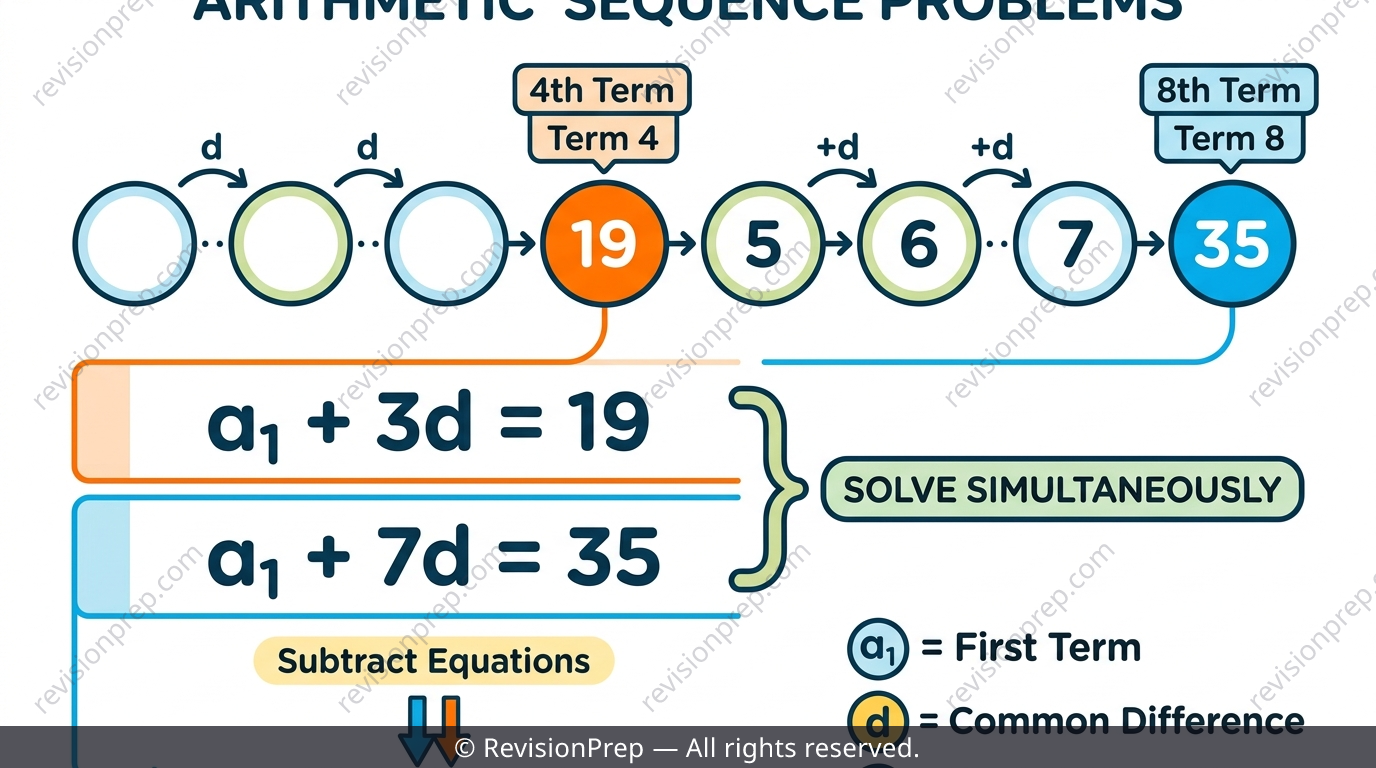
Exam questions rarely give a full list — more often you get two specific terms, like the 4th and the 8th, and must reconstruct and . Write the nth-term formula twice, once per known position using explicitly, then solve the pair of equations simultaneously. The same rearranged formula lets you check whether a target value is genuinely part of the sequence: solve for and confirm it's a positive whole number.
Exam tip
Always write out '4th term means , so the coefficient of is ' before simplifying any equation.
Common mistake
Substituting directly instead of when building the simultaneous equations, which gives the wrong and even with perfect algebra afterward.
Mini summary
Two known terms → two equations with → solve simultaneously for and .
Turning Picture Patterns into Algebraic Rules
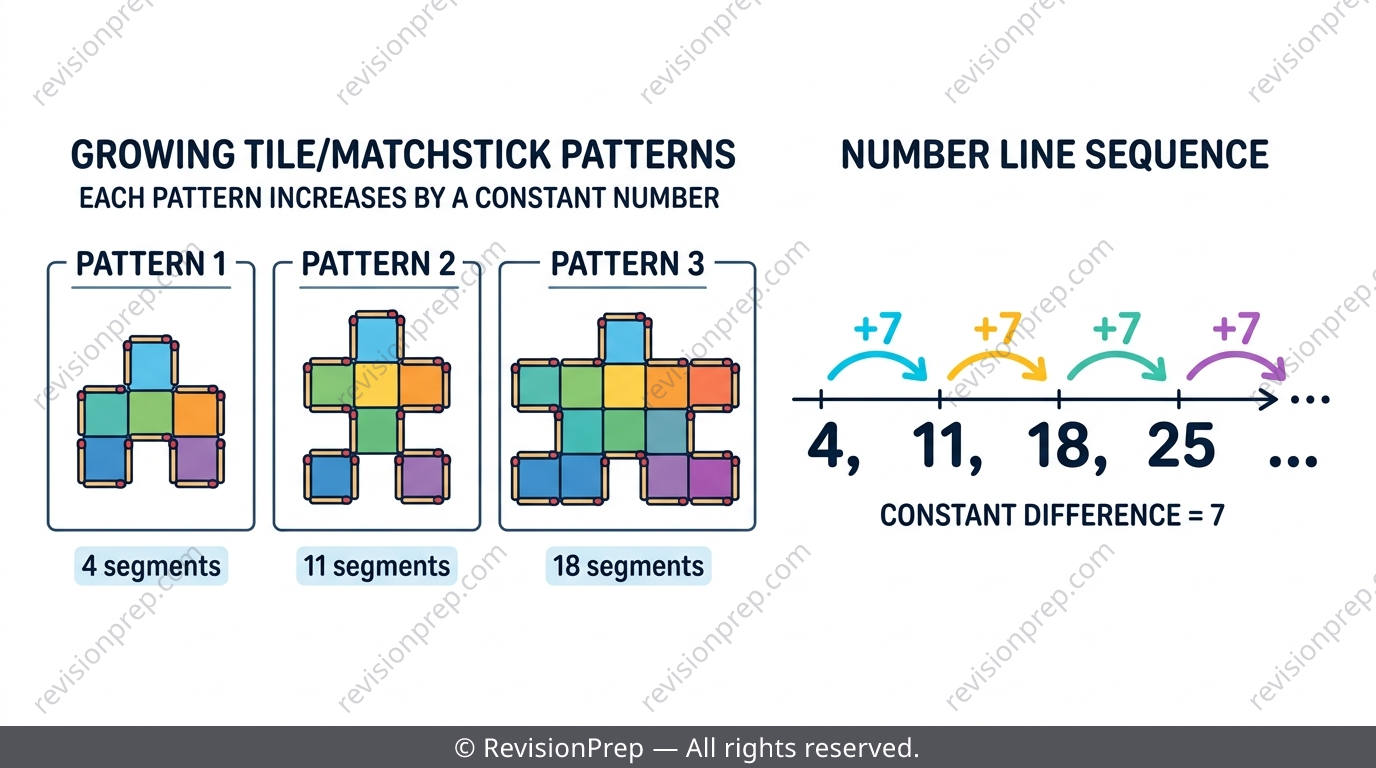
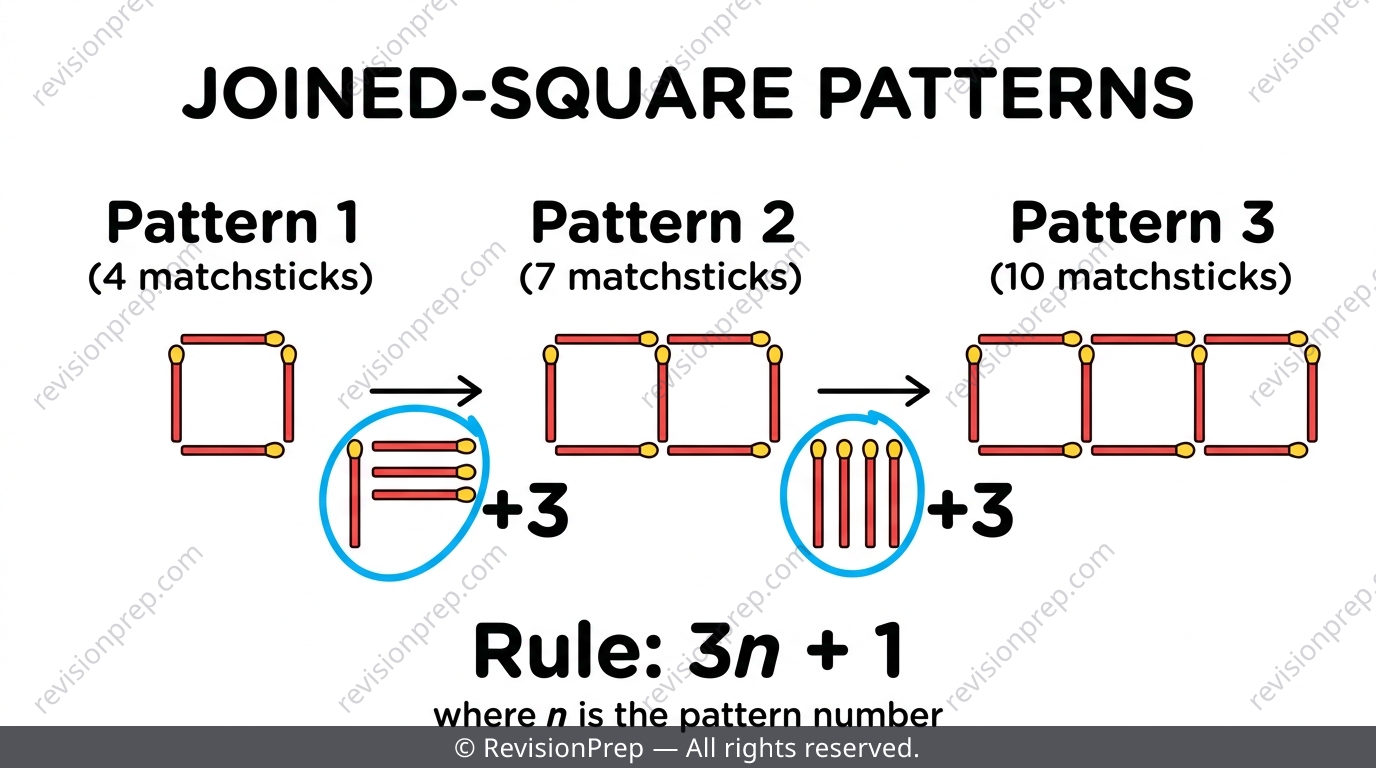
A growing matchstick, tile, or dot pattern is just an arithmetic sequence wearing a disguise. Count the constant amount added at each stage — that's — then build the rule . A term-to-term rule only describes the next stage from the current one; the position-to-term rule gives any stage directly from , which is what 'general rule' means here.
Exam tip
'Explain' questions need written justification using correct vocabulary (common difference, second difference, ratio) — a correct number with no explanation typically scores zero on the reasoning mark.
Common mistake
Using as the constant term instead of — always test in your rule to catch this instantly.
Mini summary
Find from the picture, use , and always verify with .
Square, Triangular & Fibonacci Numbers
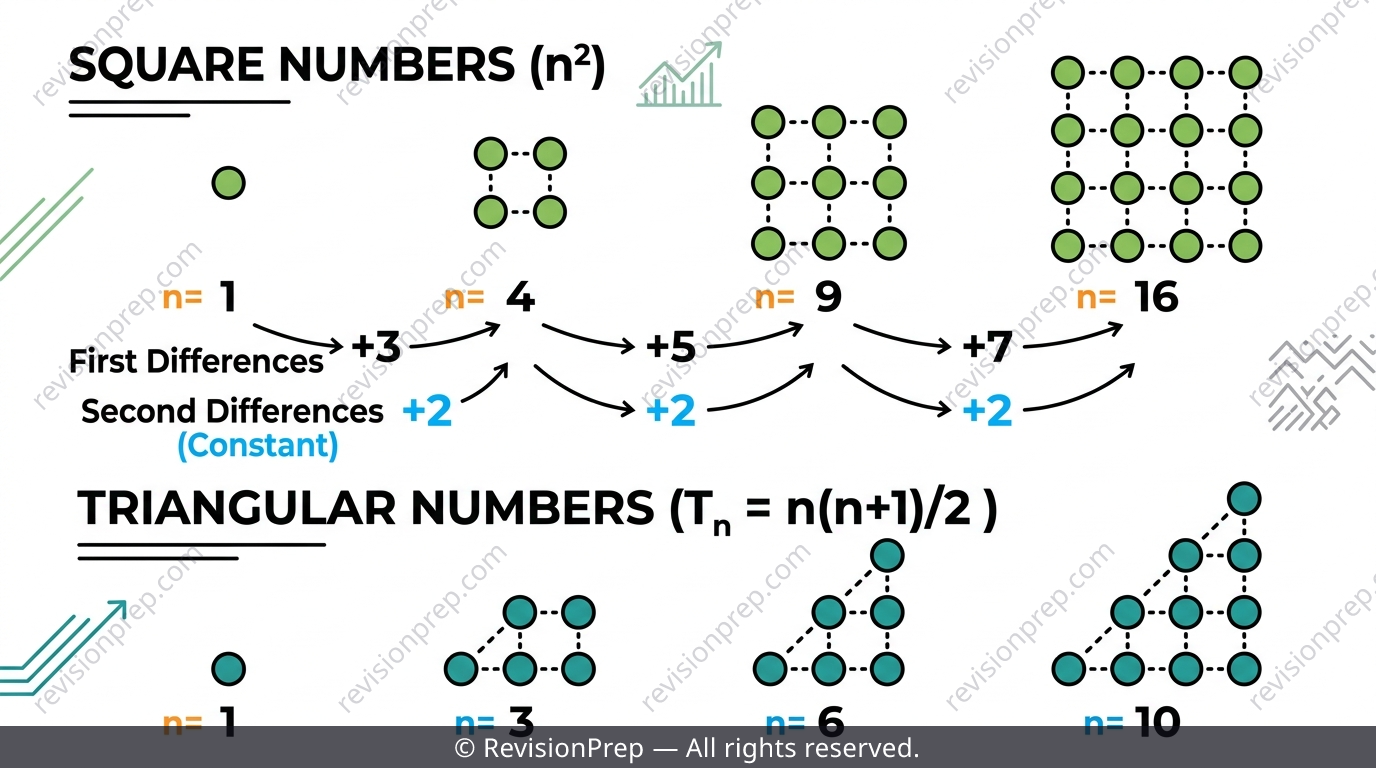
Not every pattern is arithmetic or geometric. When neither differences nor ratios stay constant, take the differences of the differences — the second differences. If those are constant, the pattern is quadratic, like square numbers with . Triangular numbers follow , while Fibonacci has no simple direct formula at this level — each term is just the sum of the two before it.
Exam tip
If first differences aren't constant, don't give up — check second differences before assuming the pattern has no algebraic structure.
Mini summary
Square, triangular, and Fibonacci patterns show that not every sequence is arithmetic or geometric — second differences reveal quadratic patterns.
Quick formula sheet
Practice questions
- Is the sequence arithmetic or geometric? State the constant value.
- Find the 6th term of the arithmetic sequence with and .
- Write the first four square numbers and the first four triangular numbers.
- A geometric sequence begins . Find the 5th term.
- A pattern uses 5 tiles for Pattern 1 and adds 4 tiles each stage. Write the position-to-term rule and find Pattern 15.
- Determine whether 100 is a term in the arithmetic sequence with and .
- In an arithmetic sequence, the 3rd term is 14 and the 7th term is 34. Find and .
- A sequence has first differences $3, 5, 7, 9$. Show that the second differences are constant and explain what this tells you about the pattern type.
- Compare an arithmetic sequence with to a geometric sequence with : state one similarity and one quantified difference between their growth after 5 terms.
Frequently asked questions
How do I tell if a sequence is arithmetic or geometric?+
Subtract consecutive terms first. If the differences are equal, it's arithmetic. If they're not, divide consecutive terms instead — equal ratios mean it's geometric. Always check at least two pairs before deciding.
Why is it (n-1) and not n in the nth-term formula?+
Because reaching term from term 1 takes jumps, not jumps. Using instead of is the most common error in these questions and gives you one term too many.
How do I find the first term and common difference if I'm only given two terms?+
Write the nth-term formula twice, once for each given position, using explicitly for each. Then solve the two equations simultaneously for and .
How do I turn a growing picture pattern into an algebraic rule?+
Find the constant amount added between stages — that's — then use . Always test your rule at to make sure the constant term is correct.
What's the difference between square numbers, triangular numbers, and Fibonacci?+
Square numbers follow , triangular numbers follow , and Fibonacci numbers follow the recursive rule with no simple direct formula at this level.
What do I do if a pattern isn't arithmetic or geometric?+
Check the second differences (the differences between the differences). If those are constant, the pattern is quadratic, like the square numbers.
Get the Full MYP 2 Patterns & Sequences Notes
Related articles