
Number Operations and Applications
Turn word problems into number sentences — and answers back into real-world verdicts
Quick facts
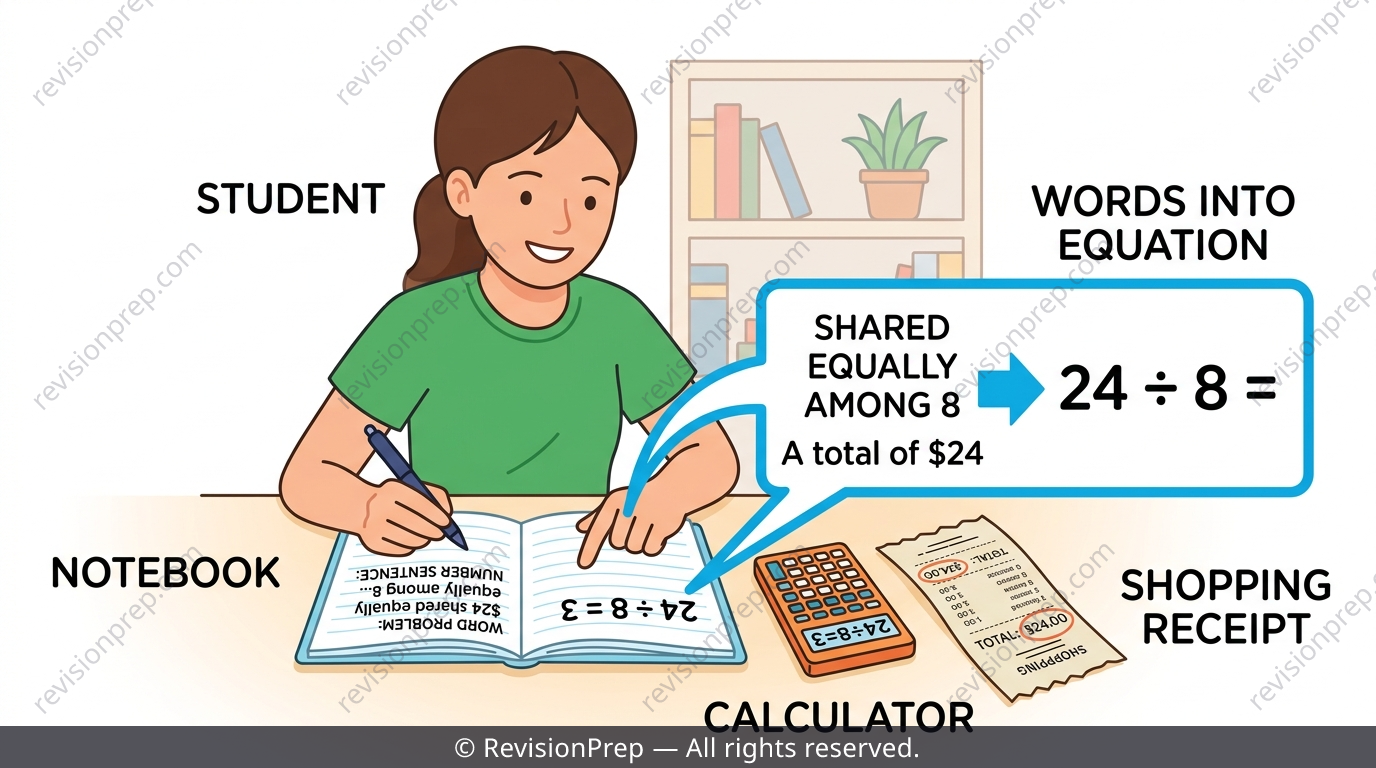
Number Operations and Applications is where all your basic arithmetic skills — the four operations, fractions, rounding — get put to work inside real contexts: shops, budgets, fundraisers, and pricing models. The real test isn't calculating; it's translation. Can you turn 'total for 8 identical notebooks' into a division, or '5 pens at $1.50 each' into a multiplication? And once you have a number, can you turn it back into a sentence that actually answers the question — did the shop hit its target, can the student afford the extra notebooks? This topic also introduces mathematical models (like a bake sale profit prediction) and asks you to spot what assumptions they're quietly making. Master the keyword bank, the totals-vs-totals rule, and the always-round-down rule for affordability, and most MYP 3 number application questions become very manageable.
What you’ll be able to do
Decoding Word Problems: Find the Hidden Operation
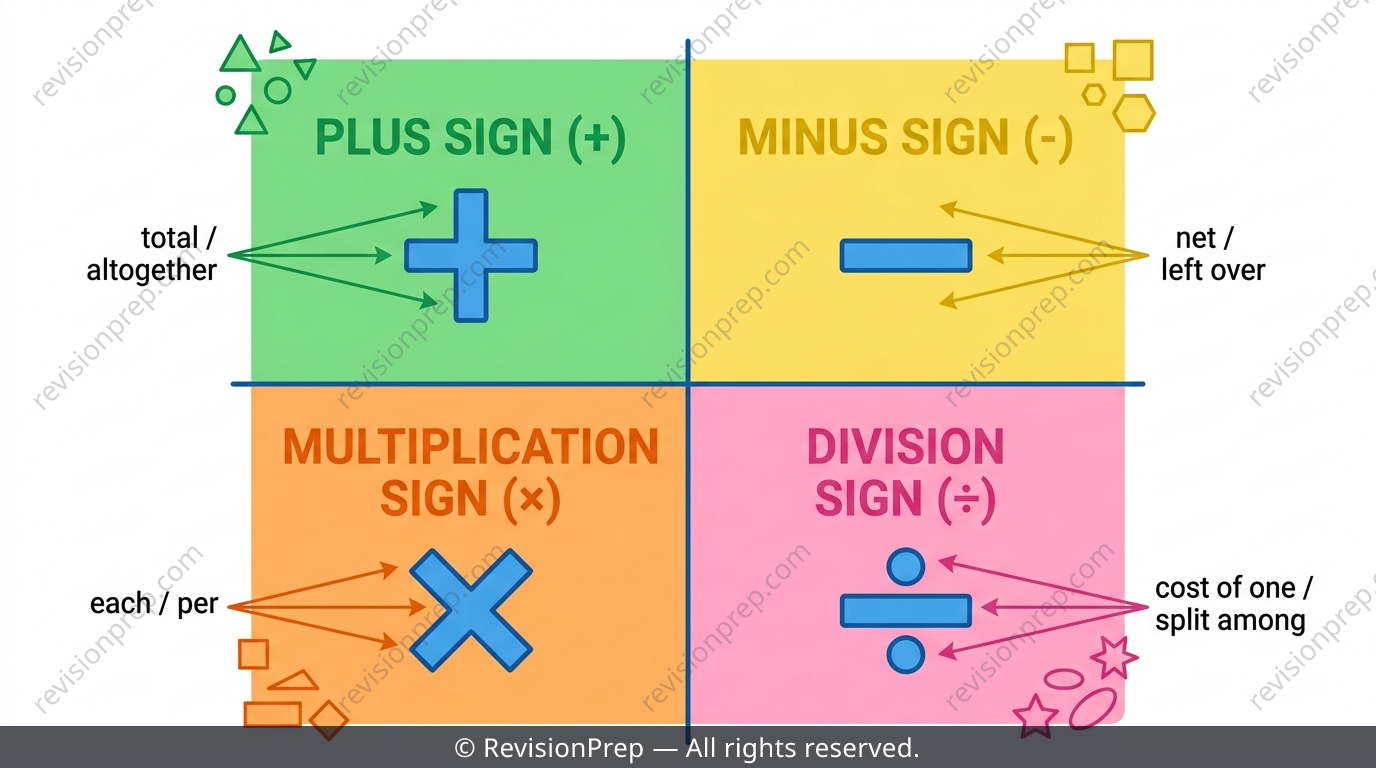
Before touching a calculator, decide what the words are doing. 'Total... altogether... combined' signals addition, even across separate weeks or categories. 'Net' or 'left over' signals subtraction, 'each/per' signals multiplication, and 'cost of one/split among' signals division. Some sentences hide two operations in a row — like buying 3 more notebooks (multiply) then adding that to what's already spent (add) before comparing to a budget.
| Operation | Common Keywords | Example Phrase |
|---|---|---|
| Addition | total, altogether, combined | chores earned in week 1 and week 2 |
| Subtraction | net, left over, after refunds | sales minus refunds and restocking |
| Multiplication | each, per, rate applied | 5 pens at $1.50 each |
| Division | cost of one, split among | $24 for 8 identical notebooks |
Exam tip
Write the number sentence down before calculating — that sentence often carries its own method mark, separate from the final answer.
Common mistake
Reading only the first outgoing amount in a subtraction problem and forgetting the rest (e.g. subtracting refunds but not restocking costs).
Mini summary
Keywords tell you the operation — but check for a second hidden operation before you finish.
Always Compare Totals to Totals
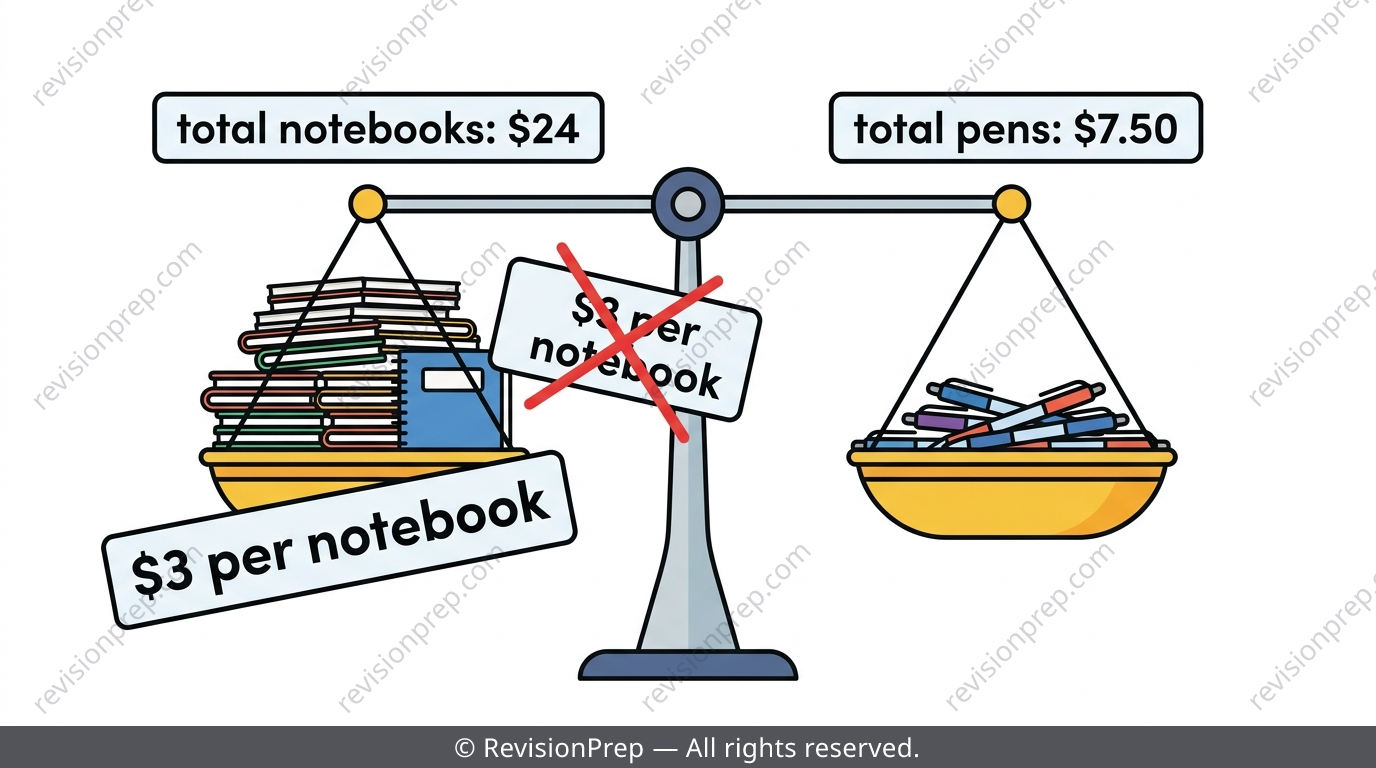
A classic trap is comparing a unit price against a grand total and drawing the wrong conclusion — for example, seeing '$3 per notebook' and wrongly declaring it cheaper than '$7.50 total for pens'. You must compare like with like: total spending on notebooks against total spending on pens, or rate against rate, never one against the other.
Exam tip
If a question asks you to compare two amounts, check that both numbers are measuring the same thing (both totals, or both unit rates) before writing your conclusion.
Common mistake
Comparing a per-unit cost directly to an overall total and concluding the wrong item is 'more expensive'.
Mini summary
Match units before you compare — total against total, rate against rate.
Net Earnings: Subtract Every Outgoing Amount
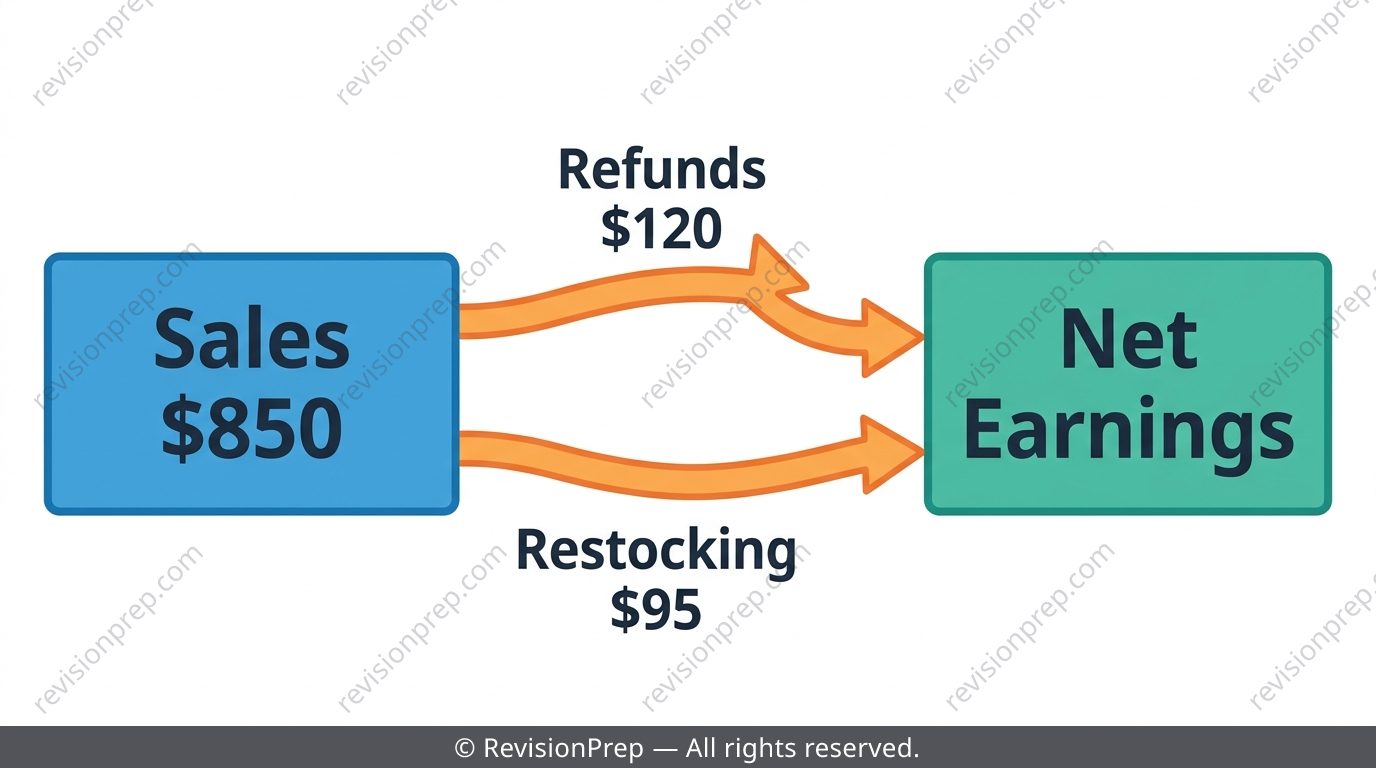
Net earnings means what's left once ALL money going out is removed from the money coming in — not just the first outgoing figure you spot. If a shop has sales, refunds, and restocking costs, both refunds and restocking must be subtracted, never treated as extra income just because they were mentioned after the sales figure.
Exam tip
List every outgoing amount first, add them together, then subtract that single combined figure from the income: sales − (refunds + restocking).
Common mistake
Subtracting only refunds and forgetting restocking costs, because it feels like 'sales minus one thing' rather than 'sales minus everything going out'.
Mini summary
Net earnings = income minus the sum of every single outgoing amount, not just one.
Real-World Models and Their Hidden Assumptions
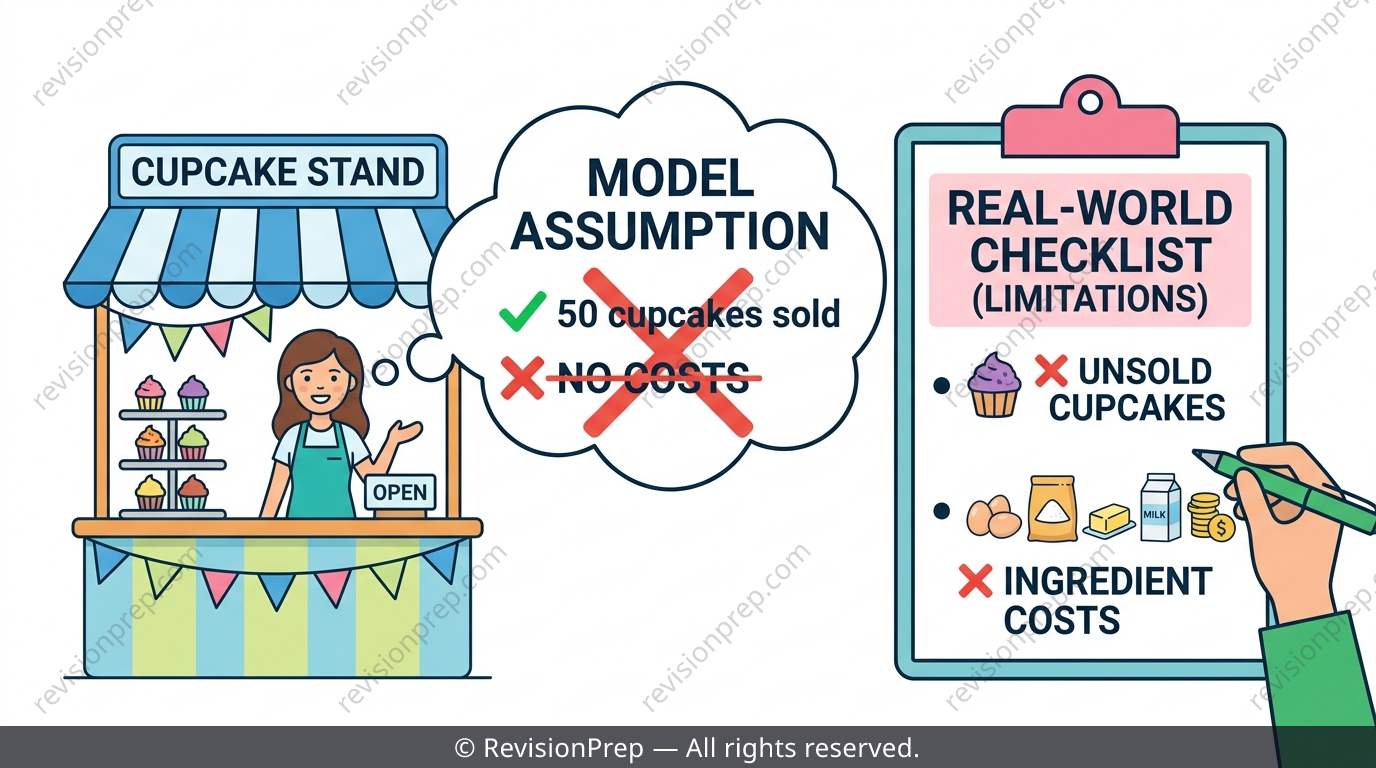
Many questions hand you a simplified model — every cupcake sells, prices divide evenly — then ask what reality would push back on. This isn't about harder arithmetic; it's about naming the specific factor the model ignores, tied to the actual numbers in the question, such as unsold stock, ingredient costs, or whole-dollar pricing constraints.
Exam tip
For 'explain a limitation' questions, give a specific reason connected to the model's stated assumption. A vague answer like 'the model might not be accurate' with no reason scores zero.
Common mistake
Failing to notice that a predicted 'profit' figure assumes zero costs, then being unable to explain why the real profit would differ.
Mini summary
A model is only as good as its assumptions — always name what it's ignoring.
Maximum Affordable Problems: Always Round Down
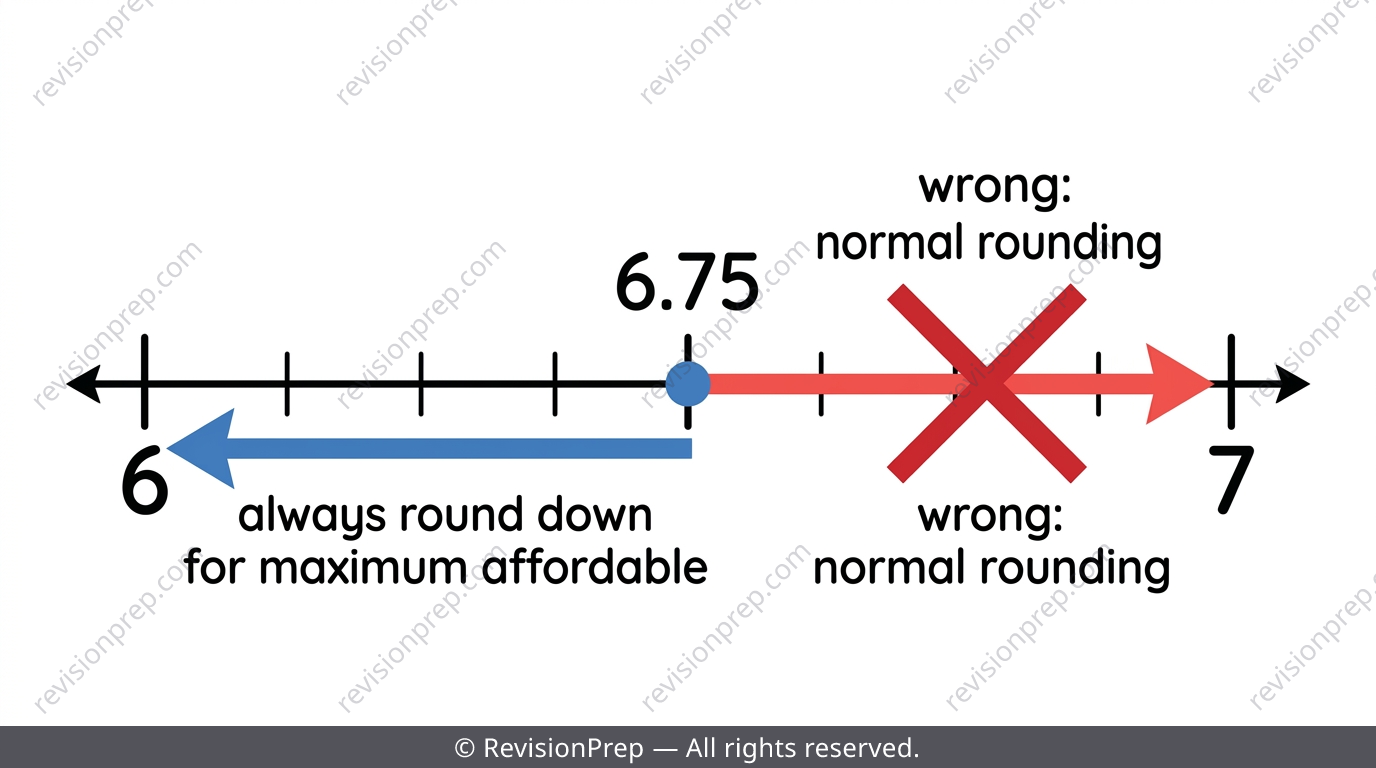
'Maximum you can afford' or 'how many can I buy' problems always round DOWN to the nearest whole unit, no matter how close the decimal is to the next whole number — 7.33 rounds down to 7, and even 6.75 rounds down to 6, not up. This overrides normal rounding rules, because you cannot buy a fraction of an item or spend more than the budget allows.
Exam tip
After rounding down, check the rounded total against the budget before finalising your answer — this double-check is often worth its own mark.
Common mistake
Applying normal rounding (round up when the decimal is ≥ 0.5) to an affordability question instead of always flooring the value.
Mini summary
For affordability questions, floor the decimal every time — never round to the nearest whole number.
Quick formula sheet
Practice questions
- Identify the operation needed for: 'Total spent on 6 identical erasers costing $12 altogether.'
- A shop has sales of $500, refunds of $40, and restocking costs of $30. State the operation needed to find net earnings.
- A right-angled triangle has legs of 6 cm and 8 cm. Which formula would you use to find the hypotenuse?
- Tom earns $22 in week one and $17 in week two. Calculate his total earnings and write the number sentence used.
- A student has $30 to buy 7 identical notebooks sold only at whole-dollar prices. Calculate the maximum price per notebook.
- A shop has sales of $650, refunds of $85, and restocking costs of $60. Calculate net earnings and state whether a $500 target was met.
- A bake sale model predicts 40 cookies at $2 each generate $80 profit, assuming all cookies sell with no costs. Explain two real-world limitations of this model.
- Maya buys 6 identical notebooks for $18 total and 4 pens at $2 each. Analyse whether she spends more overall on notebooks or pens.
- A right-angled triangle has legs of 5 cm and 12 cm. Calculate the hypotenuse, showing the square root step clearly.
Frequently asked questions
What is Number Operations and Applications in MYP maths?+
It's the MYP 3 topic where students apply the four operations, fractions, and rounding to real-life contexts like shopping, budgets, and fundraisers, translating word problems into calculations and back into real-world conclusions.
How do I know which operation to use in a word problem?+
Look for keywords: 'total/altogether' means add, 'net/left over' means subtract, 'each/per' means multiply, and 'cost of one/split among' means divide. Always write the number sentence before calculating.
Why do you always round down in maximum affordable questions?+
Because you can't buy a fraction of an item or exceed your budget — even a decimal like 6.75 rounds down to 6, overriding normal rounding rules that would round it up.
What's the difference between comparing totals and comparing rates?+
You must compare like with like: total spending against total spending, or unit rate against unit rate. Comparing a unit price directly to a grand total gives a misleading conclusion.
How do I explain a limitation of a mathematical model?+
Name a specific real-world factor tied to the model's stated assumption, such as unsold stock, ingredient costs, or whole-dollar pricing constraints. A vague statement without a reason won't score marks.
How is this topic assessed in MYP 3?+
It's assessed continuously through Criterion A (Knowing & Understanding) for accurate calculations and Criterion D (Applying in real-life contexts) for translating and interpreting results, rather than through a single fixed exam percentage.
Master Number Operations and Applications with the Full MYP 3 Revision Notes
Related articles