
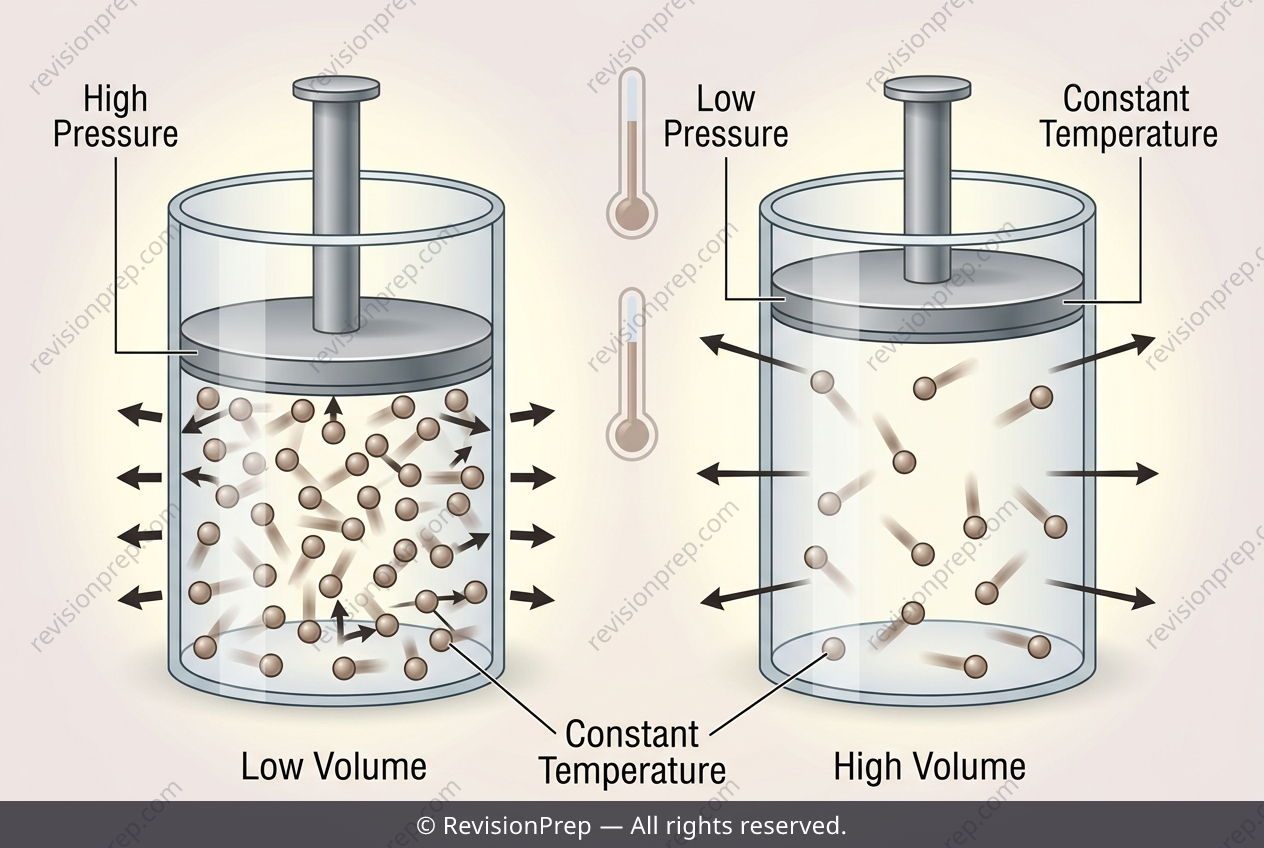
Chemistry: Boyle's Law Through Kinetic Molecular Theory
The kinetic molecular theory explains gas behaviour by treating particles as tiny, fast-moving entities in constant random motion. Collisions with container walls generate pressure, while temperature reflects average kinetic energy. Boyle's Law emerges from this model: for a fixed mass of gas at constant temperature, pressure and volume are inversely related, so P × V stays constant and P is proportional to 1/V. This matters because it links invisible particle behaviour to measurable quantities. Halving the volume compresses the same particles into less space, so wall collisions occur more frequently per unit area and pressure doubles — exactly the inverse pattern predicted. The ideal gas equation, PV = nRT, captures this relationship, assuming negligible particle volume and no intermolecular forces. Deviations from a constant P × V reveal where those assumptions break down.
Start practising IB questions today
150,000+ IB-styled questions, criteria-mapped and instantly accessible.