
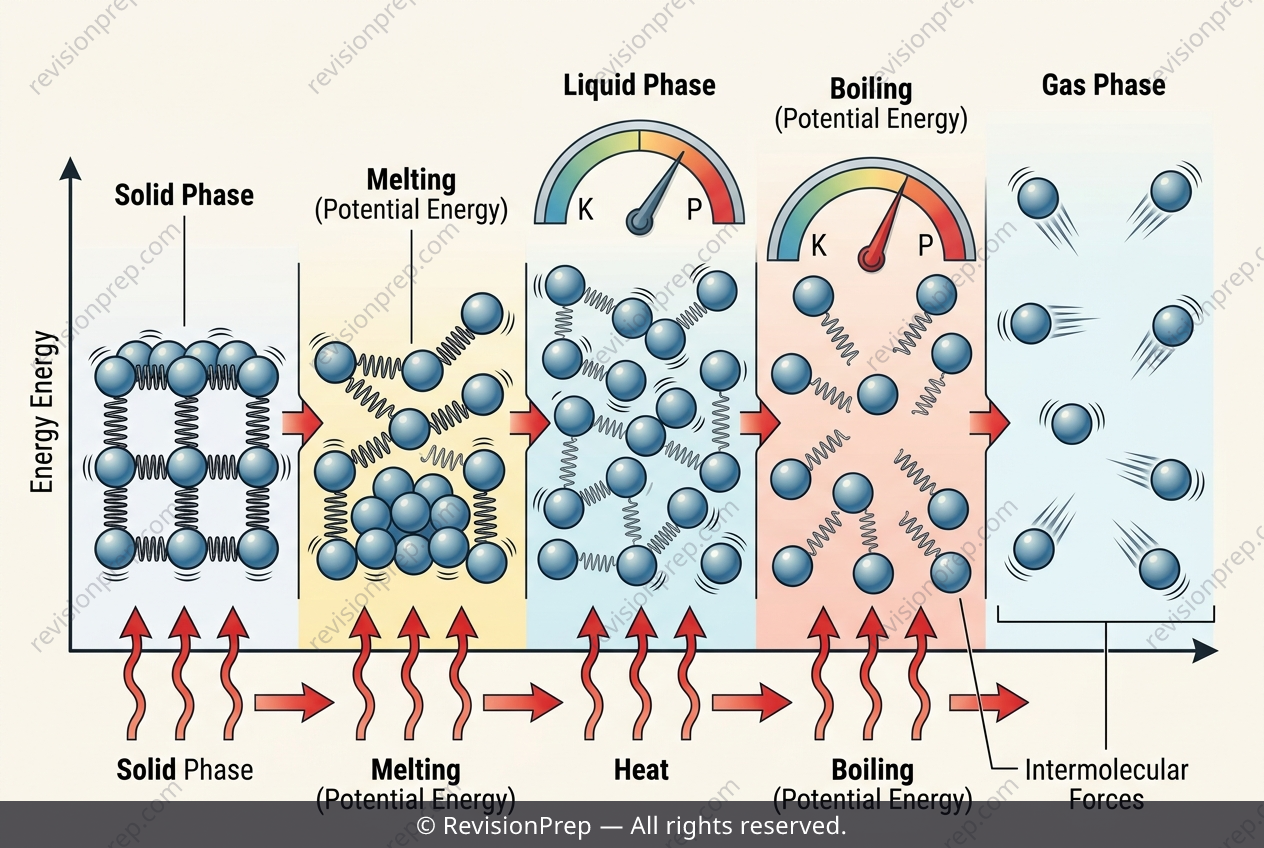
Chemistry: Energy Changes During Phase Transitions
When a pure substance is heated at a constant rate, its temperature does not rise smoothly from solid to gas. Instead, the temperature–time graph shows flat plateaus at the melting and boiling points, where energy input produces no temperature change. This is the heart of energy partitioning during phase transitions: supplied heat is converted into potential energy rather than kinetic energy. Temperature measures the average kinetic energy of particles, so during a phase change that average stays constant even as heating continues. The energy instead goes into overcoming intermolecular forces and increasing particle spacing. Melting only partially weakens these forces, since particles shift from a fixed lattice to a close, disordered arrangement. Boiling must overcome the remaining forces entirely, separating particles to much greater distances. Because the boiling plateau requires far more energy than the melting plateau, the graph reveals how intermolecular force strength and particle spacing connect to the energy needed for each transition.
Start practising IB questions today
150,000+ IB-styled questions, criteria-mapped and instantly accessible.