
Matter and the Particle Model
Link particle spacing, motion and forces to real data — the skill every MYP 5 Chemistry paper tests
Quick facts
Every IB MYP 5 Chemistry paper leans on the same core idea: all matter is built from particles in constant motion, and solids, liquids and gases differ only in how close those particles are packed and how strongly they attract each other. This unit — the particle model of matter — is foundational because it also sets up IB DP Chemistry's particulate model. Examiners love data-based questions: a table of densities, a syringe compressibility experiment, a temperature-time graph during melting. The skill they're really testing is whether you can connect a measurable, macroscopic number to invisible particle behaviour, not whether you've memorised 'gases are compressible.' This teaser walks through the five ideas that show up again and again — states of matter, compressibility and density, kinetic theory, the Kelvin scale, and changes of state — with the exact traps students fall into and how to avoid them.
What you’ll be able to do
1. States of Matter: Solid, Liquid, Gas
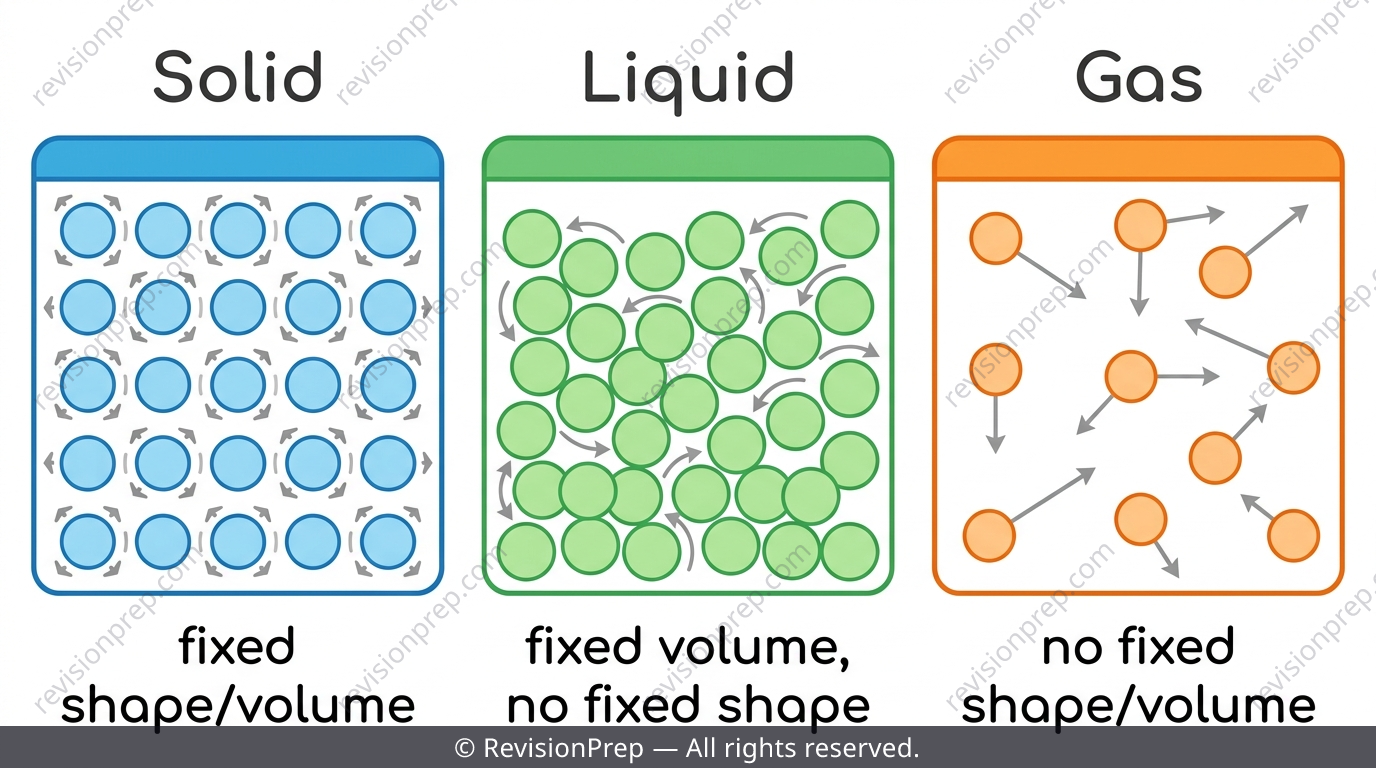
Everything comes down to three factors: particle spacing, the strength of forces between particles, and how much energy they have to move. Solids have particles locked in fixed positions with strong forces, giving fixed shape and volume. Liquids keep particles close but let them slide past each other, so volume stays fixed but shape doesn't. Gases have particles far apart with negligible forces, so they expand to fill any container.
| Property | Solid | Liquid | Gas |
|---|---|---|---|
| Particle spacing | Very close, fixed | Close, disordered | Far apart |
| Forces between particles | Strong | Moderate | Negligible |
| Shape | Fixed | Takes container's base shape | Fills container |
| Volume | Fixed | Fixed | Not fixed |
Exam tip
If a question gives volumes, densities or percentages, treat it as a 'deduce' question and quote at least one number from the table — even if it says 'explain'.
Common mistake
Writing 'gases are compressible because particles move fast' — compressibility is about spacing, not speed.
Mini summary
State is decided by particle spacing and forces, not by which substance it is — H₂O can be solid, liquid or gas.
2. Compressibility and Density as Indirect Evidence
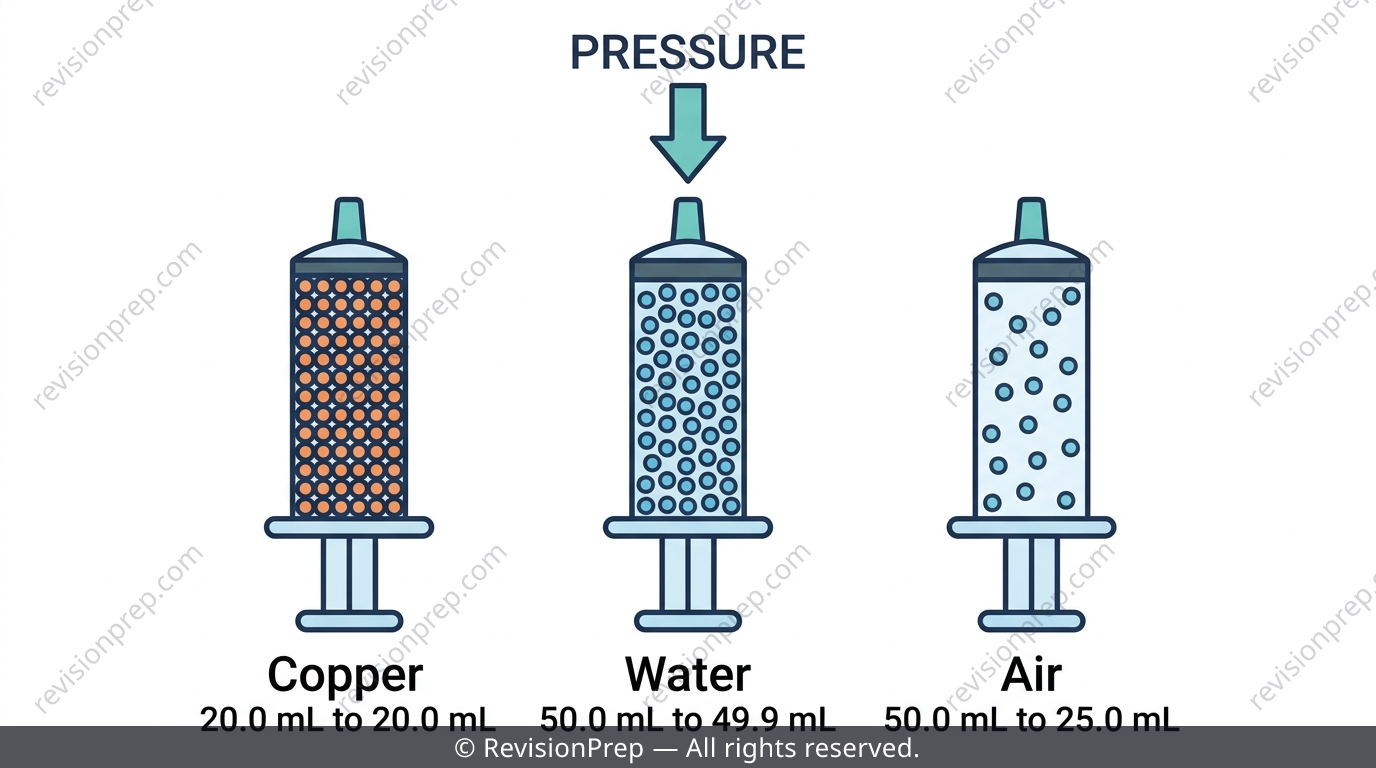
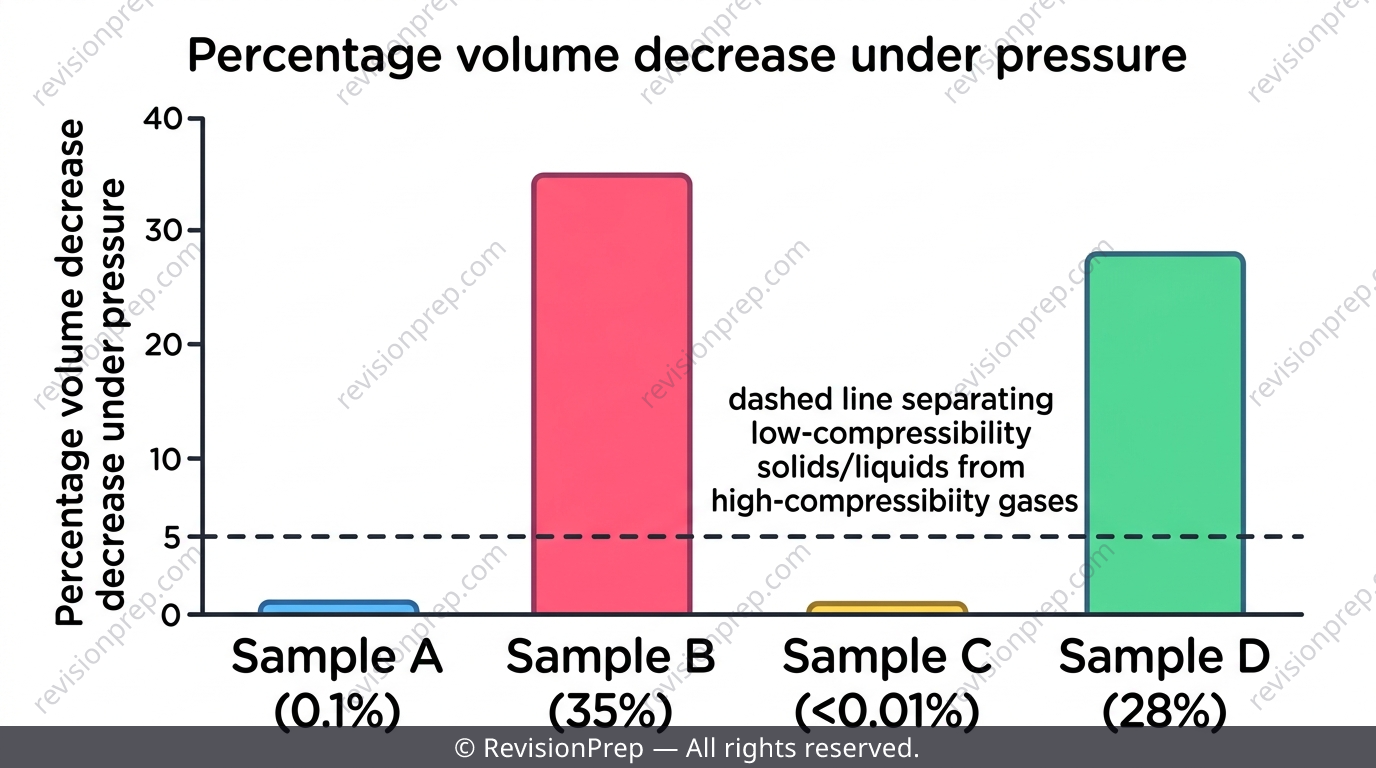
Compressibility measures how much a volume shrinks under pressure, and it depends almost entirely on empty space between particles — gases have plenty, solids and liquids have almost none. Density tells the same story from the opposite angle: mass per unit volume is low when particles are spread out and high when they're packed tightly. Both properties let examiners test particle spacing indirectly, using numbers instead of pictures.
Exam tip
Ask yourself: 'could pressure physically push particles into a gap that already exists?' Yes for gas, no for solid or liquid.
Common mistake
Assuming close percentage values (like 0.1% and less than 0.01%) mean two samples are the exact same substance, rather than just the same broad state category.
Mini summary
Compressibility and density are the two properties examiners use to test particle spacing — learn to read them both ways: data to state, and state to predicted data.
3. Kinetic Theory: The 'Why' Behind Particle Behaviour
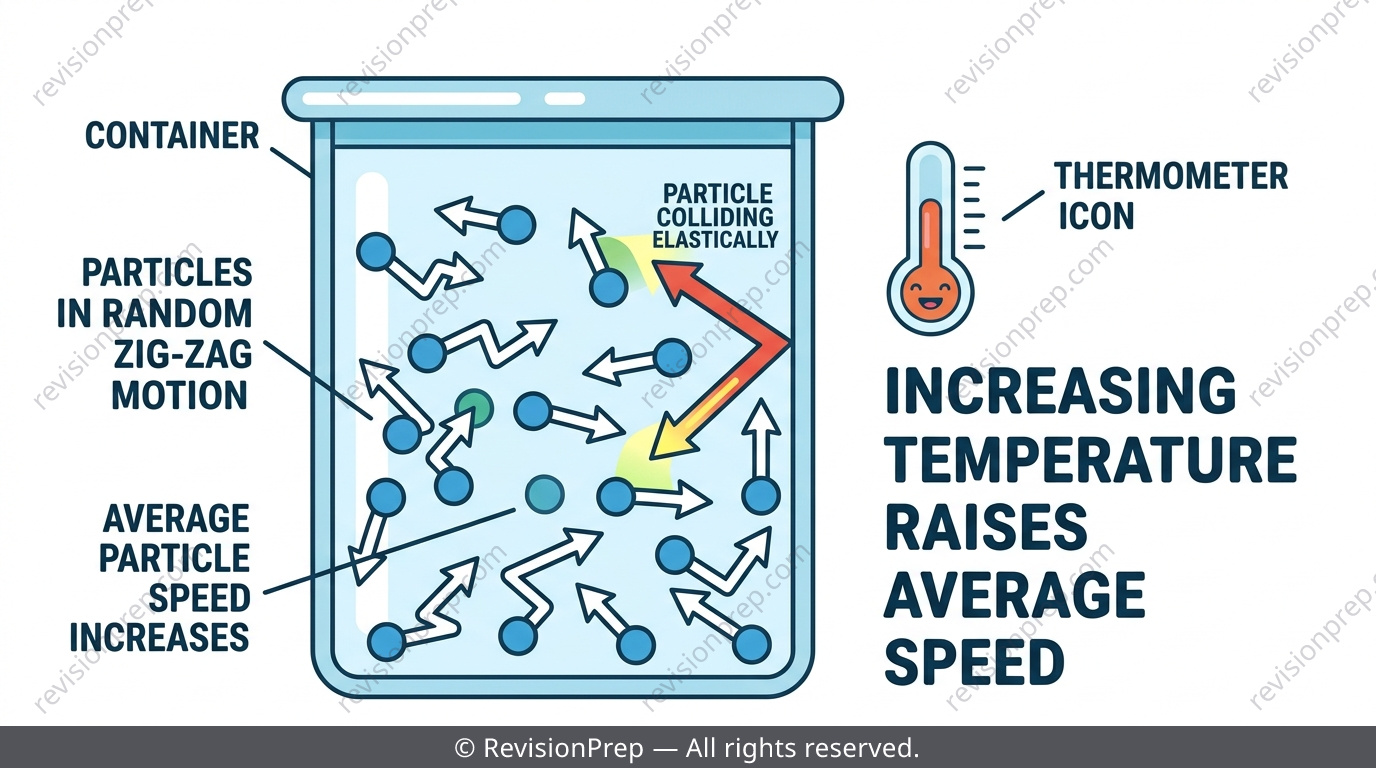
Kinetic theory explains section 1's observations rather than just describing them: particles move constantly and randomly, collisions between them are elastic, and particle volume is negligible compared to the space around them — a strong approximation for gases, weak for solids and liquids. Crucially, average kinetic energy is directly proportional to absolute temperature, so raising temperature raises average particle speed (though not every particle speeds up equally).
Exam tip
'Deduce which samples are gases' from compressibility data is really asking you to spot the order-of-magnitude jump between gas values (tens of %) and solid/liquid values (well under 1%).
Common mistake
Reasoning about kinetic energy using Celsius temperatures instead of Kelvin — the proportional relationship only holds on the absolute scale.
Mini summary
Kinetic theory ties particle spacing, forces and motion together: random motion, elastic collisions, and average speed set by absolute temperature.
4. Temperature, Kelvin and Absolute Zero
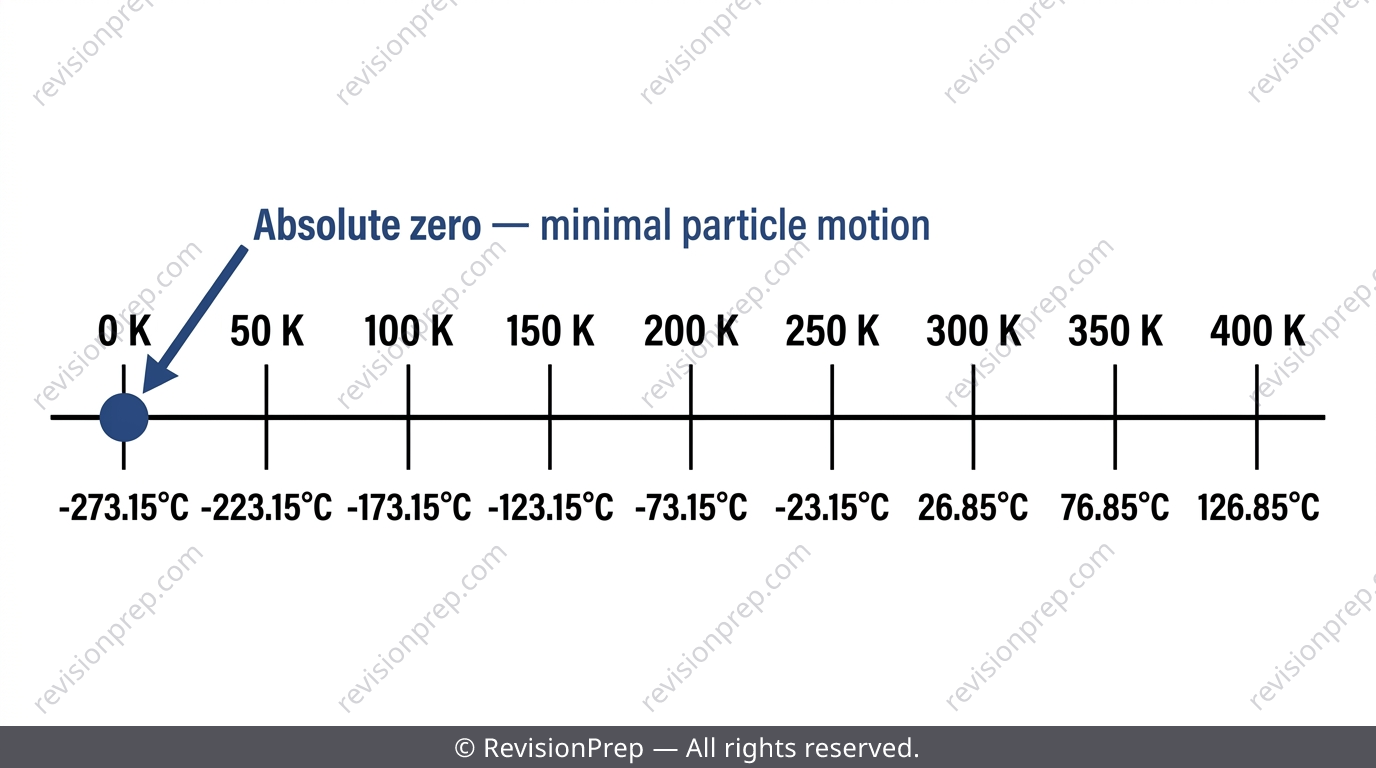
Kinetic theory only works with the Kelvin scale, so temperatures must be converted before reasoning about kinetic energy: 0°C does not mean 'no motion,' but 0 K (absolute zero) theoretically does. Forces between particles — strongest in solids, weakest in gases — combine with temperature to determine compressibility, diffusion rate and how easily a substance changes state.
Exam tip
Always convert Celsius to Kelvin first if a question asks you to compare or reason about kinetic energy — skipping this step is a very common way to lose marks.
Common mistake
Treating 0°C as the point where particles stop moving, instead of recognising absolute zero (0 K = −273°C) as that theoretical minimum.
Mini summary
Kinetic energy is proportional to absolute temperature only — convert to Kelvin before you reason about particle speed.
5. Changes of State and Energy Transfer
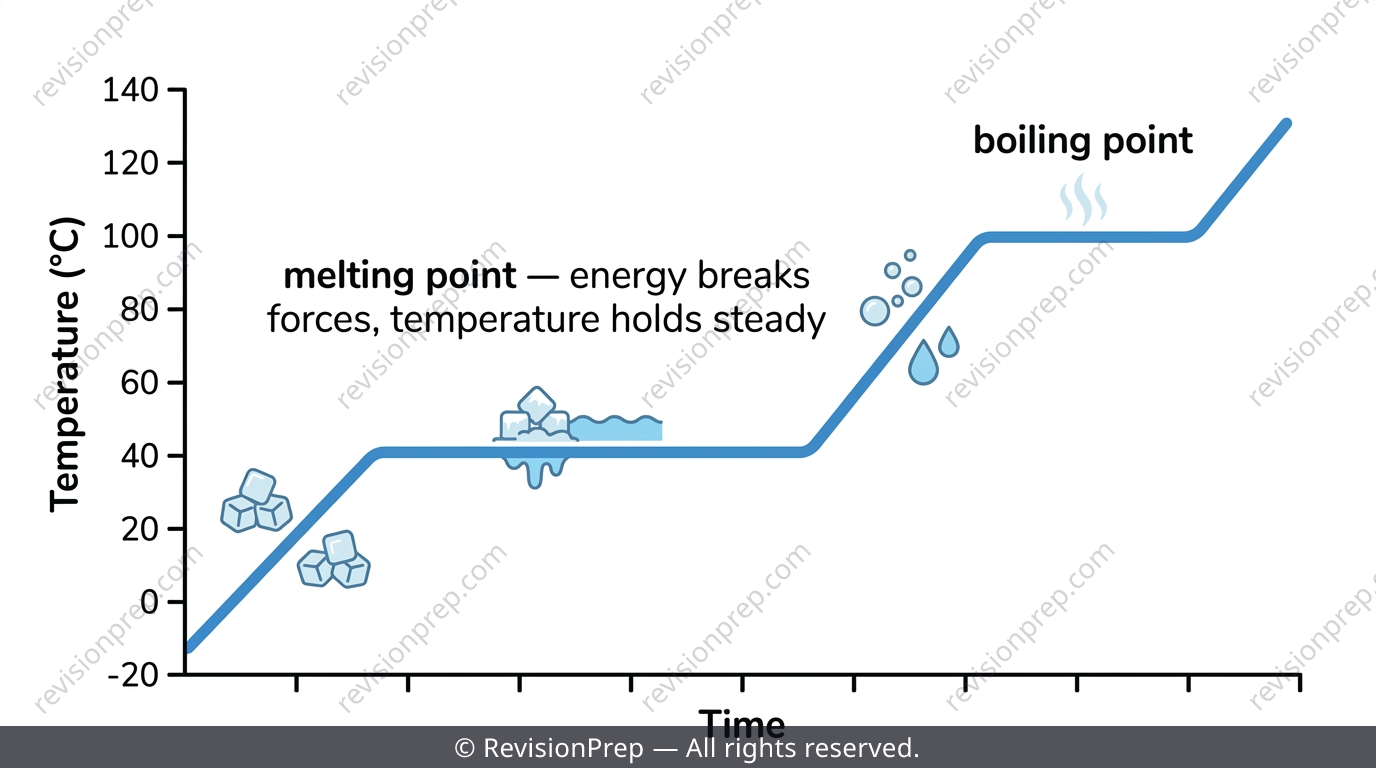
Every change of state is a physical change — particles keep their identity, so melting ice is still H₂O, not a new substance. Melting and freezing happen at the melting point, boiling and condensation happen at the boiling point, while sublimation and deposition skip the liquid state entirely (think dry ice or frost forming). Evaporation is different from boiling: it happens at any temperature, only at the liquid's surface, and only affects the highest-energy particles, whereas boiling happens throughout the liquid at one fixed temperature.
Exam tip
When a temperature-time graph plateaus, explain that energy is still being supplied but is going into weakening or breaking forces between particles rather than increasing their speed — that's why temperature doesn't rise.
Common mistake
Assuming a flat section of a heating graph means no energy is being transferred, instead of recognising it as energy going into changing state.
Mini summary
Phase changes transfer energy in or out without changing particle identity — the flat 'plateau' on a heating graph is the single most-tested idea here.
Quick formula sheet
Practice questions
- State the key difference in particle spacing between a liquid and a gas.
- Define compressibility in terms of particle arrangement.
- Convert 25°C to Kelvin.
- A gas sample shows a 30% volume decrease under pressure while a liquid sample shows 0.2%. Use this data to justify which is the gas.
- Explain, using kinetic theory, why raising the temperature of a gas increases its average particle speed.
- Explain why evaporation can occur at room temperature while boiling cannot.
- A heating curve for a pure substance shows two plateaus. Explain, using particle theory, why temperature does not rise during either plateau despite continuous heating.
- Two samples show compressibility of 0.05% and 0.008% under identical pressure. Explain why both are consistent with being non-gaseous, without assuming they are the same substance.
- Explain why sublimation and deposition are described as skipping the liquid state, using particle spacing and forces in your answer.
Frequently asked questions
What is the particle model of matter in IB MYP Chemistry?+
It's the idea that all matter is made of particles in constant motion, and that solid, liquid and gas differ only in particle spacing, the strength of forces between particles, and how much energy they have.
Why are gases so much more compressible than liquids or solids?+
Gas particles are far apart with lots of empty space between them, so pressure can push them closer together. Solids and liquids already have particles nearly touching, so there's barely any gap left to compress.
What's the difference between evaporation and boiling?+
Evaporation happens at any temperature, only at the liquid's surface, and only affects the highest-energy particles. Boiling happens throughout the whole liquid, but only at one fixed temperature (the boiling point).
Why doesn't temperature rise during a change of state?+
Energy supplied during melting or boiling goes into weakening or breaking the forces holding particles together, not into speeding particles up, so temperature holds steady until the change is complete.
Do I need to convert to Kelvin for kinetic theory questions?+
Yes — average kinetic energy is only directly proportional to absolute temperature (Kelvin). Celsius doesn't have that same proportional relationship, and 0°C does not mean particles stop moving.
How do examiners test particle spacing without asking about it directly?+
They give you compressibility, density or volume-change data and ask you to deduce the state of matter — you must quote numbers from the data, not just state a memorised rule.