
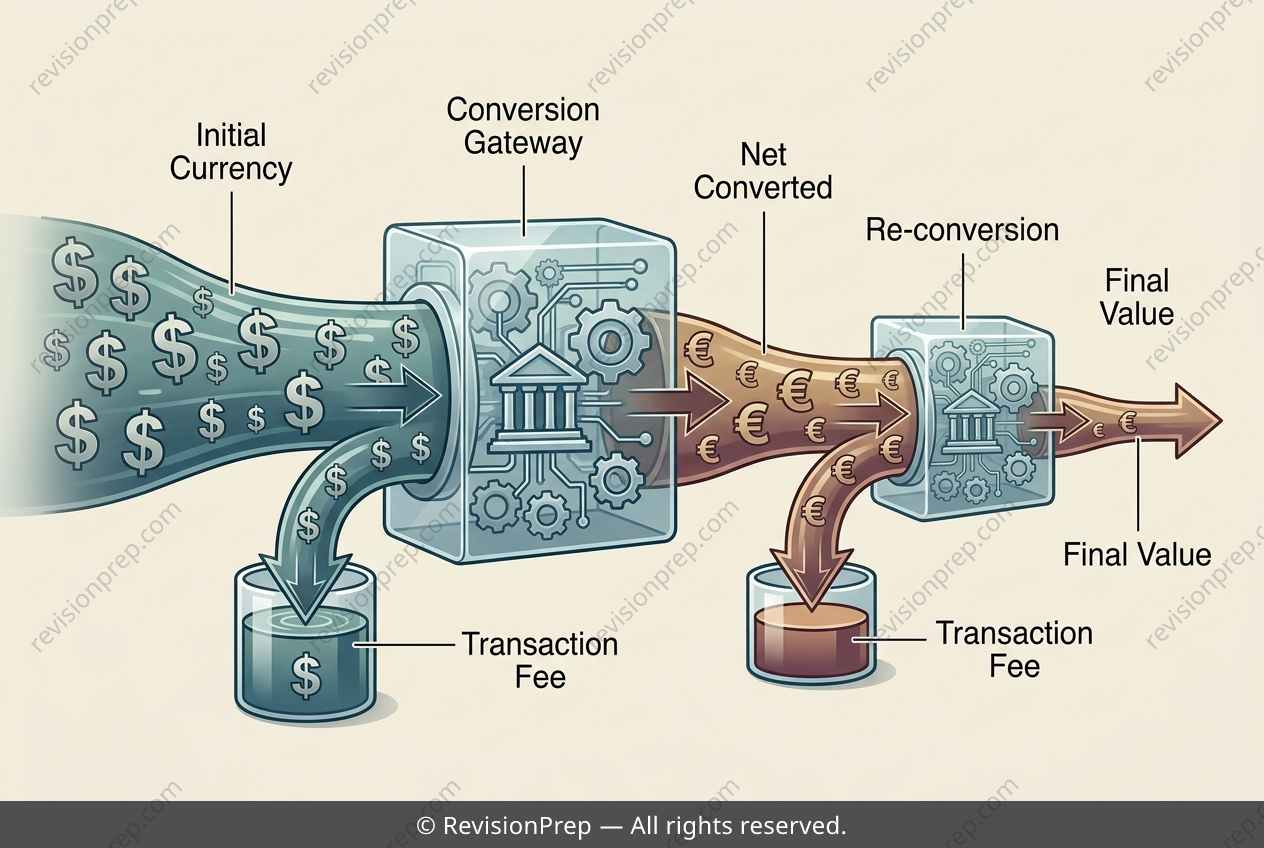
Maths: How Fees and Rates Compound on a Round Trip
Cross-currency transactions sit at the heart of financial mathematics, where exchange rates and conversion fees combine to determine what actually arrives or returns. When a company pays abroad, the amount sent is rarely the amount received: fees are deducted first, then the exchange rate is applied, so each step shrinks the value passing through. Understanding this matters because businesses plan cash flow around expected inflows and outflows, and small percentage fees can quietly erode returns. The key relationship is sequential: if x is the amount sent, the fee leaves 0.98x for conversion, and multiplying by the rate gives the final sum, as in 0.98x × 0.90 = 15 000. Reversing the direction compounds the effect, since a second fee and a different rate apply. Comparing the recovered USD to the original outlay reveals the true round-trip percentage, showing how rate spreads and fees together shape net value.
Start practising IB questions today
150,000+ IB-styled questions, criteria-mapped and instantly accessible.