
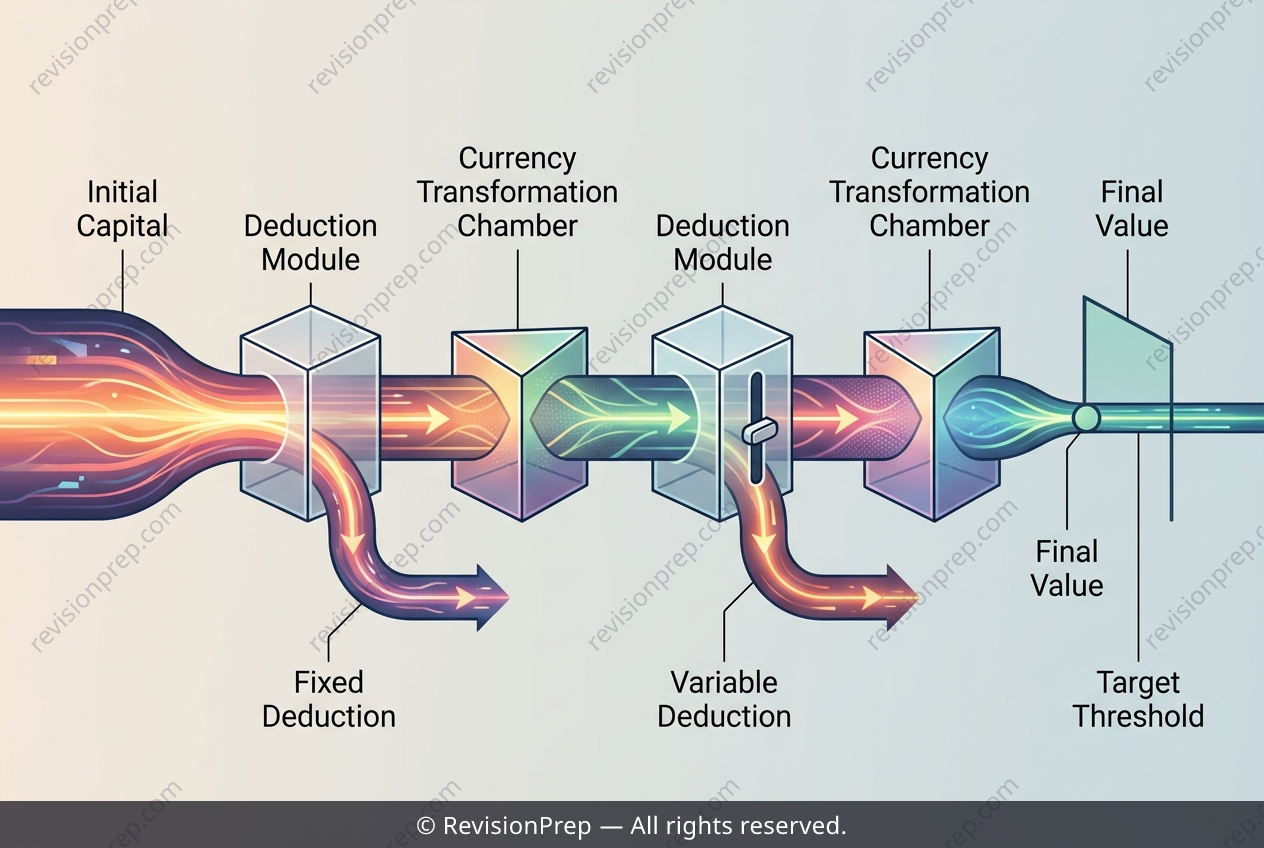
Maths: How Fees Compound Across a Currency Chain
Sequential currency conversions rarely behave like a single, simple multiplication. Each stage of a financial chain introduces its own exchange rate and its own fee, and because fees are deducted before conversion, every deduction shrinks the base that the next rate is applied to. This compounding effect is the heart of cumulative financial operations: the order of steps and the timing of each deduction both matter. Working through a chain means treating each conversion as its own calculation. First subtract the fee in the starting currency, then multiply by the exchange rate to find the amount received. That output becomes the input for the next stage, where the process repeats: subtract the new fee, then apply the new rate. The relationship can be written as amount = (previous amount − fee) × rate, applied once per conversion. Understanding this structure reveals why a small fee early in the chain can quietly reduce every subsequent result, and why comparing a target amount against the final output lets you work backwards to find the largest fee the chain can absorb.
Start practising IB questions today
150,000+ IB-styled questions, criteria-mapped and instantly accessible.