
Atomic Physics: Structure, Isotopes & Radioactive Decay
From plum pudding to the nuclear atom — everything MYP 5 Physics expects you to know
Quick facts
Atomic physics in IB MYP 5 tells one connected story: what atoms are made of, why some nuclei are stable and others aren't, and what happens when unstable nuclei decay. Rutherford's gold foil experiment overturned Thomson's plum pudding model and revealed the nucleus. From there, atomic number and mass number define every nuclide, isotope and ion you'll be asked to identify. Nuclear stability depends on the neutron-to-proton ratio, and when that ratio is wrong, the nucleus sheds alpha, beta or gamma radiation to become more stable. Exam questions in this unit love scattering-angle tables, isotope charge tables, and decay identification — nearly every mark comes from linking a specific number to a specific structural conclusion. This teaser covers the five ideas that show up most often, with the common mistakes examiners flag every year. The full revision notes go deeper into half-life calculations and safety applications.
What you’ll be able to do
Atomic Structure & the Gold Foil Experiment
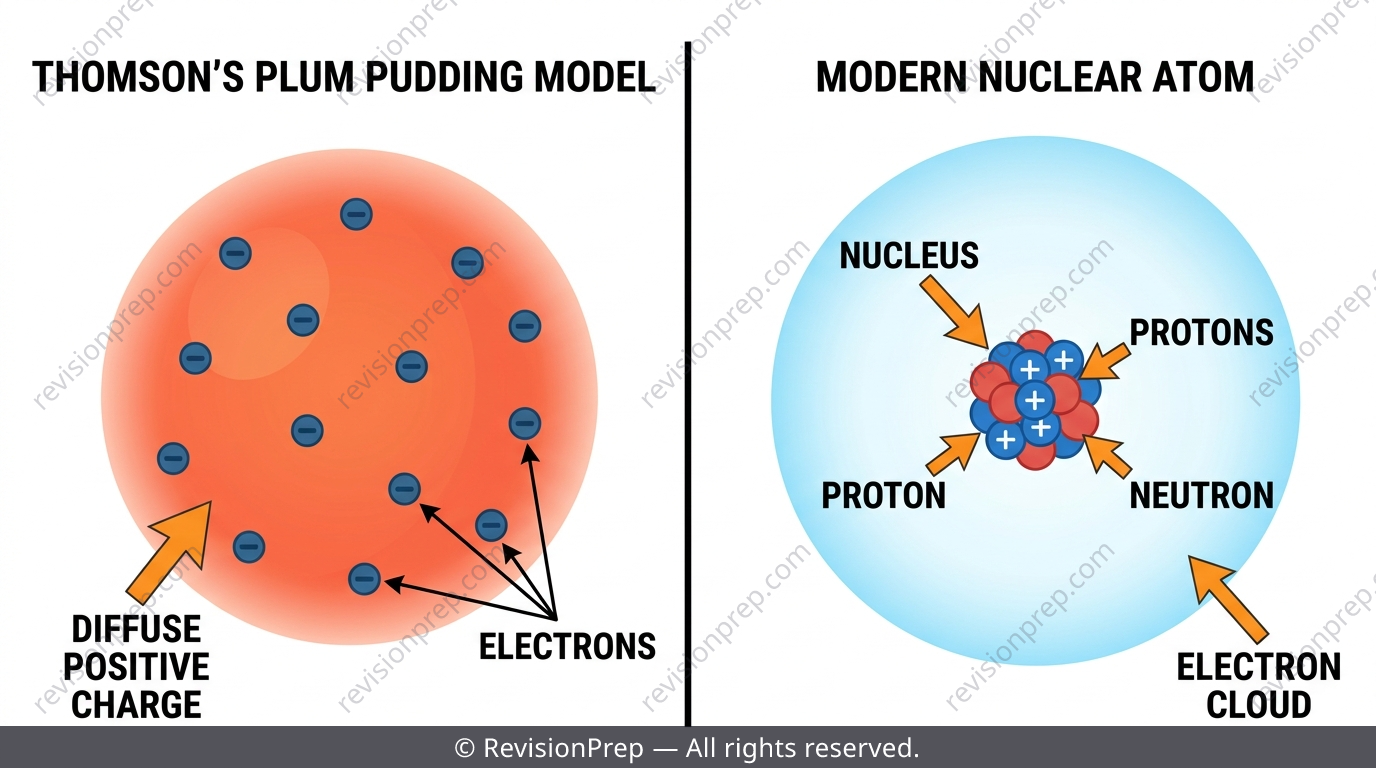
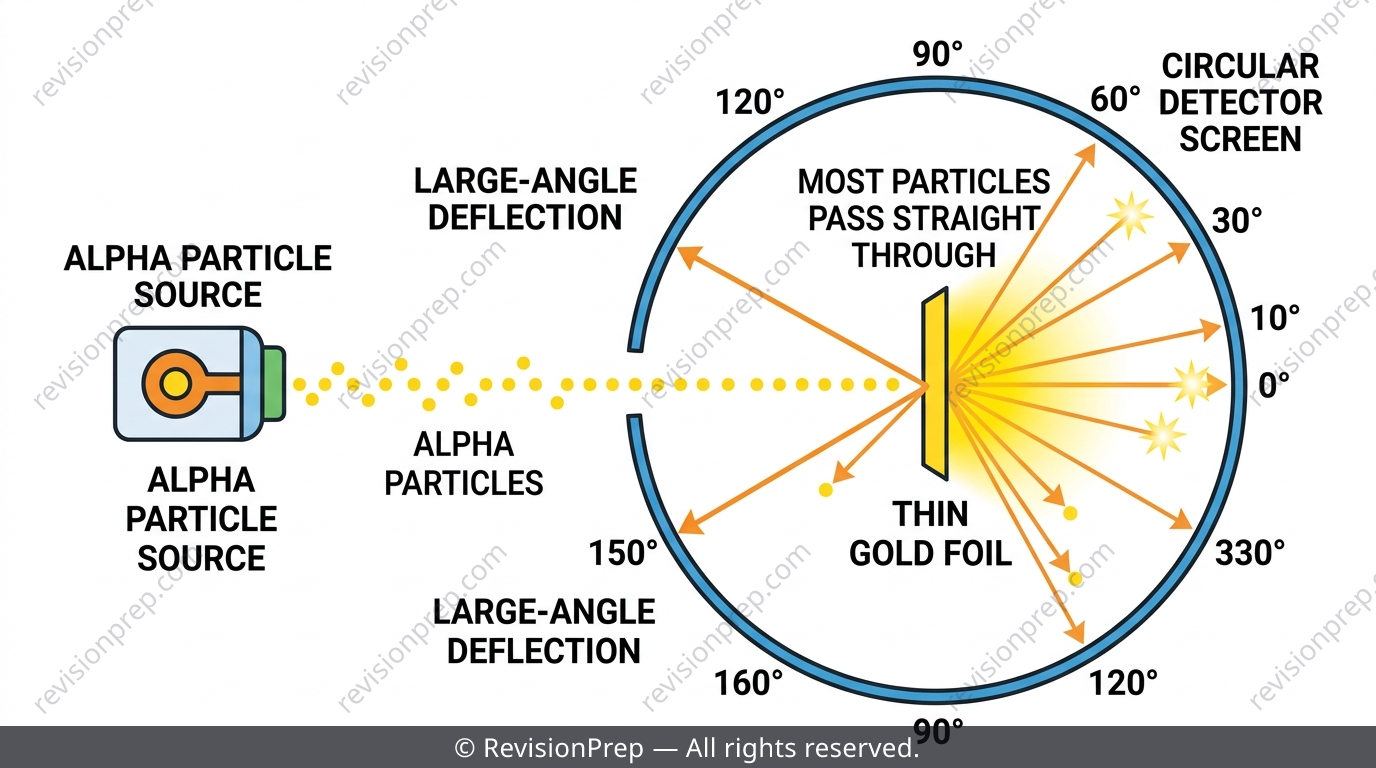
Thomson's plum pudding model pictured positive charge spread evenly through the atom with electrons studded inside it. Rutherford, Geiger and Marsden fired alpha particles at thin gold foil expecting only gentle deflections — instead, most particles passed straight through but a rare few bounced back almost the way they came. That result only makes sense if the atom has a tiny, dense, positively charged nucleus surrounded by mostly empty space, which is why Bohr's planetary orbits were later replaced by the modern electron cloud model.
| Particle | Relative charge | Relative mass | Location |
|---|---|---|---|
| Proton | +1 | 1 | Nucleus |
| Neutron | 0 | 1 | Nucleus |
| Electron | -1 | negligible | Electron cloud |
Exam tip
In scattering data questions, keep 'describe' and 'justify' separate: describe the pattern using the actual numbers first, then link it to the nucleus conclusion only in the justify part.
Common mistake
Answering an IV/DV question by flipping angle and particle count — the experimenter sets the angle or foil thickness; the detector counts particles as the outcome.
Mini summary
Rutherford's rare large-angle bounces are the single dataset that proved a dense nucleus exists.
Nuclide Notation, Isotopes & Ions
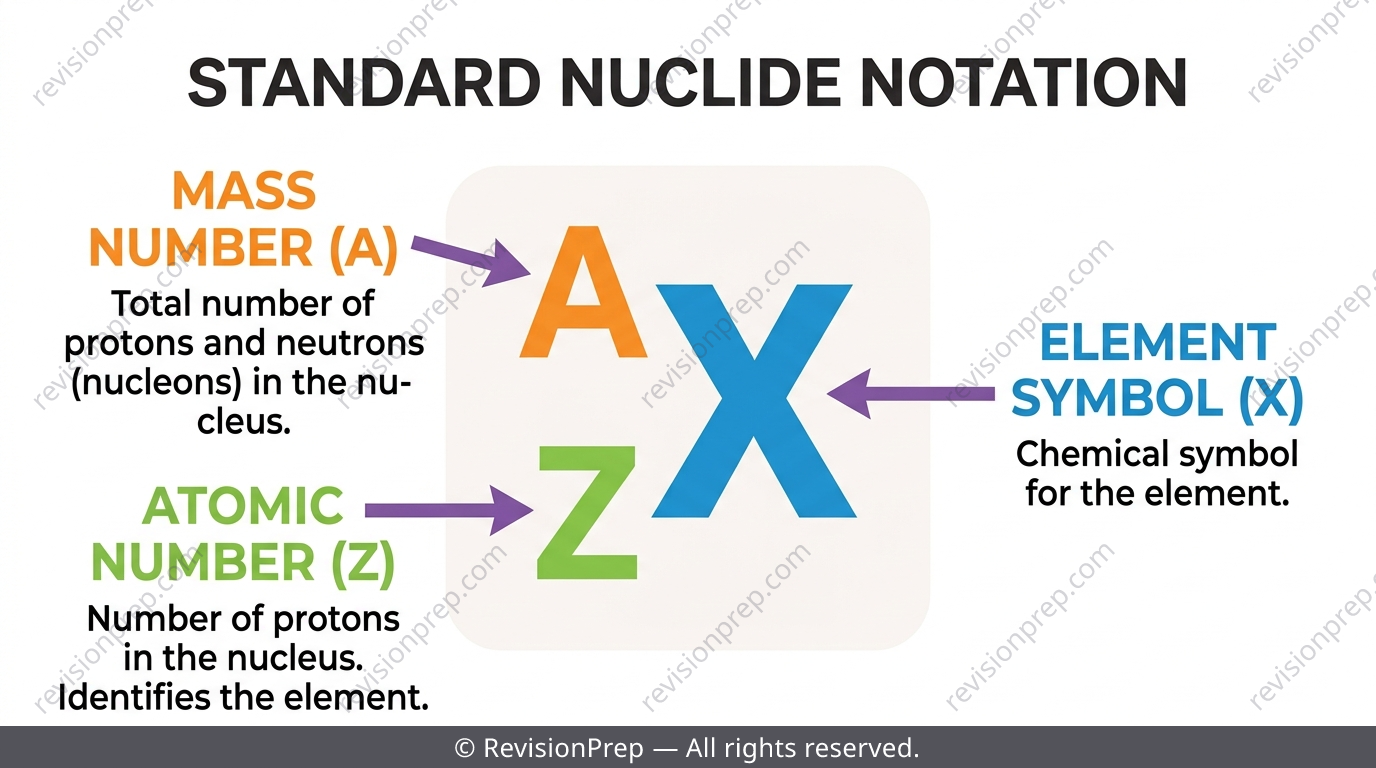
Every nuclide is fixed by two numbers: atomic number Z (protons) and mass number A (protons + neutrons). Isotopes share the same Z but different A, meaning the same element with a different neutron count and mass, like carbon-12 and carbon-14. Ions form when the number of electrons no longer matches the number of protons, giving a net charge you calculate as protons minus electrons.
| Term | Definition |
|---|---|
| Atomic number (Z) | Number of protons |
| Mass number (A) | Protons + neutrons |
| Isotope | Same Z, different A |
| Ion | Unequal protons and electrons |
Exam tip
For 'deduce' questions, show the working chain explicitly: Z gives protons, A−Z gives neutrons, Z−charge gives electrons — a bare final answer can lose method marks.
Common mistake
Assuming a negative net charge means fewer electrons. Negative charge actually means EXTRA electrons, since electrons are negative — always check with charge = protons − electrons.
Mini summary
Two numbers, Z and A, unlock protons, neutrons, electrons and charge every time.
Nuclear Stability & the Neutron:Proton Ratio
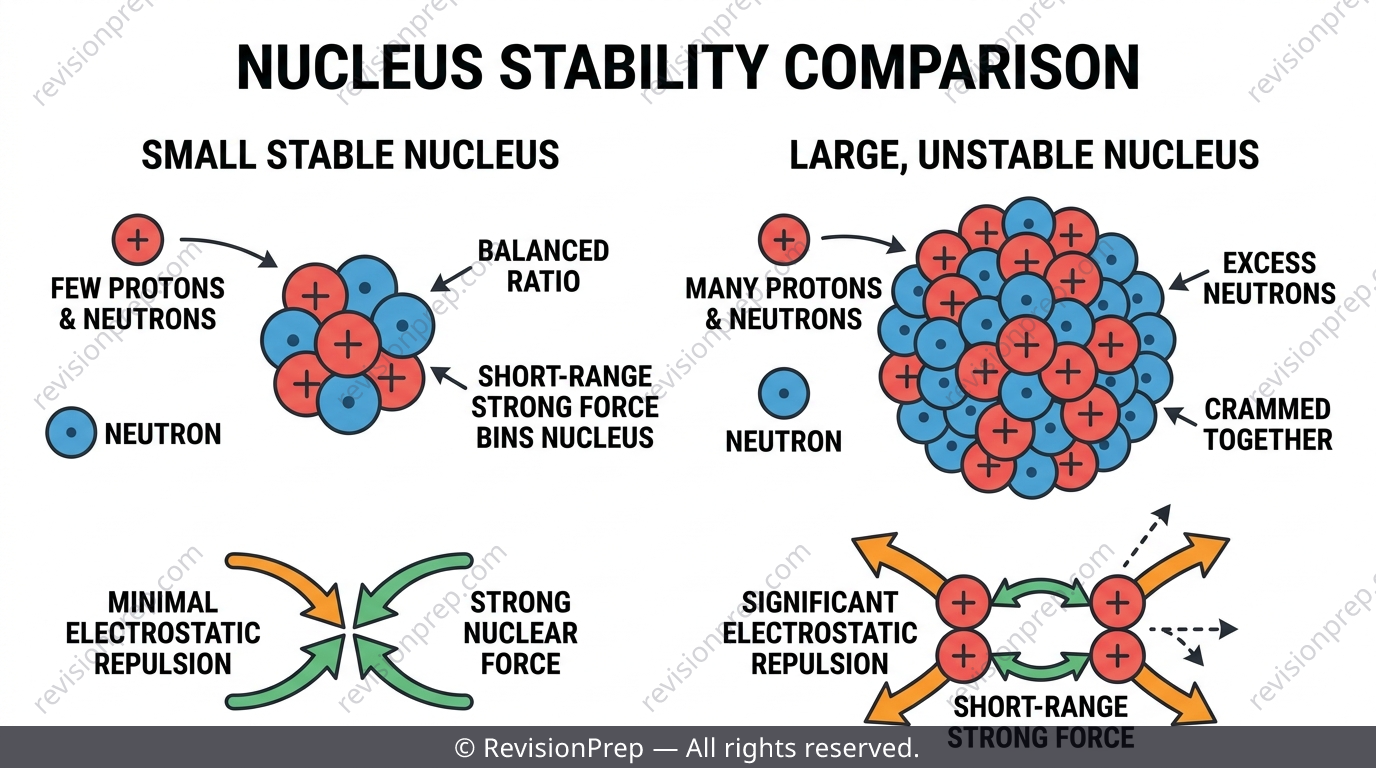
Whether a nucleus is stable depends on its neutron-to-proton ratio — too few or too many neutrons relative to protons leaves it unstable and heading toward decay. Extra neutrons help offset the electrostatic repulsion between crammed-together protons, which is why heavier stable nuclei need proportionally more neutrons than light ones. Beyond a certain size, elements like uranium and plutonium can't find any stable ratio at all, which is exactly why they are naturally radioactive and appear in reactor fuel and waste.
Exam tip
Link every stability question back to the neutron:proton ratio explicitly — naming the ratio earns marks even when you can't calculate an exact value.
Mini summary
No neutron:proton ratio keeps very heavy nuclei stable — that's why uranium and plutonium isotopes are radioactive.
Radioactive Decay: Alpha, Beta & Gamma
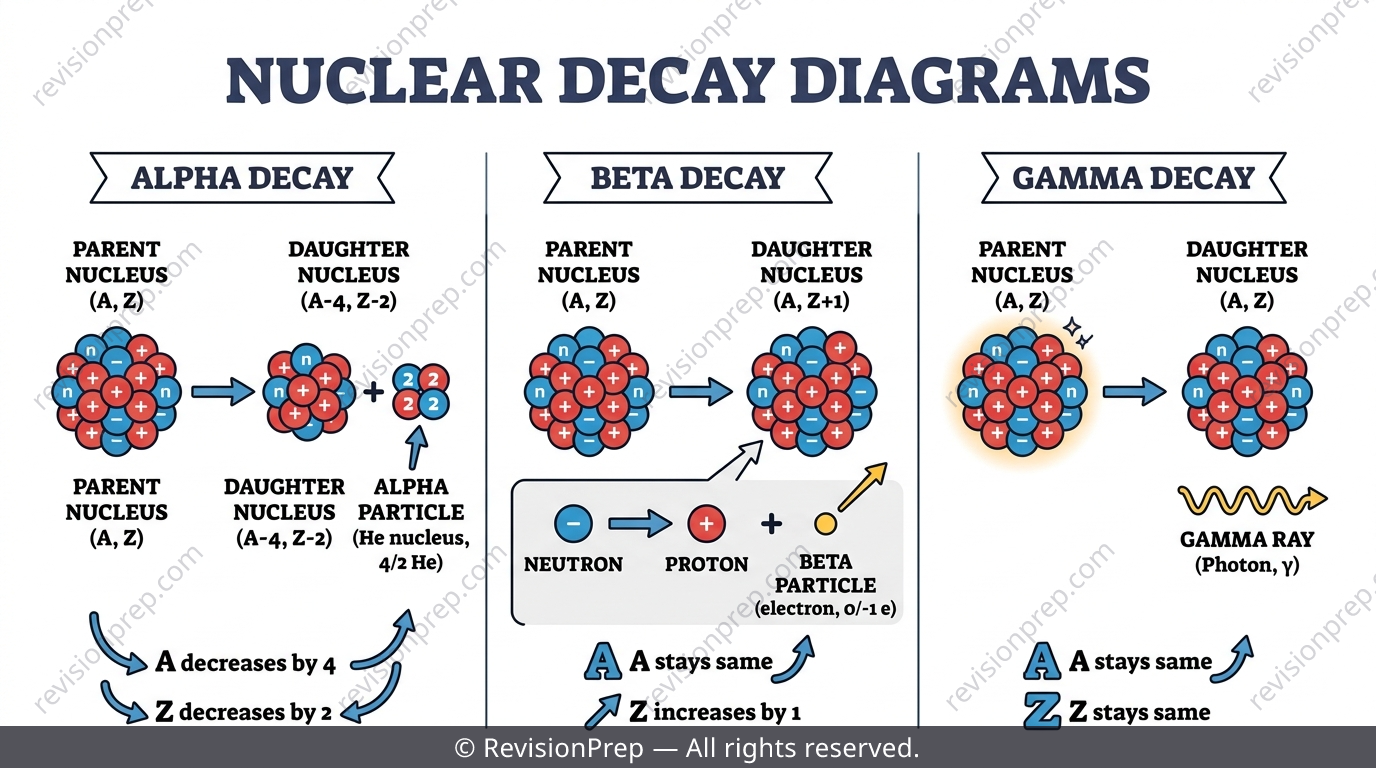
An unstable nucleus sheds particles or energy to move toward stability, and this decay is spontaneous and random for any single nucleus — nothing chemical or physical changes the rate. Alpha decay emits a helium nucleus, dropping A by 4 and Z by 2 to form a new element. Beta decay converts a neutron into a proton plus an emitted electron, keeping A the same but raising Z by 1. Gamma decay emits a high-energy photon with no change to A or Z, often following alpha or beta decay to release leftover energy.
| Decay type | Emission | Change in A | Change in Z |
|---|---|---|---|
| Alpha | Helium nucleus (2p+2n) | −4 | −2 |
| Beta | High-speed electron | 0 | +1 |
| Gamma | High-energy photon | 0 | 0 |
Exam tip
State explicitly that decay rate is a purely nuclear property unaffected by temperature, pressure or chemical bonding — this is a favourite explain/justify point.
Mini summary
Alpha and beta decay always create a new element (transmutation); gamma decay never does.
Randomness of Decay & Half-Life
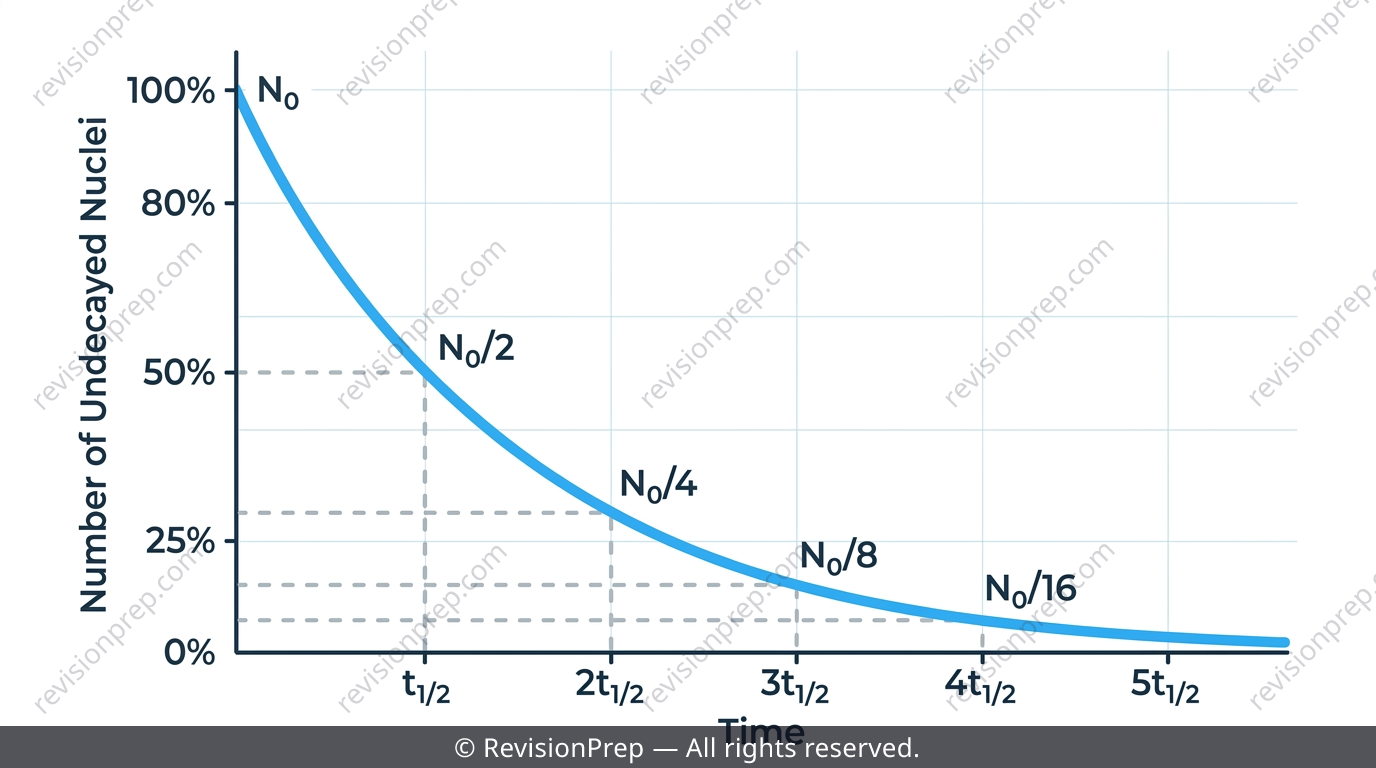
A single unstable nucleus decays completely at random — you can never predict which nucleus decays or exactly when. Scale that up to a huge sample of nuclei, though, and the behaviour becomes statistically reliable, which is exactly what half-life exploits: the time for the number of undecayed nuclei to fall to half its original value. This contradiction between individual unpredictability and group reliability is a favourite conceptual question in this unit.
Exam tip
When asked to explain why decay is 'random but predictable', address both scales explicitly: unpredictable for one nucleus, statistically reliable for a large sample.
Mini summary
Half-life turns the randomness of single nuclei into a reliable, measurable pattern for large samples.
Quick formula sheet
Practice questions
- State the relative charge and relative mass of a proton, neutron and electron.
- Define isotope and give one example pair of isotopes.
- Name the three types of radioactive decay.
- A nuclide has Z = 11 and A = 23. Calculate the number of protons, neutrons and electrons if it is neutral.
- Explain why a small number of alpha particles bounced back almost the way they came in the gold foil experiment.
- Explain why alpha decay always produces a new element.
- A particle has A = 40, Z = 19, and net charge = +1. Deduce the number of protons, neutrons and electrons, showing your working.
- Explain why decay is described as random for a single nucleus but reliable for a large sample, and how half-life connects the two ideas.
- Justify why very heavy elements like uranium cannot achieve a stable neutron:proton ratio at any mass.
Frequently asked questions
What is the difference between atomic number and mass number?+
Atomic number (Z) is the number of protons and defines the element. Mass number (A) is the total number of protons and neutrons combined.
How did the gold foil experiment disprove the plum pudding model?+
The plum pudding model predicted only small deflections everywhere, but a small number of alpha particles bounced back at large angles — only possible if a tiny, dense, positive nucleus existed.
What is the difference between an isotope and an ion?+
Isotopes have the same number of protons but different numbers of neutrons. Ions have an unequal number of protons and electrons, giving them a net charge.
Why are heavy elements like uranium radioactive?+
Beyond a certain size, no neutron:proton ratio can keep the nucleus stable, so very heavy nuclei are naturally unstable and decay.
What is the difference between alpha, beta and gamma decay?+
Alpha decay emits a helium nucleus and reduces A by 4 and Z by 2. Beta decay emits an electron and increases Z by 1 with A unchanged. Gamma decay emits a photon with no change to A or Z.
Why is radioactive decay considered random?+
You can never predict exactly which nucleus will decay or when, since decay is a spontaneous nuclear process unaffected by external conditions — though large samples behave statistically reliably, which is what half-life measures.
Get the Full Atomic Physics Revision Notes
Related articles