
Biology: Adaptation Dynamics: Beaks vs. Migration
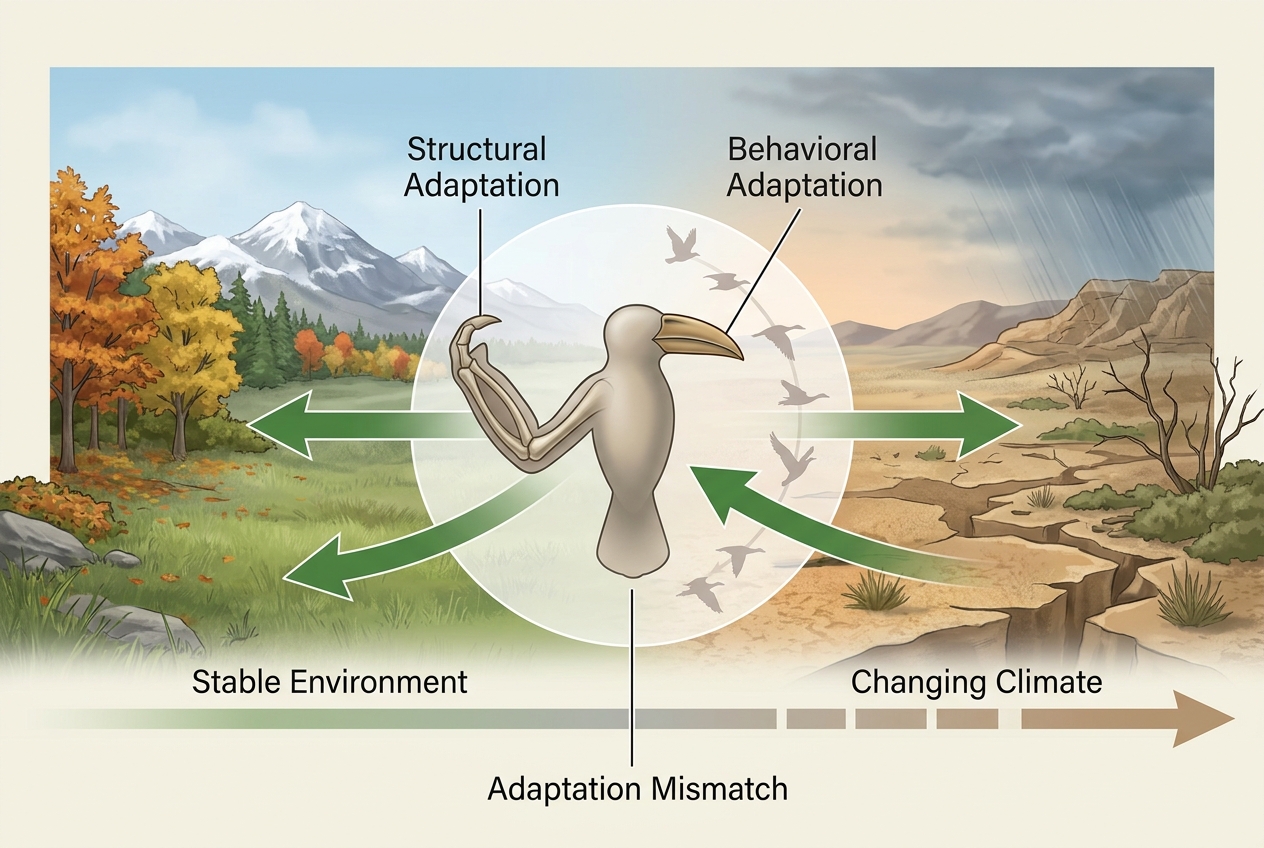
Adaptation dynamics explores how organisms survive by matching their traits to their environment, and—crucially—what happens when that environment shifts. In this case, a bird’s thick, strong beak is a structural adaptation: a fixed physical tool that grants reliable access to hard seeds, offering a competitive edge when softer foods vanish. Its annual southward migration, by contrast, is a behavioral adaptation—a flexible, energy-hungry response triggered by seasonal cues like temperature and day length. Why does this distinction matter? Because rapid climate change does not attack all adaptations equally. The beak’s value persists as long as hard seeds exist; it is stable and cue-independent. Migration, however, depends on external signals that can be disrupted quickly—milder winters may mean food remains at home, yet the bird still expends vast energy flying south, possibly arriving to conditions no better than those it left. The core relationship here is between the speed of environmental change and the flexibility of the adaptive response. Structural traits are slow to become obsolete, while behavioral triggers can misfire within a single generation, making migration the more vulnerable strategy under accelerating climate shifts.
Start practising IB questions today
150,000+ IB-styled questions, criteria-mapped and instantly accessible.