
Organic Chemistry: Tetravalency, Naming & Isomers Explained
The five ideas that unlock every MYP 5 organic chemistry question
Quick facts
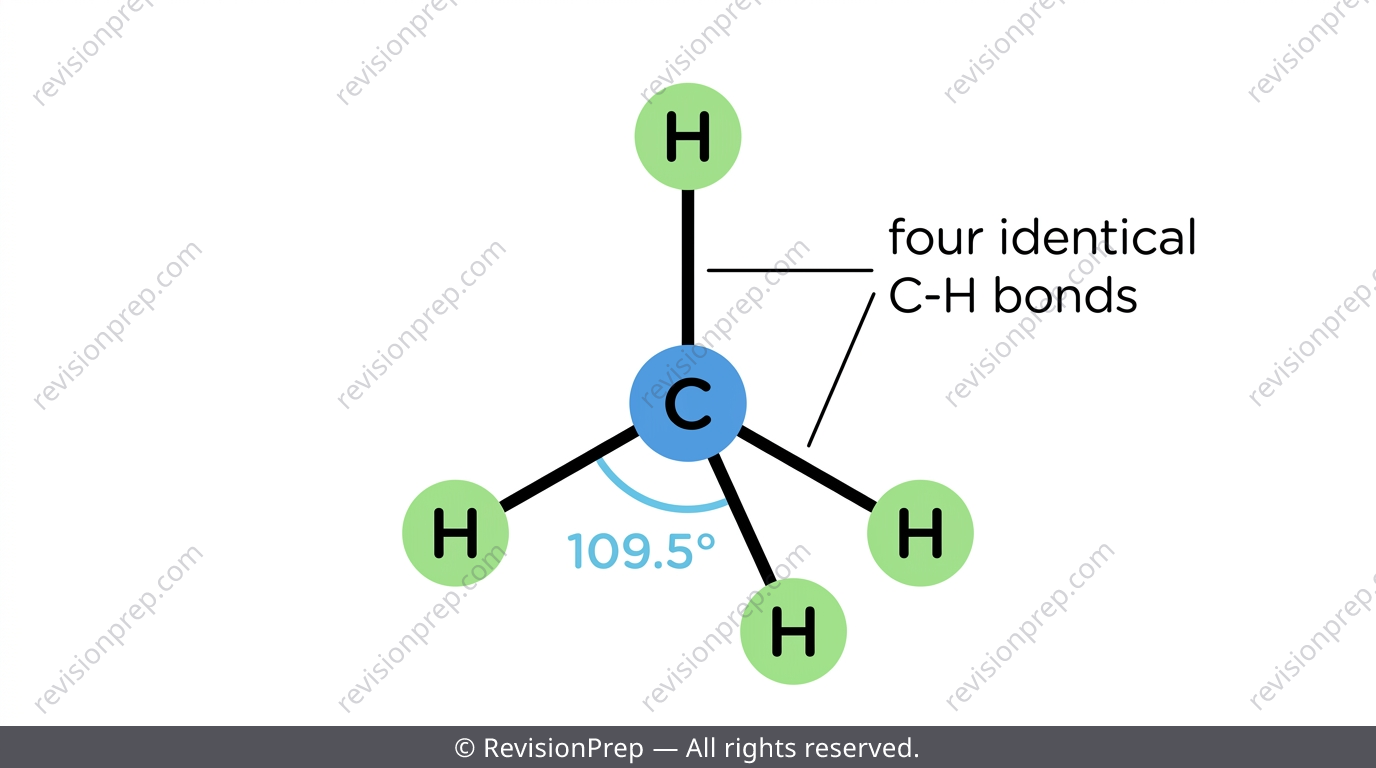
Organic chemistry is the chemistry of carbon — and almost everything you'll be asked to do in MYP 5, from drawing Lewis diagrams to naming branched alkanes, traces back to just two facts about carbon: it always forms four covalent bonds (tetravalency), and it bonds to itself endlessly (catenation). Together these two properties explain why millions of organic compounds exist while most other elements form only a handful. This teaser walks through the five ideas examiners test most: why carbon behaves this way, how IUPAC naming rules turn a structure into a name, the difference between structural and condensed formulas, and why structural isomers with an identical molecular formula can be completely different substances. Master these five, and the rest of the unit — hydrocarbon families, functional groups, polymers — falls into place. The full revision notes on RevisionPrep go deeper with worked examples and diagrams.
What you’ll be able to do
Tetravalency: Why Carbon Always Forms Four Bonds
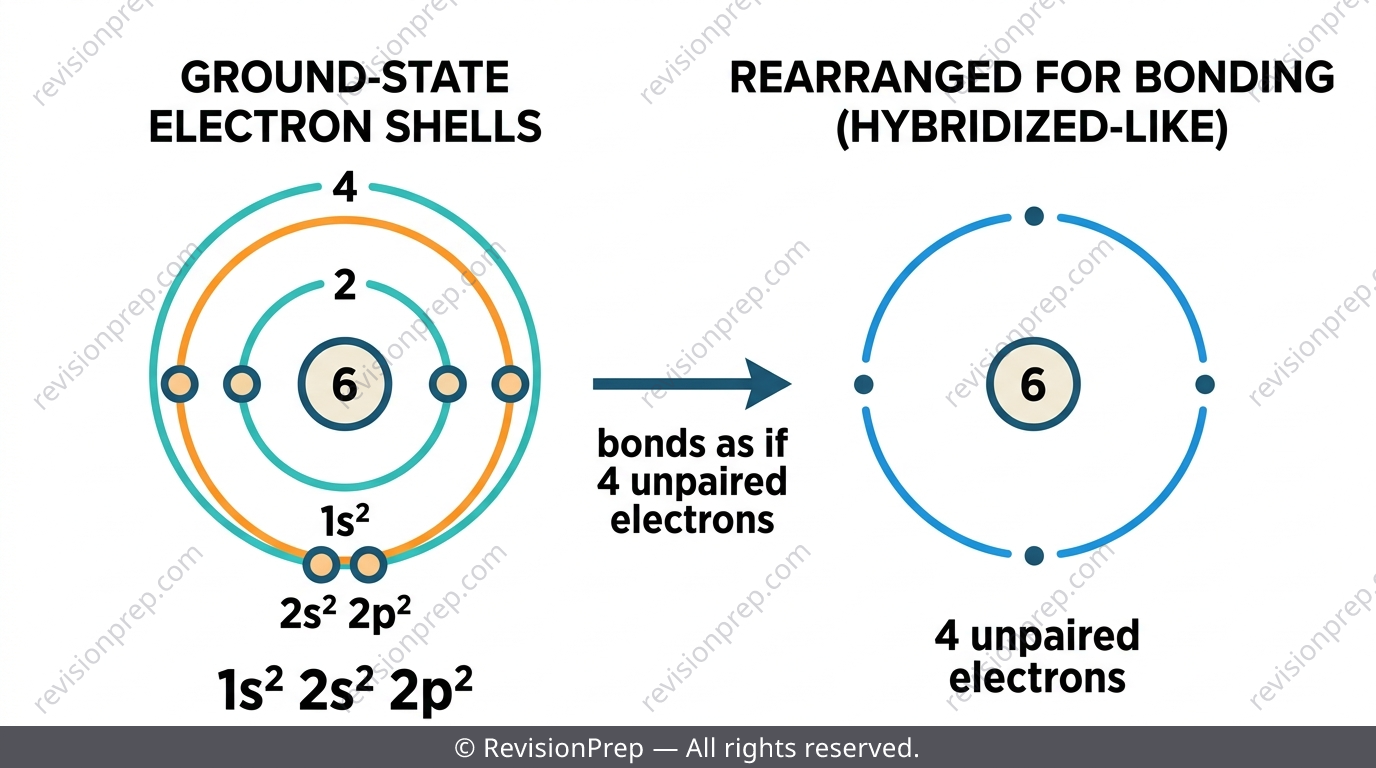
Carbon's electron configuration is 2,4 — two electrons inside, four in the outer shell. To fill that outer shell it shares four electrons, so every stable carbon atom you draw has exactly four covalent bonds, never three, never five. This single rule is why organic chemistry exists as its own branch: one element, endless bonding combinations.
Exam tip
If a question shows carbon's ground-state configuration with only 2 unpaired electrons, don't be fooled — carbon still bonds as if it has 4 unpaired electrons available, so draw 4 bonds every time.
Common mistake
Students see the ground-state configuration (2,4) and draw carbon with only 2 bonds, like oxygen — always start from the tetravalency rule, not the raw configuration.
Mini summary
Carbon's 2,4 configuration means it shares 4 electrons, so it forms exactly 4 covalent bonds in every stable compound.
Catenation: The Reason Millions of Organic Compounds Exist
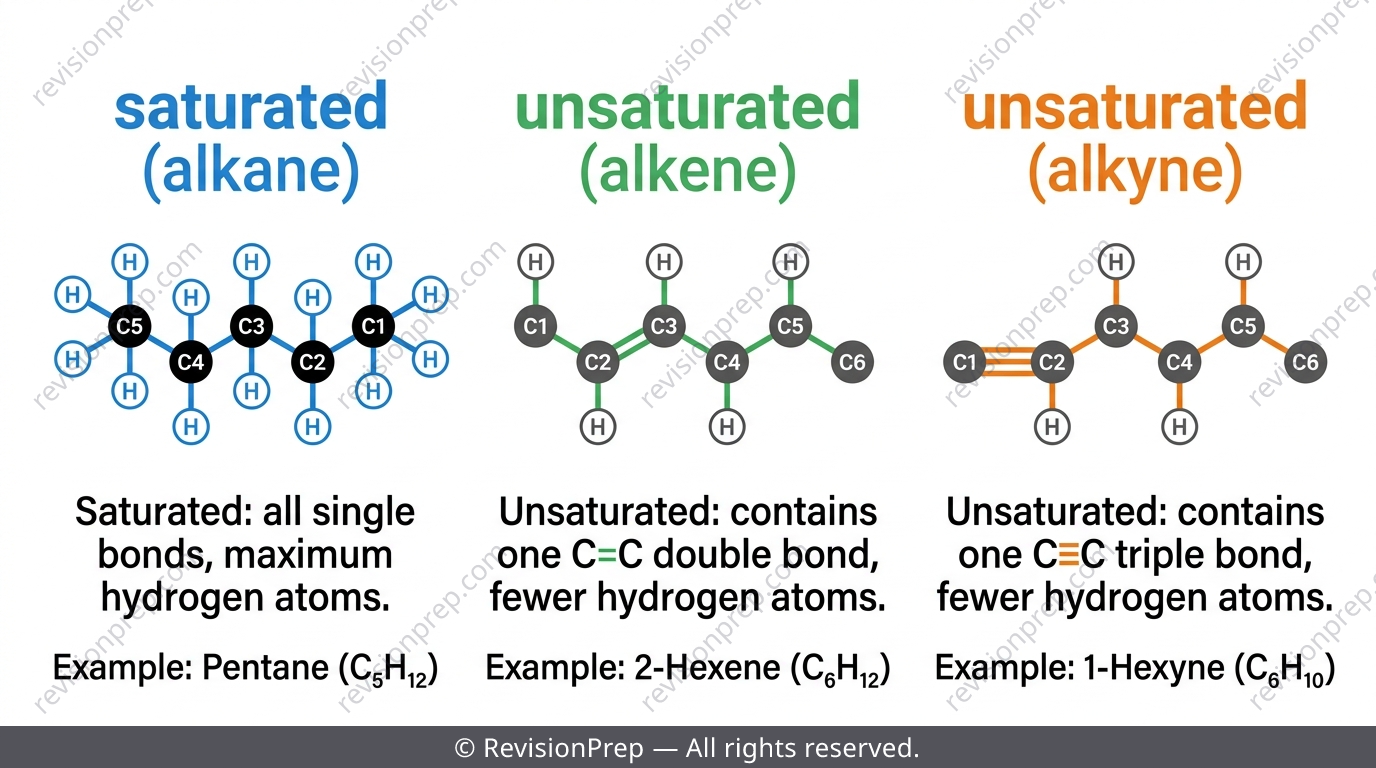
Catenation is carbon's ability to bond repeatedly to itself, building long chains, branches and rings — silicon and germanium can do this too, but far less extensively, which is why almost every Group 14 compound you meet is carbon-based. Carbon's four bonds can be arranged as four single bonds, or as combinations with double and triple bonds. Compounds with only single C-C bonds are saturated; anything with a C=C or C≡C is unsaturated and reacts differently, by addition across the multiple bond.
Exam tip
Group 14 trend questions test bond count, not bond number changing down the group — C, Si and Ge all form 4 bonds because they all have 4 valence electrons; atomic size affects bond strength/length, not bond number.
Mini summary
Catenation lets carbon build chains, branches and rings; how those bonds are arranged (single, double, triple) defines saturated vs unsaturated compounds.
IUPAC Naming: Stem, Suffix and the Lowest-Locant Rule
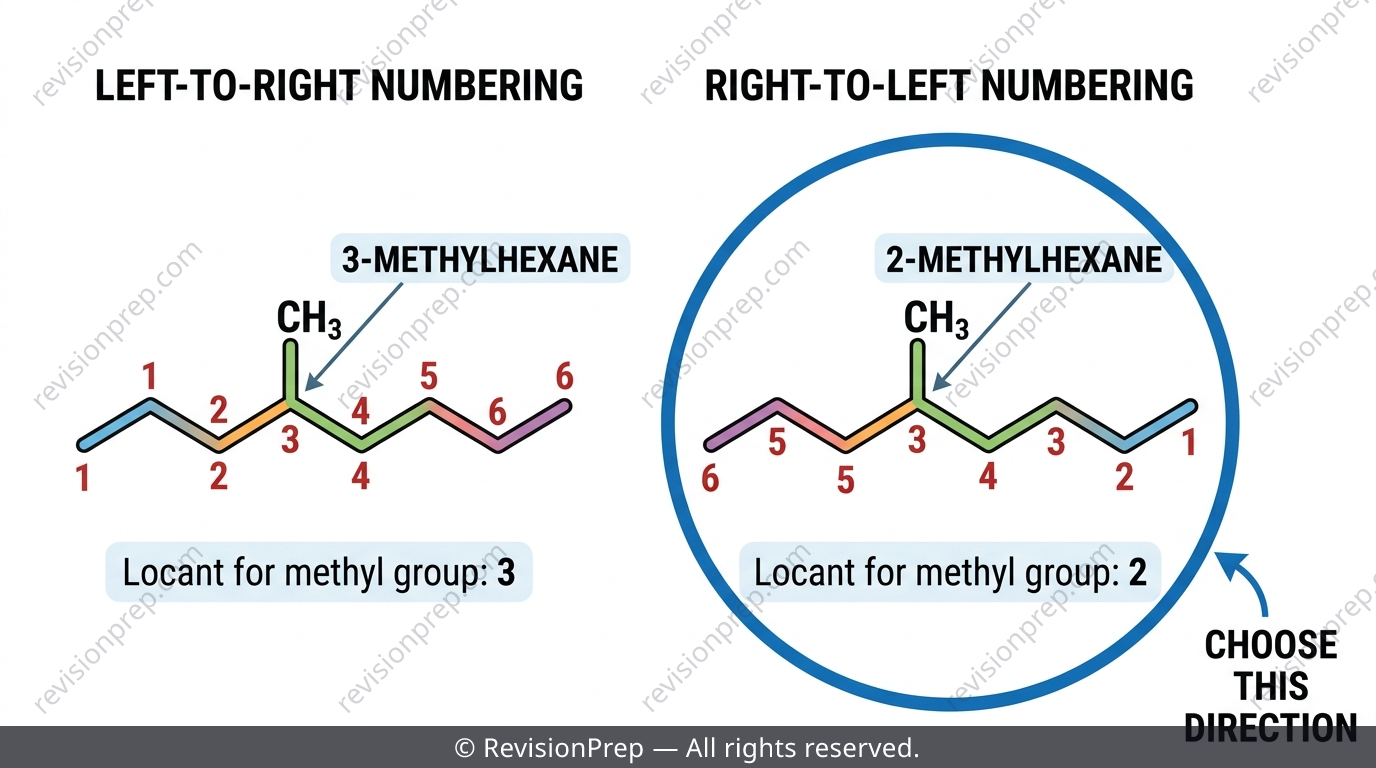
Every IUPAC name follows the same four steps: find the longest continuous chain through the functional group, name it with a carbon-count prefix (meth-, eth-, prop-, but-...), add a suffix that flags the functional group (-ane, -ene, -yne, -ol, -oic acid), then number the chain from whichever end gives the lowest possible locant. Branches get their own locant and prefix, listed alphabetically when there's more than one.
| Carbons | Prefix | Example |
|---|---|---|
| 1 | meth- | methane |
| 2 | eth- | ethane |
| 3 | prop- | propane |
| 4 | but- | butane |
| 5 | pent- | pentane |
Exam tip
Always test both numbering directions mentally before writing the final name — pick whichever direction gives the lowest locant to the substituent or functional group.
Common mistake
Numbering the chain from whichever end you happened to start drawing from, rather than checking both directions for the lowest locant.
Mini summary
Parent chain + prefix + suffix + lowest-locant numbering = a correct IUPAC name.
Structural Formula vs Condensed Structural Formula
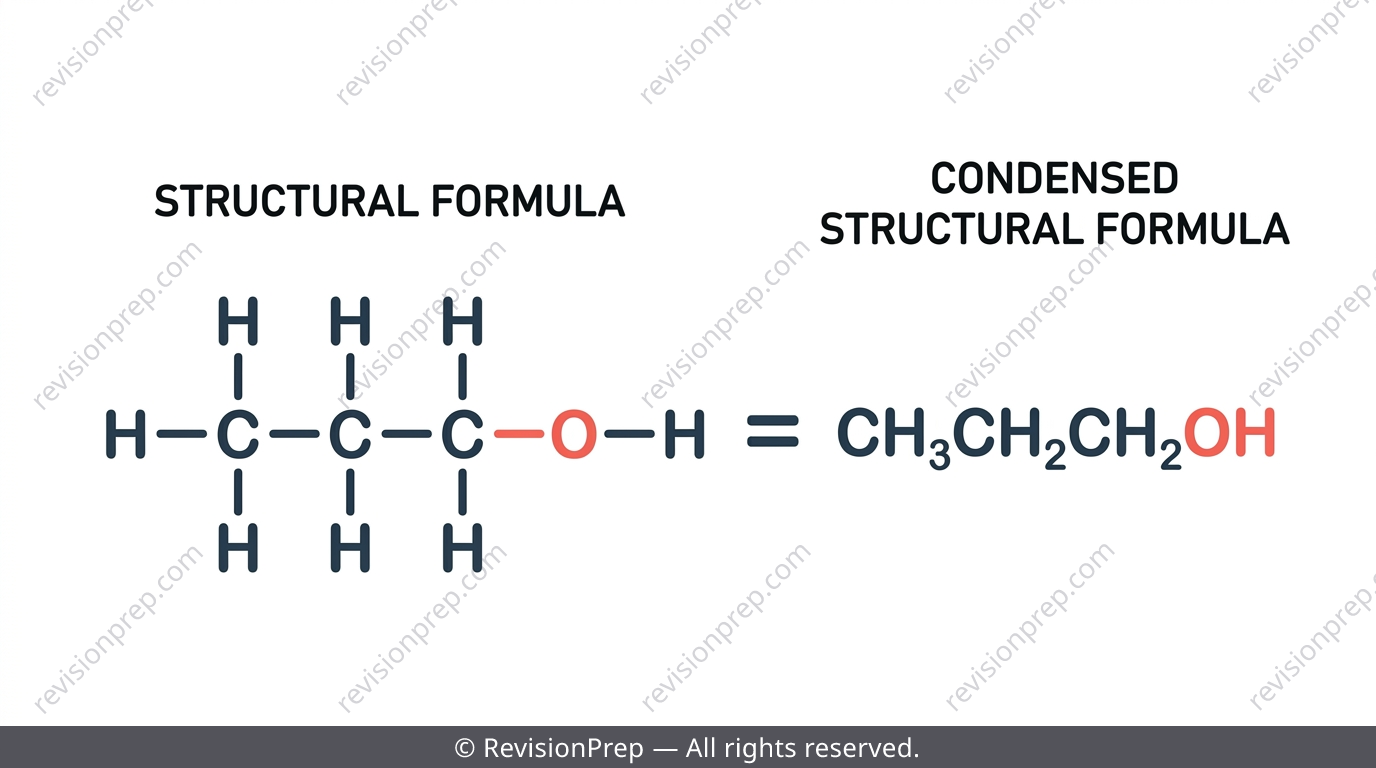
A structural formula shows every atom and every bond explicitly, exactly like a full Lewis diagram. A condensed structural formula groups atoms onto a single line without drawing every bond, such as instead of a fully displayed structure. Both represent the same molecule — which one you produce depends entirely on the command term used in the question.
Exam tip
If a question asks you to 'construct the structural formula' and doesn't say 'condensed' or 'skeletal', draw every bond including every C-H bond explicitly, or you lose the construction mark.
Common mistake
Writing a condensed formula when the question specifically asked for a full structural diagram — read the command term carefully before choosing your format.
Mini summary
Structural formula = every bond drawn; condensed formula = atoms grouped on one line — same molecule, different level of detail.
Structural Isomerism: Same Formula, Different Molecule
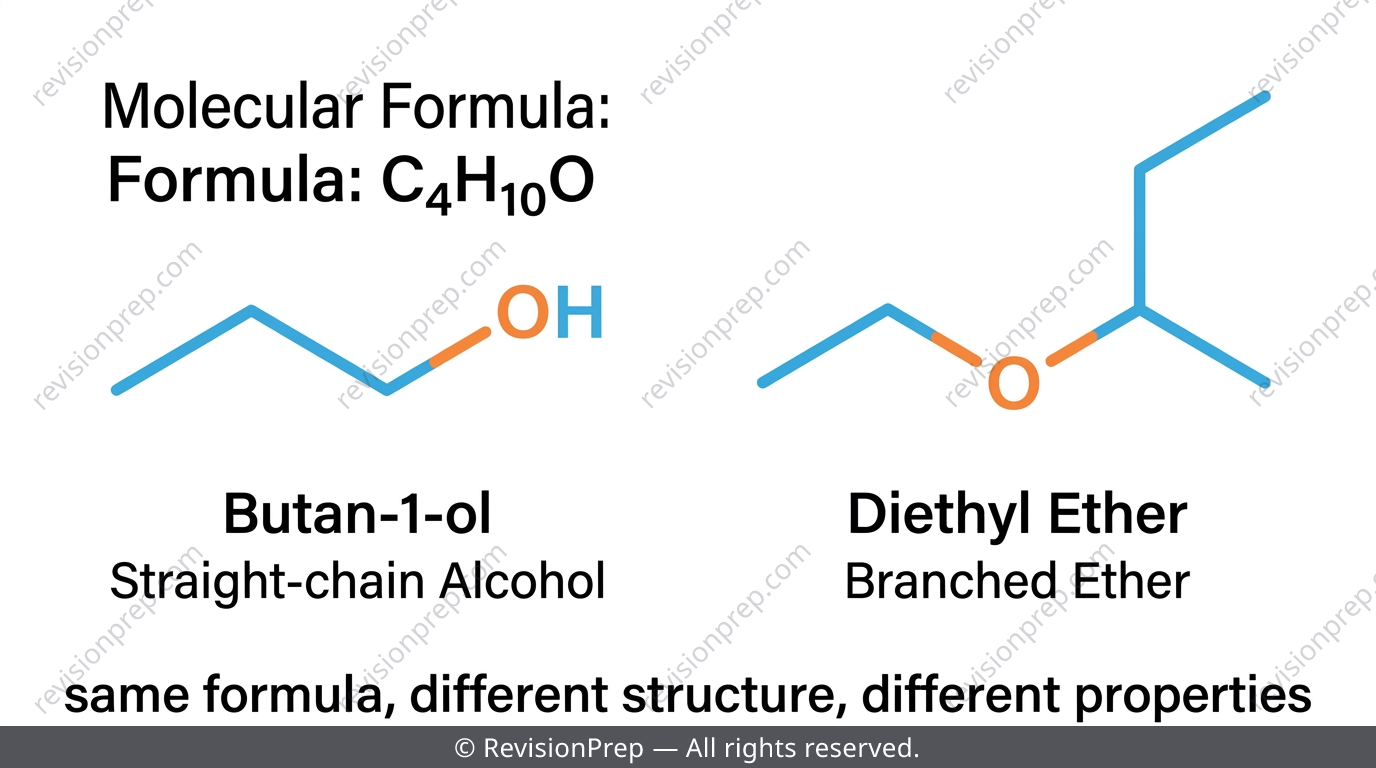
A molecular formula like only tells you atom counts — it can't tell you how those atoms are connected. Structural isomers share that same molecular formula but have their atoms arranged in a different order, giving each isomer its own name, boiling point, solubility and reactivity. Isomers are not 'basically the same compound' just because the formula matches — the different bonding arrangement changes real, measurable properties.
Exam tip
When comparing isomers, always point to the different bonding arrangement as the cause of different physical properties — matching molecular formulas is not evidence the compounds behave the same.
Common mistake
Treating two isomers as identical because they share a molecular formula, when their different atom connectivity gives them different boiling points, smells and reactivity.
Mini summary
Same molecular formula, different atom arrangement = structural isomers with different real-world properties.
Quick formula sheet
Practice questions
- State the electron configuration of carbon and explain how it leads to tetravalency.
- Define catenation in your own words.
- Write the IUPAC prefix used for a five-carbon chain.
- Explain why silicon and germanium do not form nearly as many compounds as carbon, despite being in the same group.
- Give the IUPAC name for , showing which numbering direction you chose and why.
- Explain the difference between a structural formula and a condensed structural formula, using an example.
- Two molecules share the molecular formula . Explain why they can have different boiling points despite having identical atom counts.
- Draw Lewis dot diagrams for ethane, ethene and ethyne, and explain how each diagram demonstrates the tetravalency of carbon.
- A student names a branched alkane by numbering from the end they started drawing. Identify the error and state the correct rule for choosing locants.
Frequently asked questions
Why does carbon always form exactly four bonds?+
Carbon's electron configuration is 2,4 — four electrons in its outer shell. It completes its octet by sharing four electrons, so every stable carbon atom forms four covalent bonds. This is called tetravalency.
What's the difference between tetravalency and catenation?+
Tetravalency is the fact that carbon always forms four bonds. Catenation is carbon's ability to use those bonds to link to itself repeatedly, forming chains, branches and rings — the reason millions of organic compounds exist.
How do I know which end to number an organic chain from?+
Always test both directions and choose the one that gives the lowest locant to the functional group or substituent — never just number from the end you happened to draw first.
What's the difference between saturated and unsaturated compounds?+
Saturated compounds contain only single C-C bonds, so every carbon holds the maximum number of hydrogens. Unsaturated compounds contain at least one C=C or C≡C bond and react by addition across that multiple bond.
Are structural isomers basically the same compound?+
No. Structural isomers share a molecular formula but have their atoms connected differently, which changes boiling point, solubility, reactivity and even smell — they are genuinely different substances.
Why does this MYP 5 topic matter for later chemistry study?+
Organic chemistry in MYP 5 builds the naming, bonding and isomer skills that DP Chemistry's organic topics rely on directly, so a solid grasp here makes later study much easier.
Get the Full MYP 5 Organic Chemistry Revision Notes
Related articles