
Environmental and Atmospheric Chemistry
How water treatment and a steady-state atmosphere hold the planet's balance together
Quick facts
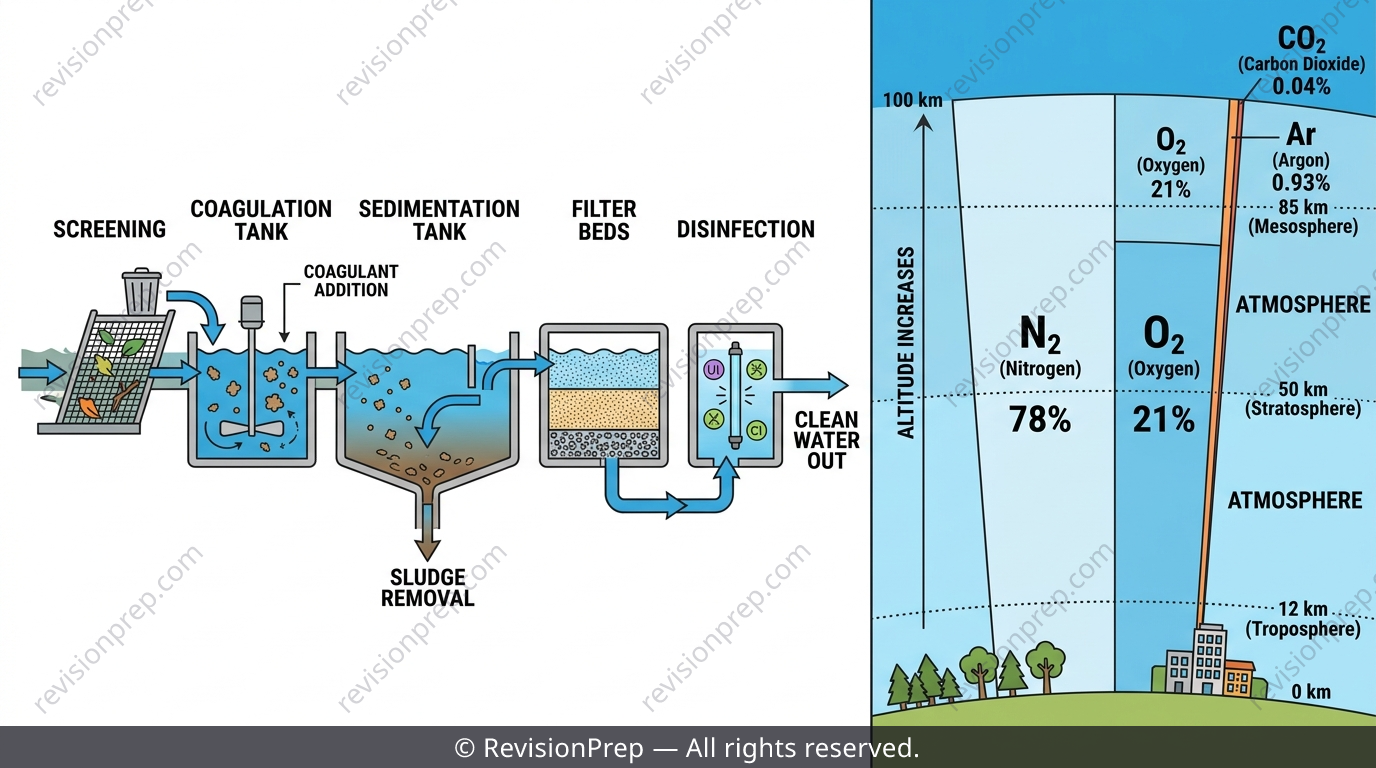
The atmosphere's composition looks fixed, but it's actually a steady state — gases are constantly produced and removed in balance, and human activity can tip that balance in traceable ways. This topic in IB MYP 5 Chemistry links two big ideas: how humans treat water to make it safe, and why the air around us stays roughly 78% N and 21% O despite constant chemical activity. Expect exam-style questions that ask you to explain mechanisms (why coagulant works, why N resists reacting) rather than just name a process — MYP examiners reward the 'why', not just the 'what'. This teaser covers the five most exam-critical ideas: the water treatment sequence, coagulation's mechanism, wastewater's extra stages, atmospheric steady state, and gas reactivity. The full revision notes go deeper into acid rain, ozone depletion and greenhouse gases.
What you’ll be able to do
The Drinking Water Treatment Sequence
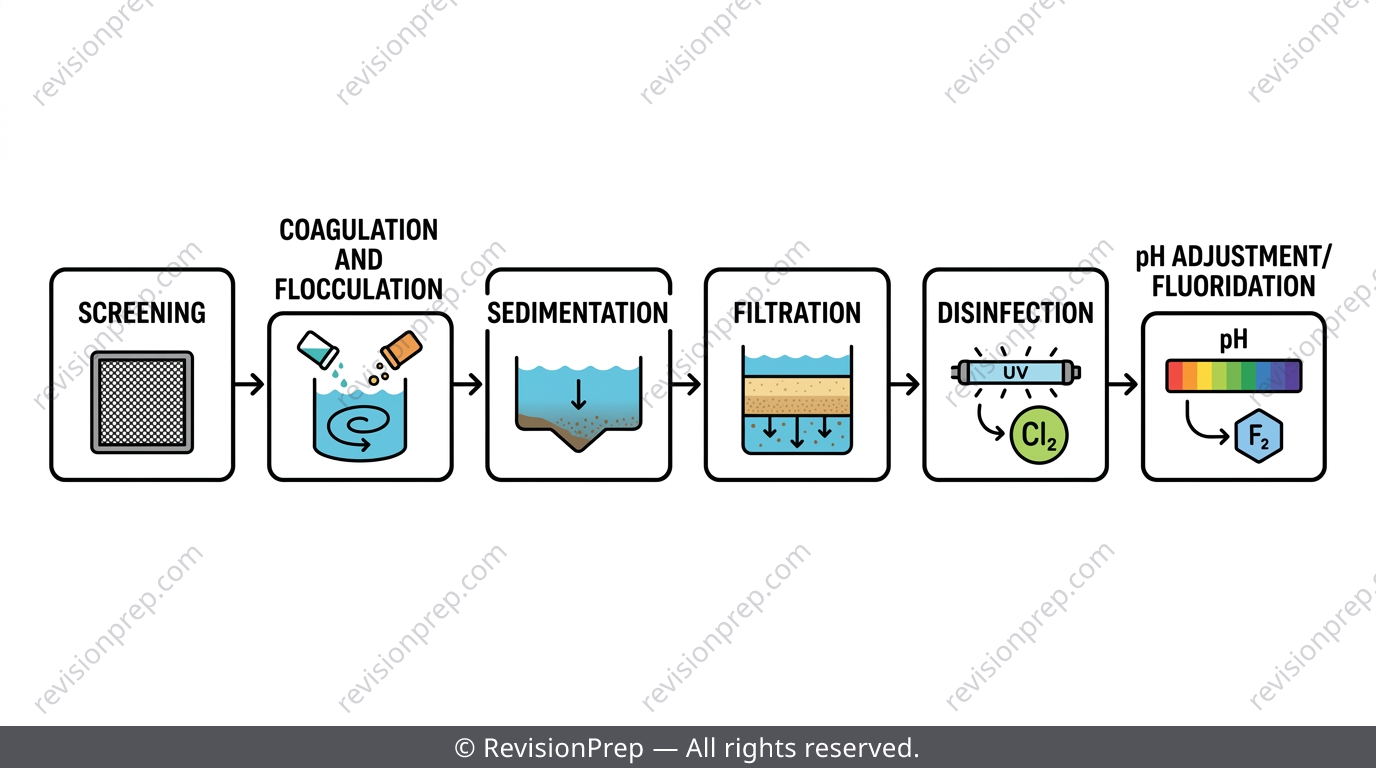
Raw water carries suspended solids, dissolved minerals and pathogens, and treatment removes them in a fixed order: screening, coagulation/flocculation, sedimentation, filtration, disinfection, then pH adjustment or fluoridation. Screening removes large debris with a mesh grille before anything else happens. Large-scale distillation is too energy-expensive for everyday supply, which is why it's reserved for desalination in water-scarce regions rather than standard treatment.
Exam tip
If asked to list the treatment sequence, write it as a chain with a connecting word for each step (e.g. 'first... then... finally...') — examiners check the order, not just the names.
Common mistake
Claiming filtration alone makes water 'safe to drink' — filtration only removes physical particles; it does not kill pathogens.
Mini summary
Order: screening → coagulation/flocculation → sedimentation → filtration → disinfection → pH adjustment.
Coagulation and Flocculation: The Mechanism Behind the Name
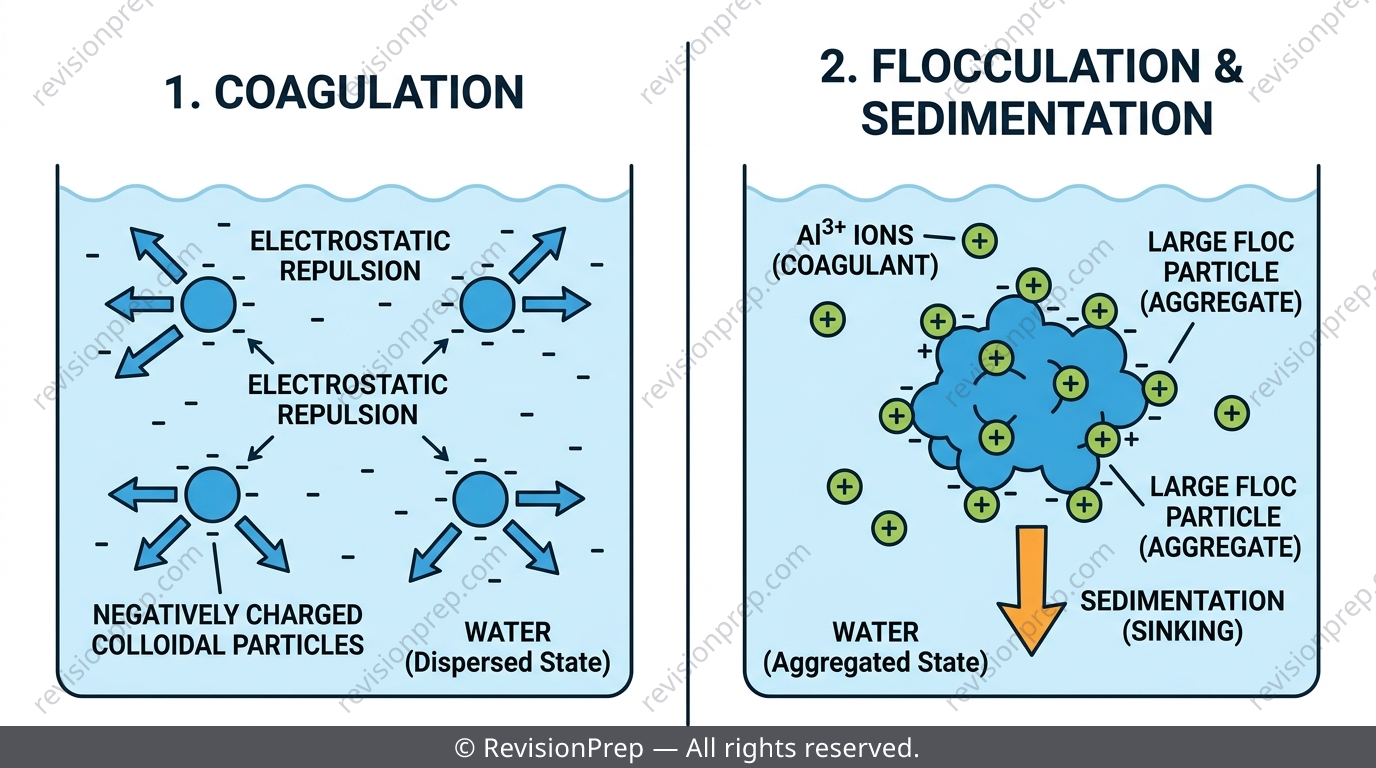
A coagulant such as or is added to neutralise the charge on tiny suspended colloidal particles, so they stop repelling each other and clump into larger 'floc'. This floc is heavy enough to settle out during sedimentation, reducing turbidity before filtration even begins. Naming the process without stating the charge-neutralisation mechanism will only earn partial credit on 'explain' questions.
Exam tip
For 'explain' questions on coagulants, always state the mechanism — charge neutralisation causing floc formation — not just 'it removes dirt.'
Common mistake
Describing coagulation as simply 'removing dirt' instead of explaining the ion charge-neutralisation mechanism.
Mini summary
Coagulant ions neutralise colloidal charge → particles clump into floc → floc settles out.
Wastewater Treatment and Preventing Eutrophication
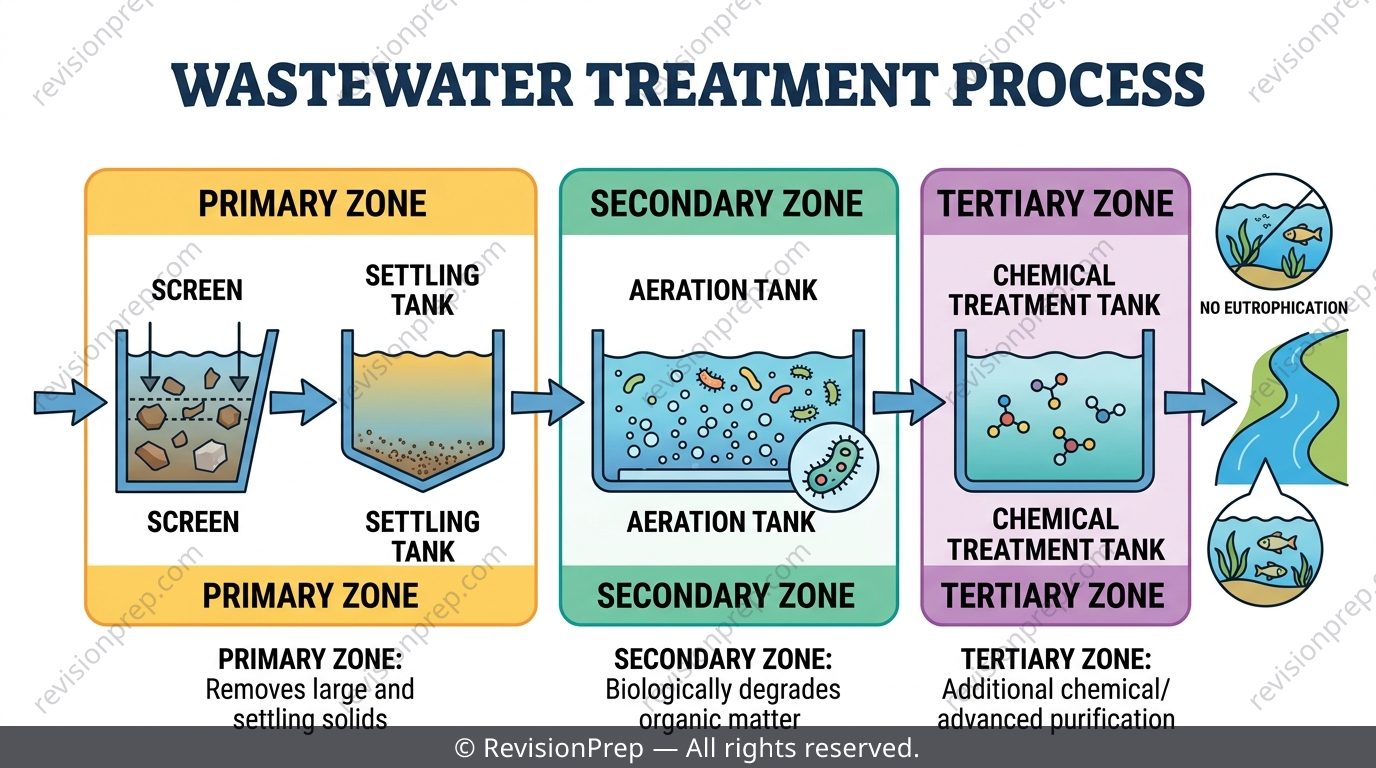
Sewage treatment mirrors drinking water treatment but in reverse purpose: primary treatment uses physical screening and sedimentation, secondary treatment uses aerobic bacteria to break down organic matter and lower BOD, and tertiary treatment chemically removes nitrates and phosphates before the water is released. Skipping tertiary treatment lets excess nutrients trigger eutrophication — algal blooms that die, decompose, and deplete dissolved oxygen, killing aquatic life.
| Stage | Method | Purpose |
|---|---|---|
| Primary | Screening + sedimentation | Remove solids physically |
| Secondary | Aerobic bacteria | Lower BOD by breaking down organic matter |
| Tertiary | Chemical nutrient removal | Prevent eutrophication downstream |
Common mistake
Forgetting that a high BOD signals heavy organic pollution, and confusing BOD with nutrient pollution (which causes eutrophication instead).
Mini summary
Primary = physical, secondary = biological (lowers BOD), tertiary = chemical (prevents eutrophication).
The Atmosphere as a Steady State
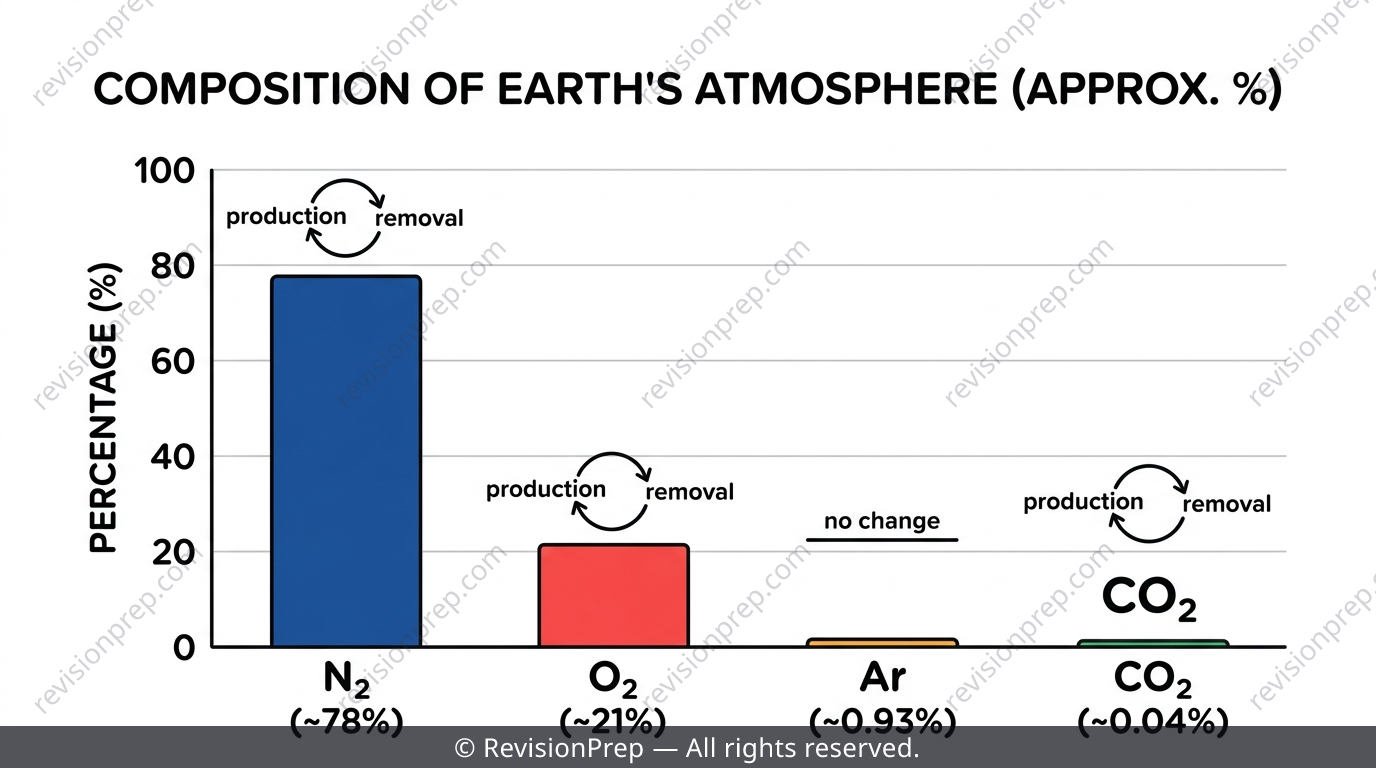
Dry air is overwhelmingly (~78%) and (~21%), with (~0.93%) and (~0.04%) as trace gases. Composition stays nearly constant up to 80–100 km because production and removal processes balance — nitrogen fixation removes while denitrifying bacteria return it, photosynthesis and respiration balance , and photosynthesis plus ocean dissolution keep low. Argon shows essentially zero variation with altitude because it has no biological source or sink at all.
| Gas | % by volume (approx.) | Key property / role |
|---|---|---|
| N₂ | ~78.08% | Balanced by nitrogen fixation and denitrification |
| O₂ | ~20.95% | Balanced by photosynthesis and respiration/combustion |
| Ar | ~0.93% | Chemically inert, no biological source or sink |
| CO₂ | ~0.04% | Trace gas, removed by photosynthesis and ocean dissolution |
Exam tip
'State the approximate %' questions accept ~78% N₂ and ~21% O₂ — full decimal precision is not required unless the question gives you data to that precision.
Common mistake
Treating CO as chemically insignificant because its percentage is tiny — always separate 'how much of it there is' from 'how much it matters.'
Mini summary
Atmosphere composition is a balance of production and removal, not an absence of reactions.
Why Some Gases Refuse to React
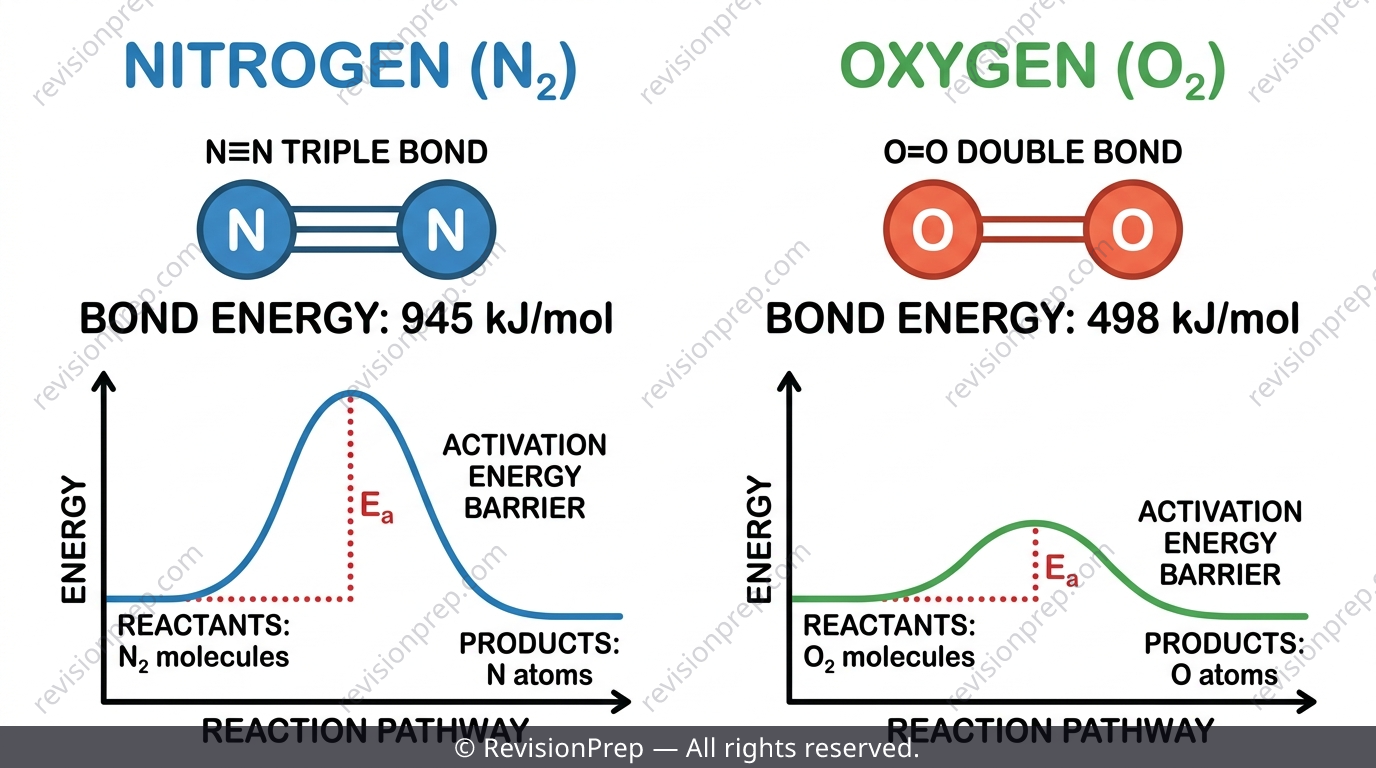
Noble gases like He, Ne and Ar are unreactive because their outer electron shell is already full, leaving no energetic driving force to gain, lose or share electrons — though helium is the exception with only 2 outer electrons, not 8. is far less reactive than at room temperature for a different reason: its triple bond (, 945 kJ mol⁻¹) is nearly twice as strong as 's double bond (, 498 kJ mol⁻¹), so breaking it needs activation energy that isn't available under normal conditions.
Exam tip
Bond-energy 'explain' questions need two linked ideas, not one — state that the stronger bond requires more activation energy, and link that directly to lower reactivity, or you'll only earn the first mark.
Common mistake
Writing 'noble gases all have 8 outer electrons' as a blanket rule — helium only has 2, so state the rule as 'full outer shell' with helium flagged as the exception.
Mini summary
Noble gases: unreactive due to full outer shell. N₂: unreactive due to very strong triple bond needing high activation energy.
Quick formula sheet
Practice questions
- List the six stages of drinking water treatment in the correct order.
- State the approximate percentage of N and O in dry air.
- Define eutrophication in one sentence.
- Explain how adding before sedimentation improves water quality.
- Explain why filtration alone is not enough to make water safe to drink.
- Explain why argon shows no variation in percentage with altitude while CO does.
- Using bond energy data ( = 945 kJ mol⁻¹, = 498 kJ mol⁻¹), explain why N is less reactive than O at room temperature.
- Explain why noble gases are chemically unreactive, using electron configuration as evidence, and identify the exception to the '8 outer electrons' rule.
- Evaluate why tertiary treatment is essential for preventing ecological damage downstream of a wastewater plant.
Frequently asked questions
What is the correct order of drinking water treatment steps?+
Screening, then coagulation/flocculation, sedimentation, filtration, disinfection, and finally pH adjustment or fluoridation before distribution.
Why is aluminium sulfate added to water?+
Its ions neutralise the charge on suspended colloidal particles, causing them to clump into floc that settles out during sedimentation.
What's the difference between filtration and disinfection?+
Filtration physically removes particles using sand and gravel layers; disinfection uses chlorine, ozone or UV to kill or inactivate pathogens. Both are needed for safe drinking water.
Why doesn't atmospheric composition change much with altitude?+
Turbulent mixing in the homosphere (surface to ~80–100 km) keeps gases well-blended, and production/removal processes stay balanced, maintaining a steady state.
Why are noble gases chemically unreactive?+
Their outer electron shell is already full, so there's no energetic driving force to gain, lose or share electrons — helium is the exception with only 2 outer electrons rather than 8.
Why is CO$_2$ still important even though it's a trace gas?+
Low abundance doesn't mean low importance — CO's role in the carbon balance and greenhouse effect matters regardless of its small percentage.
Get the full IB MYP 5 Environmental and Atmospheric Chemistry notes
Related articles