
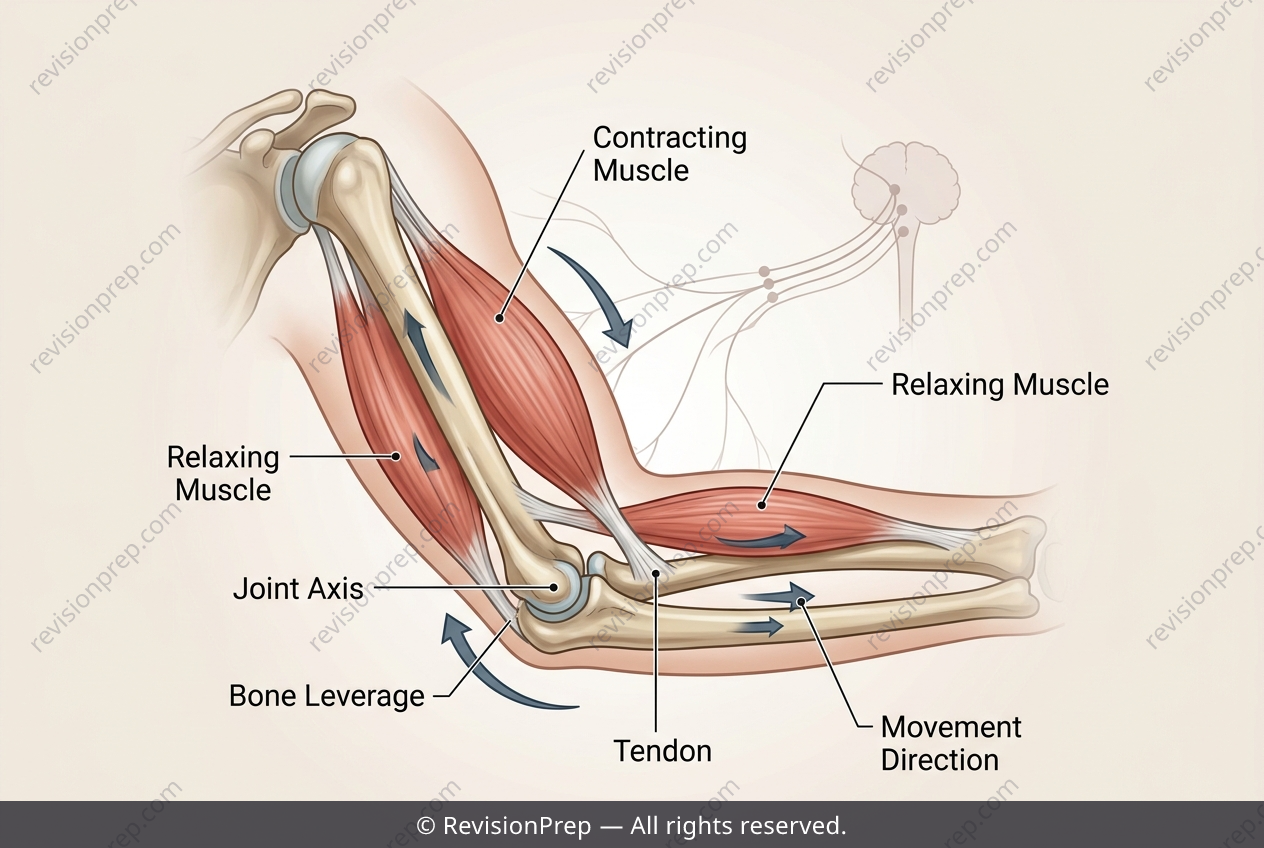
Biology: Antagonistic Muscle Action and Joint Movement for IB Biology
The human body is a marvel of coordinated movement, and at the heart of every action—from a simple wave to a powerful sprint—lies the partnership between the skeletal and muscular systems. This relationship is not just about individual muscles working in isolation; it is about precise, opposing forces that create controlled motion. The core of this mechanism is antagonistic muscle action, where two muscles work in opposite directions to move a joint, ensuring that every bend and extension is both powerful and smooth. Consider the upper arm, a perfect illustration of this principle. The biceps brachii, located on the front, is the prime mover for elbow flexion, bending the arm to lift an object. Its functional opposite, the triceps brachii on the back, extends the arm. When you curl a weight, the biceps contract and shorten while the triceps relax and lengthen, and the reverse happens when you straighten your arm. This push-pull dynamic, orchestrated by the nervous system, is what allows for the precise, graded movements we perform daily, transforming simple muscle contraction into purposeful, joint-driven action.
Start practising IB questions today
150,000+ IB-styled questions, criteria-mapped and instantly accessible.