
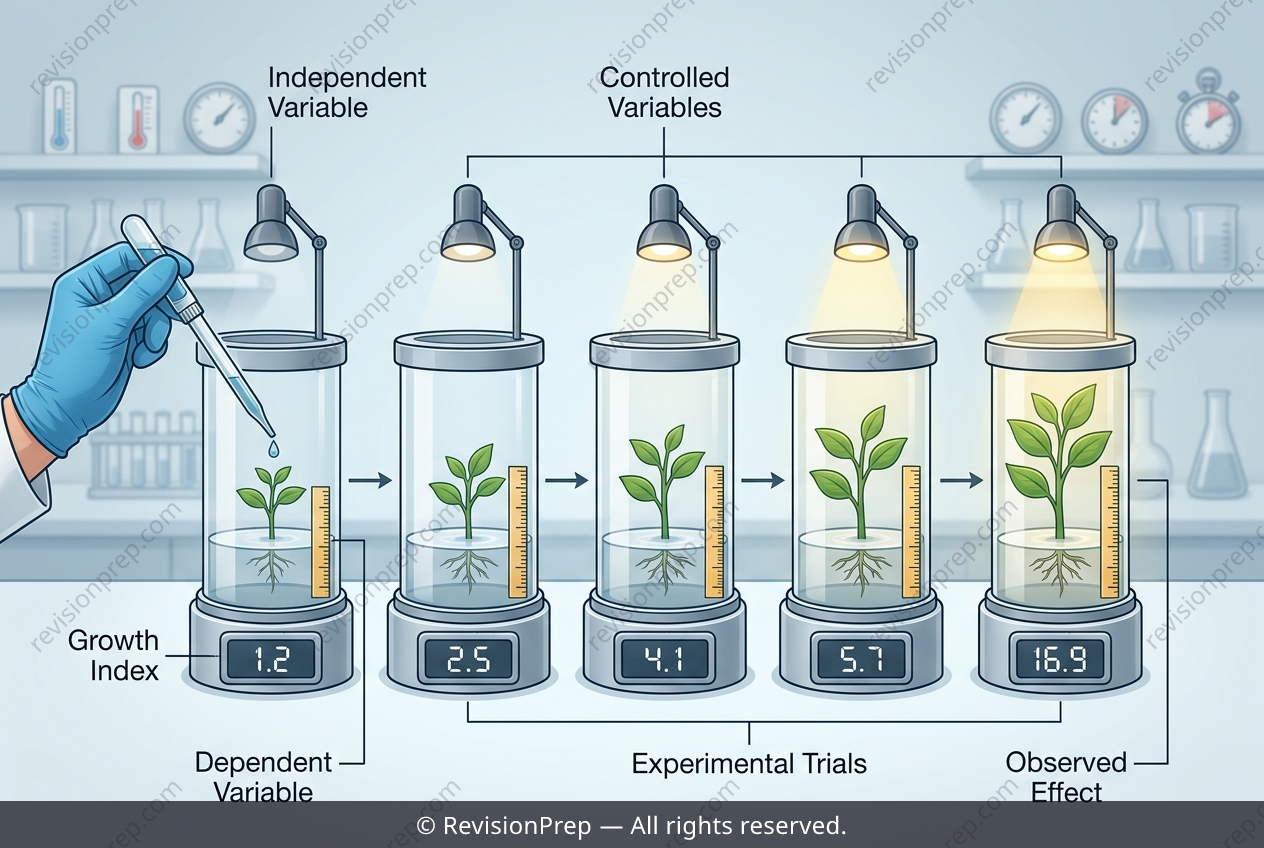
Biology: Controlled Variables Isolate Cause and Effect
Experimental design is the backbone of reliable science: it is how we move from a curious observation to a conclusion we can actually trust. At its heart lies the relationship between variables. The independent variable is the factor deliberately changed — here, the amount of fertilizer added to the water, varied across 0 g, 1 g, 2 g and 3 g. The dependent variable is what responds, in this case the number of algae plants counted after two weeks. For that response to mean anything, everything else must stay constant. Controlled variables — the number of algae seeds, container size, water volume, temperature, light and the two-week duration — ensure the fertilizer is the only difference between setups. This matters because ecology increasingly depends on such experiments to understand nutrient pollution and algal blooms. Change one factor, hold all others fixed, and any pattern in the results can be attributed to that factor alone.
Start practising IB questions today
150,000+ IB-styled questions, criteria-mapped and instantly accessible.