
Biology: Auditory Transduction and Hearing Limits for IB Sciences
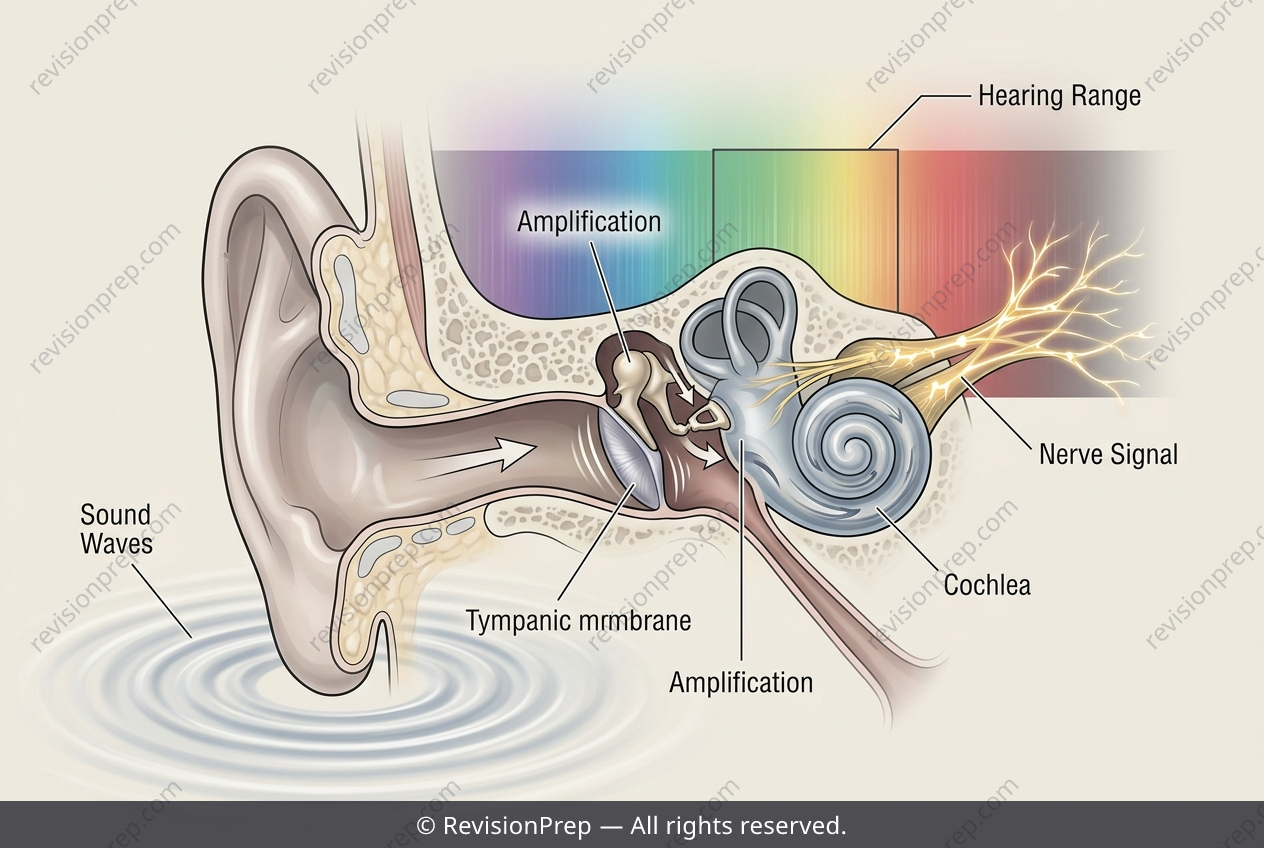
Hearing is a finely tuned biological process that hinges on auditory transduction—the conversion of sound waves into electrical signals the brain can interpret. At its core, this system operates within strict sensory perception limits, defined by both frequency (pitch) and amplitude (loudness). The human ear is divided into three functional regions—the outer, middle, and inner ear—each playing a distinct role in this chain of events. The journey begins as sound waves enter the outer ear and strike the eardrum, causing it to vibrate. These vibrations are then amplified by the three tiny bones of the middle ear—the hammer, anvil, and stirrup—before reaching the cochlea in the inner ear. There, the mechanical energy is transformed into a nerve signal that travels to the brain. This entire pathway is frequency-dependent: humans typically detect sounds between 20 Hz and 20,000 Hz. Sounds above this range, like a dog whistle at 25,000 Hz, fall outside our perceptual window, meaning the cochlea cannot transduce them into a signal—not because the sound is too quiet, but because its pitch exceeds our biological limit. Understanding this relationship between structure, amplification, and frequency range reveals why hearing is both remarkably sensitive and strictly bounded.
Start practising IB questions today
150,000+ IB-styled questions, criteria-mapped and instantly accessible.