
Biology: Calcium’s 10,000-Fold Signal
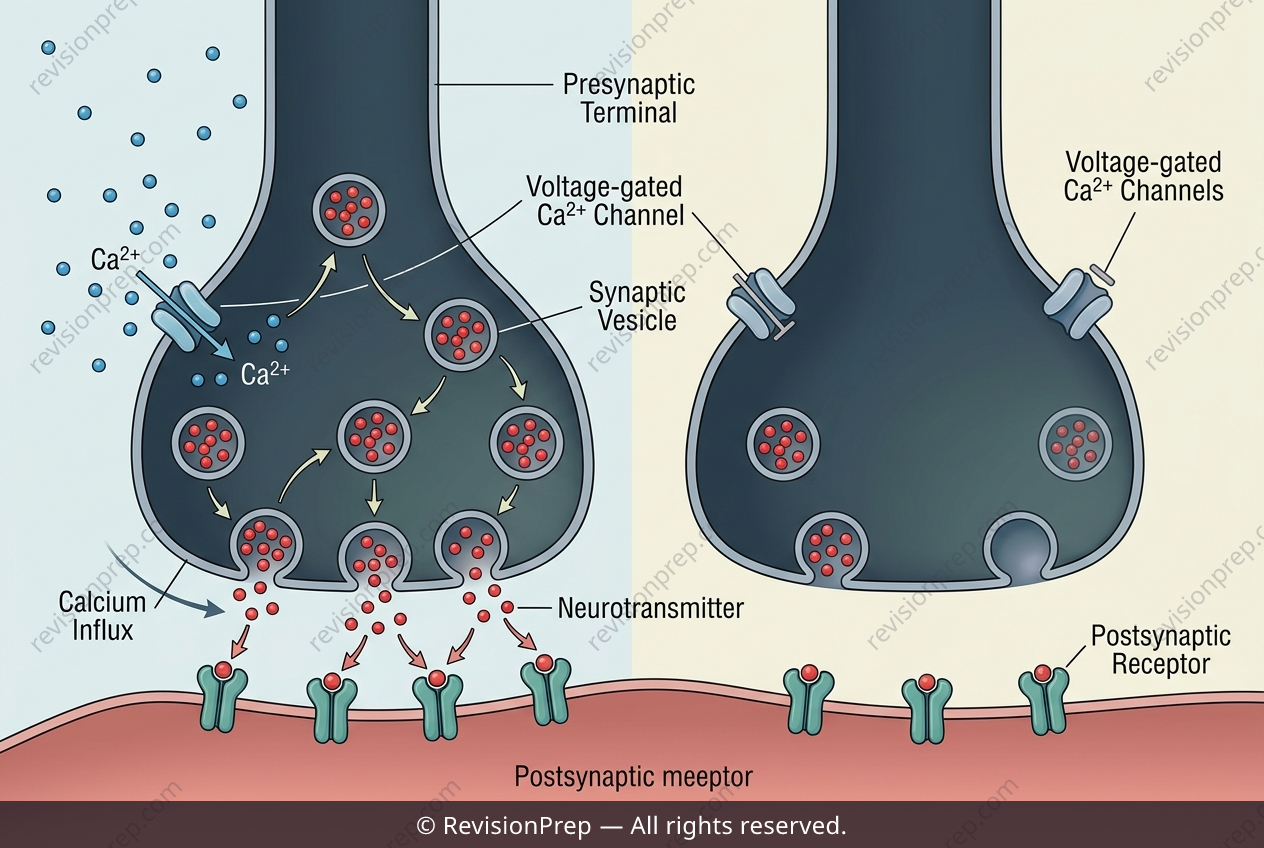
At the heart of every muscle twitch and every thought lies a deceptively simple event: the release of a chemical messenger across a tiny gap. In the nervous system, communication between a motor neuron and a muscle cell depends on a precise, calcium-triggered cascade. When an action potential arrives at the presynaptic terminal, voltage-gated calcium channels open, allowing Ca²⁺ ions to flood inward. This sudden rise in intracellular calcium is the critical signal that drives synaptic vesicles to fuse with the presynaptic membrane, releasing neurotransmitter by exocytosis into the synaptic cleft. The entire process hinges on a steep concentration gradient—extracellular calcium sits at millimolar levels while the resting intracellular concentration is in the sub-micromolar range, creating a driving force roughly ten thousand times in favor of influx. This is why even a small disruption to calcium entry has outsized consequences. If a toxin blocks these channels, reducing influx by 90%, vesicle fusion drops dramatically. Fewer neurotransmitter molecules reach the postsynaptic receptors on the muscle cell, so the threshold for generating a new action potential is not met. The result is weakened or absent muscle contraction—a stark reminder that synaptic transmission is not a binary switch, but a finely tuned, concentration-dependent process.
Start practising IB questions today
150,000+ IB-styled questions, criteria-mapped and instantly accessible.