
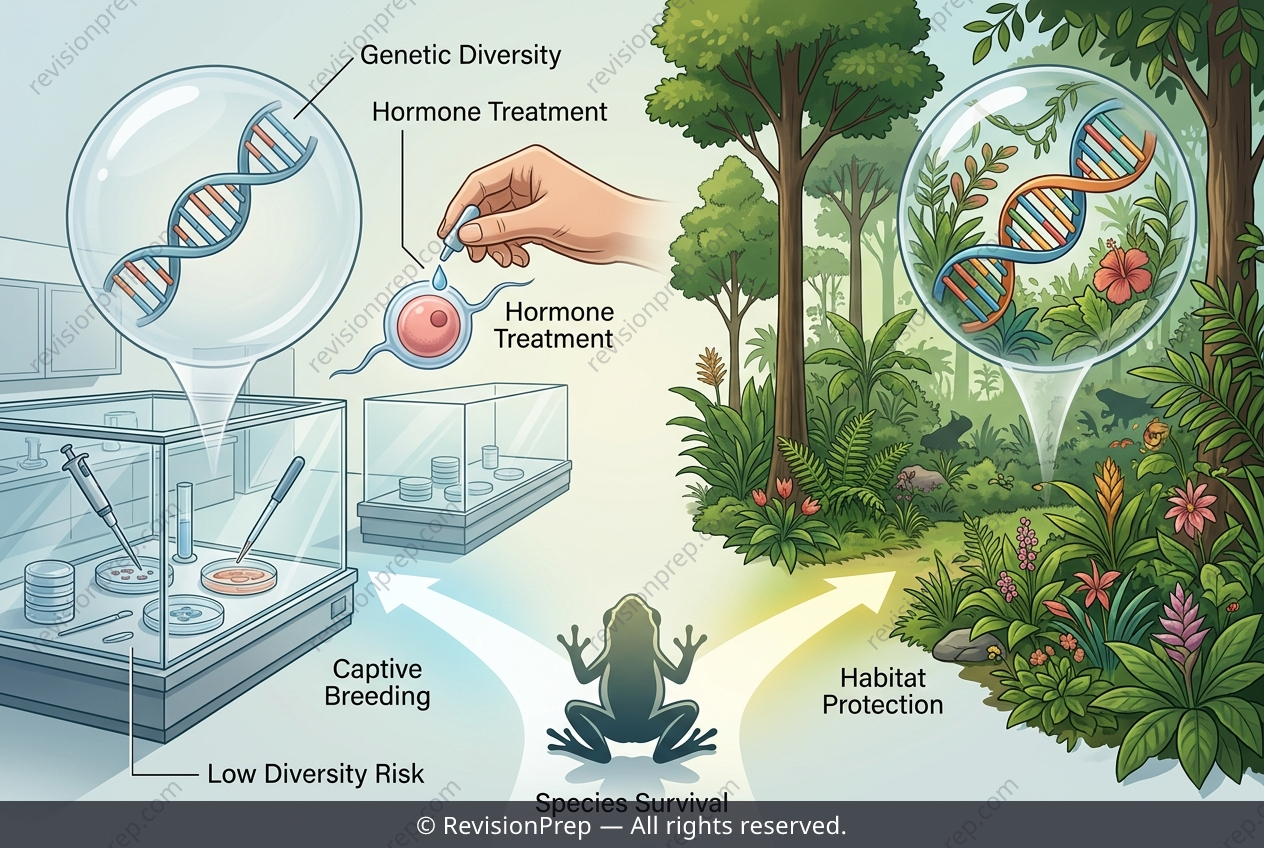
Biology: Conservation Strategies with the Panamanian Golden Frog Case Study
When a species is reduced to just two individuals, its survival hangs on a genetic knife’s edge. This is the reality for the Panamanian golden frog, and it introduces a core tension in conservation biology: how to save a species without sacrificing the diversity that lets it adapt. Low genetic diversity—where offspring inherit nearly identical DNA—means that any inherited weakness or disease vulnerability becomes amplified across the entire population, leaving no genetic “backup” for future environmental changes. Conservation strategies therefore operate on two fronts. In captivity, hormone treatments artificially trigger reproduction, rapidly boosting offspring numbers and stalling immediate extinction. This is a short-term rescue, buying time but not addressing why the frogs vanished in the wild. In contrast, protecting natural habitats tackles the root cause—habitat loss—by providing a safe, self-sustaining environment where frogs can breed naturally and retain vital survival behaviours. The relationship is complementary: hormone treatment offers a quick population spike, while habitat protection offers long-term resilience. Understanding this balance—between intervention and restoration—is central to biodiversity conservation, because genetic diversity is not just a statistic; it is the raw material for a species’ future.
Start practising IB questions today
150,000+ IB-styled questions, criteria-mapped and instantly accessible.