
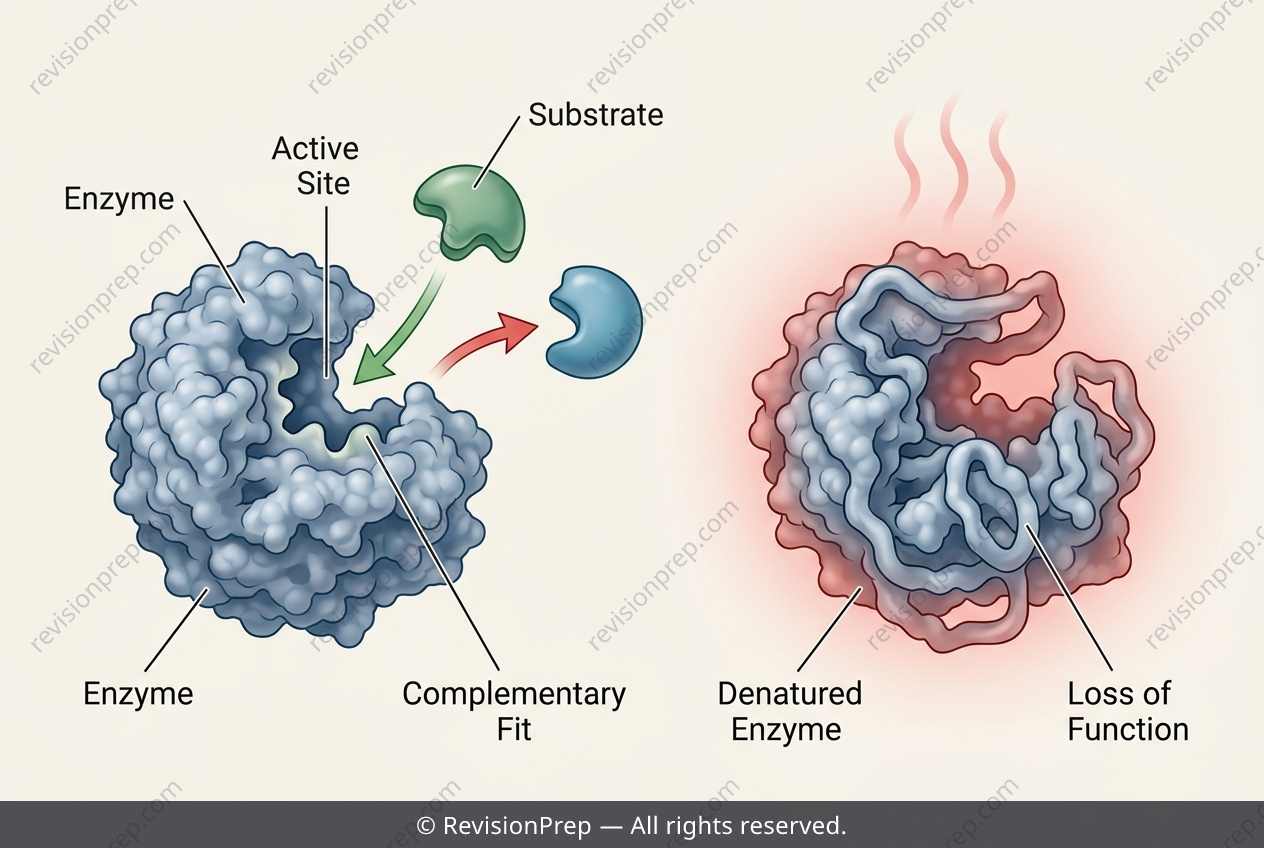
Biology: Enzyme Specificity and Denaturation in Digestion
Enzymes are biological catalysts that speed up chemical reactions, and their power lies in their precise three-dimensional architecture. At the heart of this architecture is the active site—a specific pocket or groove where the substrate binds. The lock-and-key model describes this interaction: just as only the correct key fits a lock, only a substrate with a shape perfectly complementary to the active site can bind. This specificity is what makes enzymes highly selective, ensuring they catalyse only their intended reaction among thousands of possible substrates in a cell. The relationship between enzyme shape and function is fragile, however. The active site’s geometry is maintained by weak bonds that hold the enzyme’s overall structure together. When environmental conditions change—such as an increase in temperature—these bonds can break, causing the enzyme to denature. Denaturation alters the active site’s shape, so even a previously complementary substrate can no longer bind. This loss of fit directly explains why enzymes stop working outside their optimal conditions. Understanding this structure-function link is fundamental to grasping how digestion, metabolism, and countless biological processes are regulated.
Start practising IB questions today
150,000+ IB-styled questions, criteria-mapped and instantly accessible.