
Systems in Organisms: Bones, Muscles and Reproduction Made Simple
The IB MYP 3 Sciences guide to how structure, function and consequence connect in the human body
Quick facts
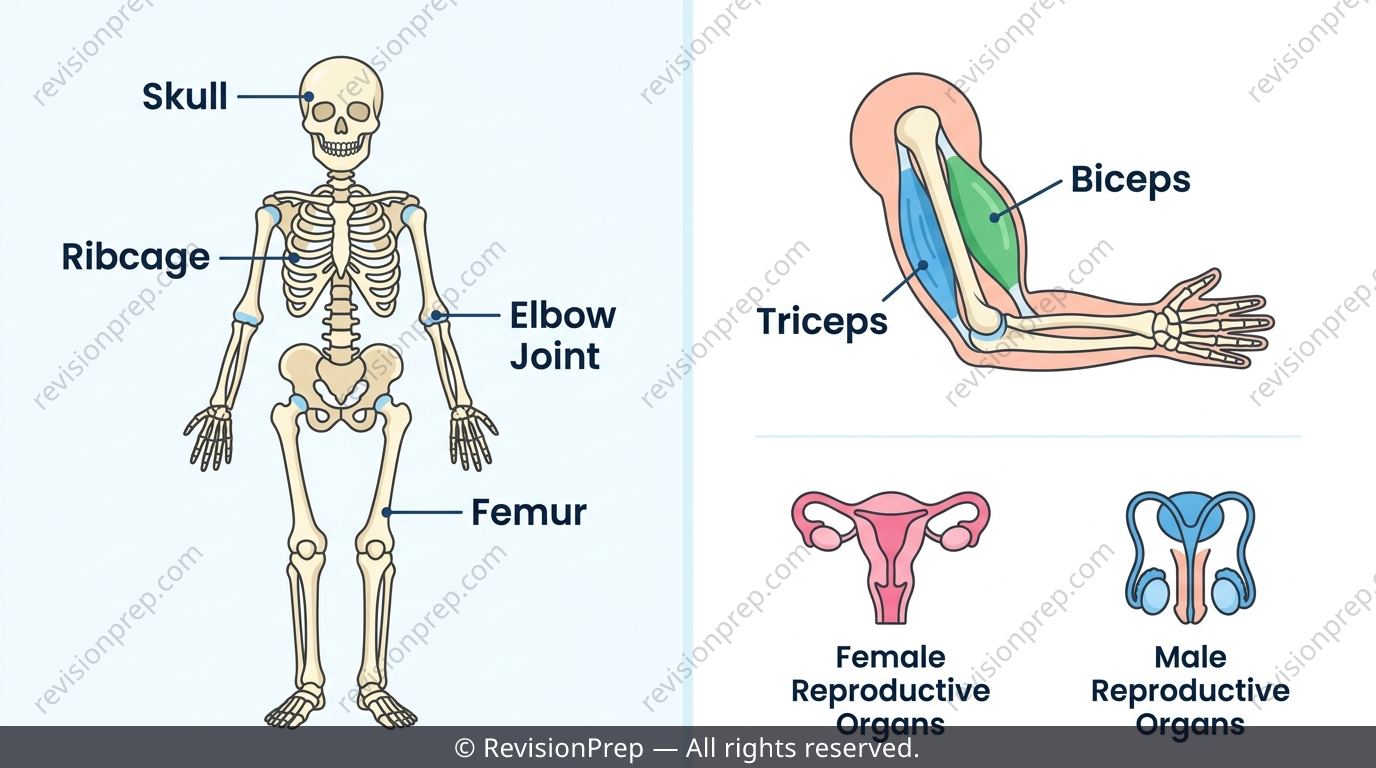
In IB MYP 3 Sciences, the Systems in Organisms unit asks you to see the body as a set of connected systems rather than a list of parts. A bone's composition only makes sense once you link it to the job it does; a muscle only makes sense once you see it working against a partner across a joint. Exam-style questions almost always give you a table, graph or diagram and mark you on reading it correctly, using command terms like 'identify' and 'explain' precisely. This teaser covers the five ideas that come up again and again: why bone composition varies, how long bones are built for load and leverage, how antagonistic muscle pairs move joints, how to handle lever maths and mechanical advantage, and the essentials of the reproductive system. For the full breakdown, worked examples and every definition, the complete revision notes are linked below.
What you’ll be able to do
Why Bone Composition Matches Its Job
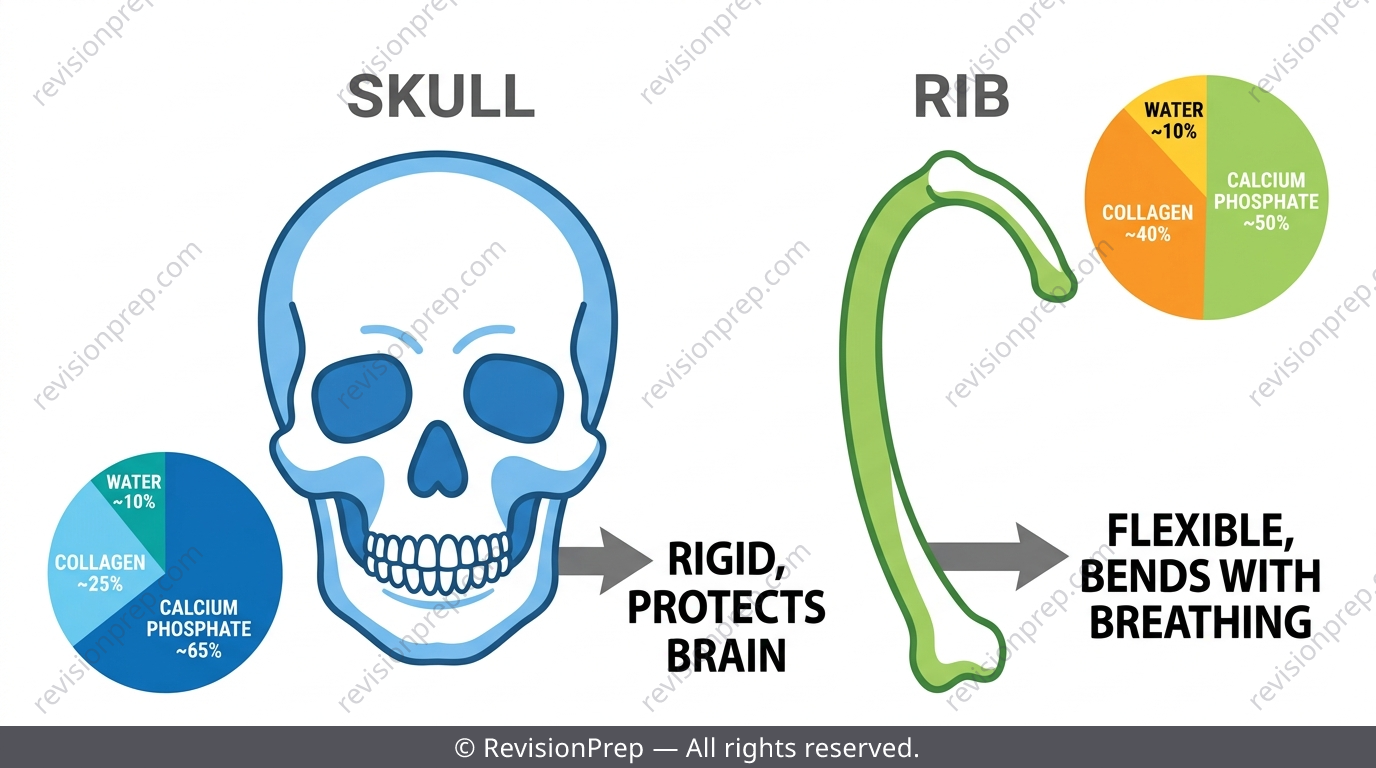
Bone is a mix of calcium phosphate (hard, resists compression), collagen (flexible, resists snapping) and water. The exact ratio shifts depending on what a bone has to survive: the skull needs more calcium phosphate to stay rigid and protect the brain, while the rib needs more collagen because it must flex slightly with every breath. Beyond composition, the skeleton has five jobs worth naming: support, protection, movement (as levers), mineral storage, and blood cell production in red marrow.
Exam tip
For 'explain the difference in composition' questions, you must connect the percentage to the mechanical property AND the specific job. Saying only 'the skull needs more calcium' scores zero — say why it needs to be rigid.
Mini summary
More mineral = more rigid and protective; more collagen = more flexible.
Long Bones: Built for Load and Leverage
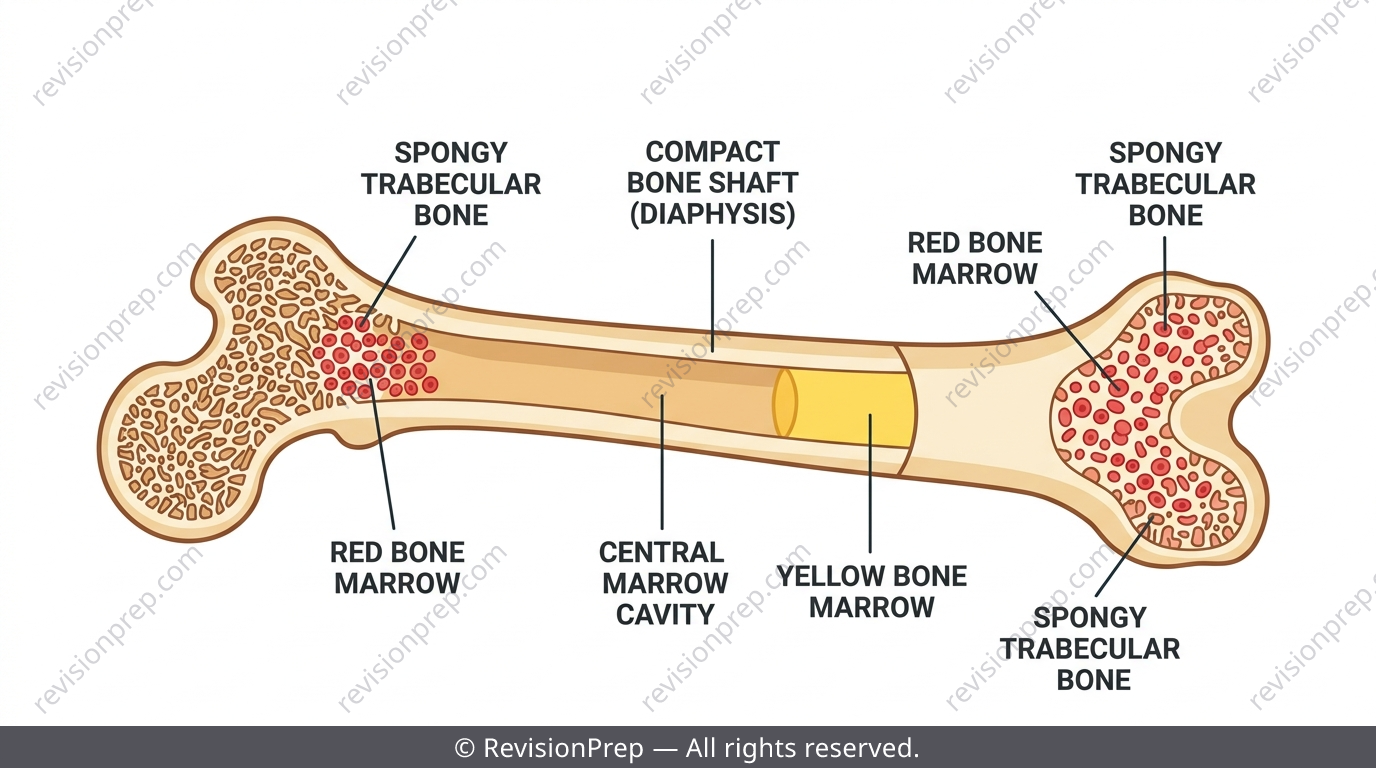
Long bones like the femur and humerus are engineered for load-bearing and leverage. Compact bone forms the dense shaft and resists bending, spongy (trabecular) bone at the ends absorbs shock at the joint, and the hollow marrow cavity stores fat as yellow marrow in adults or produces blood cells as red marrow in children.
| Structure | Location | Main role |
|---|---|---|
| Compact bone | Shaft (diaphysis) | Strength, resists bending |
| Spongy bone | Ends of long bone | Shock absorption, houses red marrow |
| Marrow cavity | Centre of shaft | Fat storage (yellow) or blood cell production (red) |
Mini summary
Compact bone = strength; spongy bone = shock absorption; marrow cavity = storage or blood production.
Antagonistic Muscles and the Elbow Lever
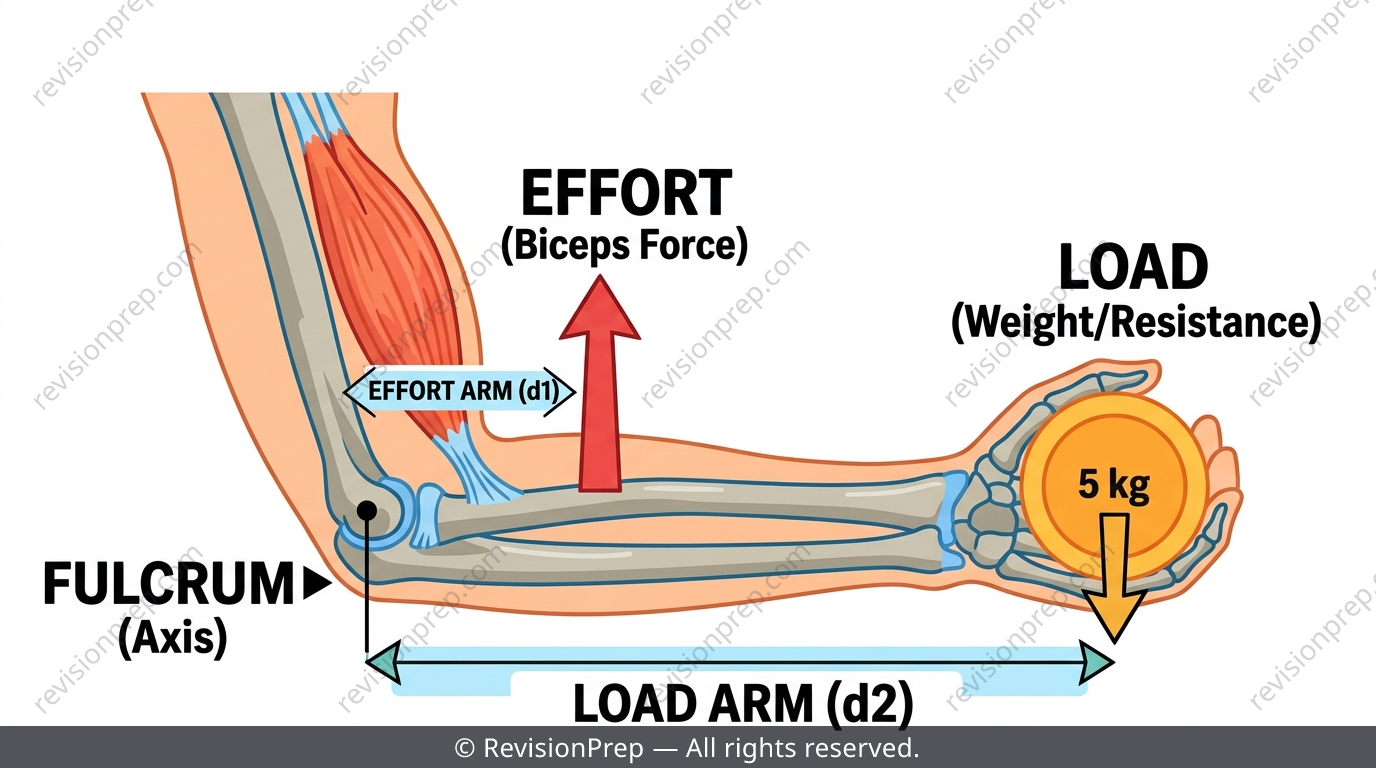
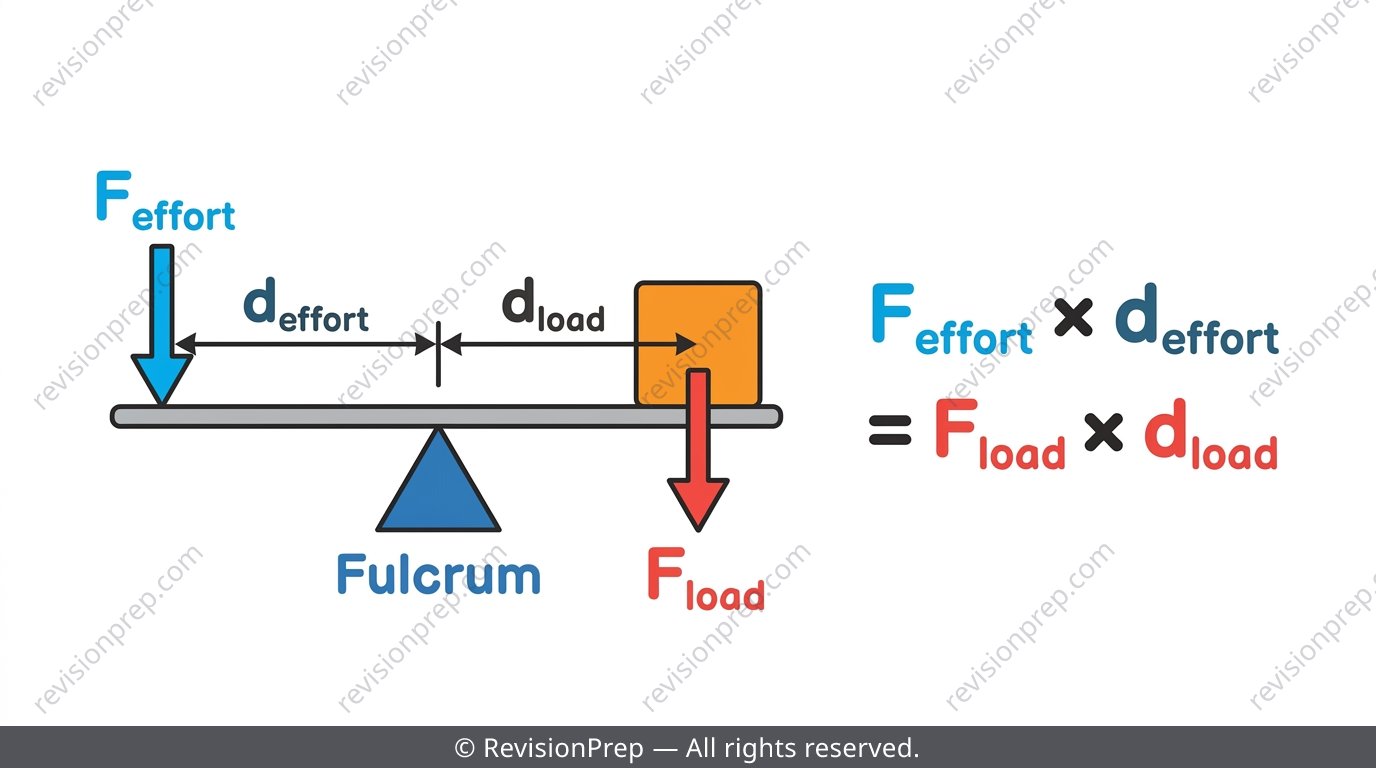
Muscles can only pull, never push, so they work in antagonistic pairs across a joint: when the biceps contracts to flex the elbow, the triceps relaxes and lengthens, and their roles reverse to extend the arm. Every joint acts as the fulcrum of a lever system — in the classic forearm example, the elbow is the fulcrum, the biceps insertion point is the effort, and whatever the hand holds is the load.
Common mistake
Swapping the effort arm and load arm distances when setting up the moment equation. Label which distance belongs to the muscle and which belongs to the load before substituting numbers.
Mini summary
Muscles pull in pairs; joints act as the fulcrum of a body lever.
Lever Maths: Balancing Moments and Mechanical Advantage
A balanced lever satisfies , so you can rearrange to find the unknown force or distance. Mechanical advantage is ; because the effort arm in most human limb levers is shorter than the load arm, MA is usually less than 1, meaning the muscle trades force for a greater range and speed of movement.
Exam tip
If your calculated effort force comes out smaller than the load's weight while the effort arm is shorter than the load arm, you've inverted the ratio — flip it back.
Common mistake
Writing (the arms flipped) instead of matching each force to its own distance.
Mini summary
Balance moments about the fulcrum; MA < 1 trades force for speed and range.
Reproductive Systems: Producing the Next Generation
Unlike other systems in this unit, the reproductive system doesn't run continuously to keep one individual alive — it switches on at puberty. Males produce sperm continuously in the testes, while females are born with all their egg cells already present in the ovaries and release roughly one per cycle (ovulation). Fertilisation, the fusion of sperm and egg nucleus, normally happens in the oviduct, forming a zygote that implants in the uterus lining; if fertilisation doesn't occur, that lining is shed as menstruation.
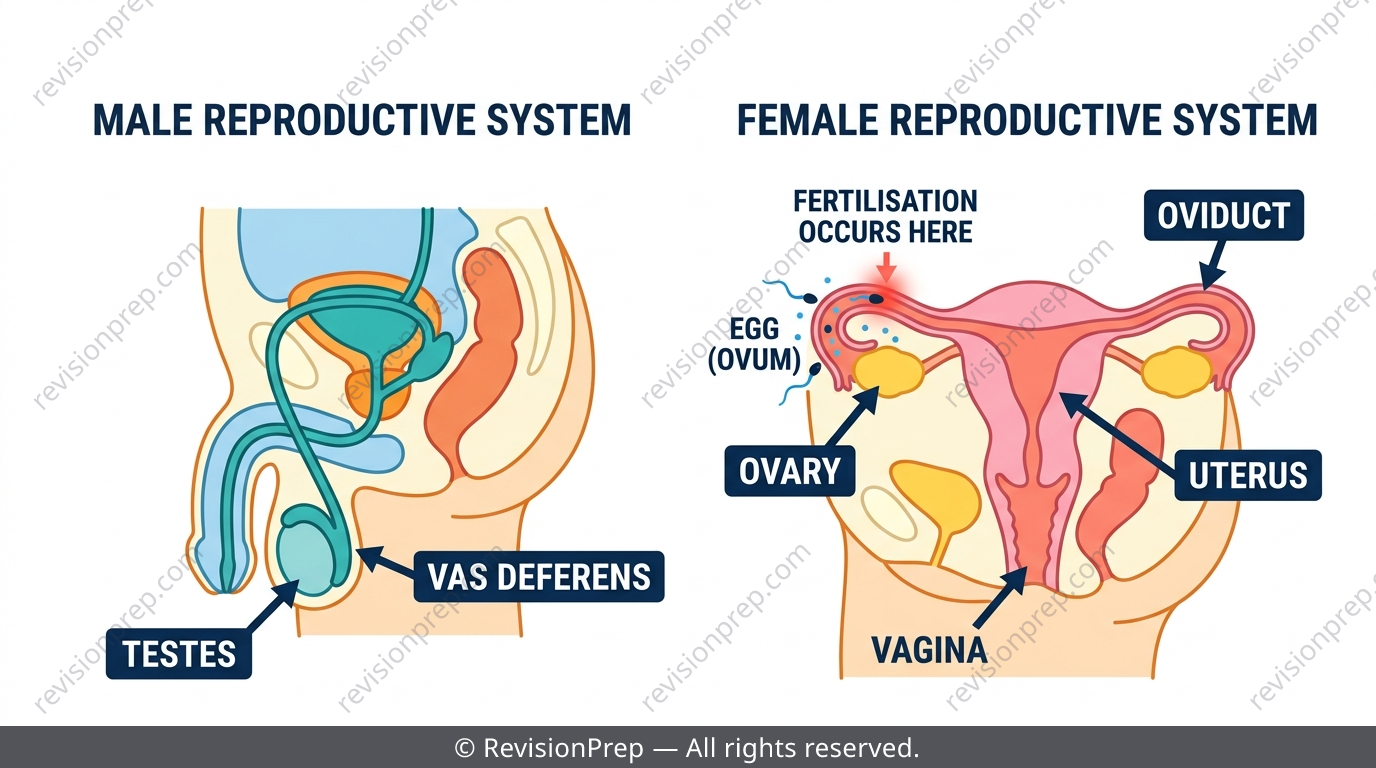
| Feature | Male system | Female system |
|---|---|---|
| Gamete production site | Testes | Ovaries |
| Timing | Continuous from puberty | Cyclical, fixed supply from birth |
| Site of fertilisation | Sperm delivered | Oviduct/fallopian tube |
Mini summary
Reproduction produces the next generation via gametes, fertilisation and cyclical hormone control.
Quick formula sheet
Practice questions
- Identify two functions of the human skeleton.
- What is the role of collagen in bone?
- Where does fertilisation normally occur in the human body?
- A bone has a higher percentage of calcium phosphate than another. Explain what job this bone is likely built for.
- Explain why muscles must work in antagonistic pairs to move a joint.
- A lever has an effort arm of 5 cm and a load arm of 25 cm. Calculate its mechanical advantage.
- Two people of equal mass fall and decelerate at the same rate, but one has lower bone density. Explain why they are more likely to fracture despite experiencing the same impact force.
- A forearm lever has an effort arm of 4 cm and lifts a 2 kg mass held 30 cm from the elbow. Calculate the effort force required (g = 10 N/kg).
- Explain, using the terms 'effort arm' and 'load arm', why most limb levers in the human body have a mechanical advantage less than 1.
Frequently asked questions
Why does the skull need more calcium phosphate than the ribs?+
The skull's job is to protect the brain from impact, so it needs more calcium phosphate for rigidity. The ribs need more collagen because they must flex slightly with every breath without snapping.
What is the difference between compact bone and spongy bone?+
Compact bone is dense and forms the shaft of long bones, giving strength and resisting bending. Spongy bone is honeycomb-like, found at the ends of long bones, and absorbs shock while housing red marrow.
Why do muscles work in pairs instead of alone?+
Muscles can only pull, not push, so moving a joint in two directions requires two muscles working against each other — one contracts while its partner relaxes, then their roles reverse.
What does a mechanical advantage less than 1 mean?+
It means the effort arm is shorter than the load arm, so the muscle must apply more force than the load's weight, but in exchange the hand moves faster and through a greater range.
Where are eggs and sperm produced?+
Sperm are produced continuously in the testes from puberty onward. Eggs are already present in the ovaries at birth, with roughly one released per cycle during ovulation.
What happens if fertilisation doesn't occur during the menstrual cycle?+
The uterus lining that was built up to receive a fertilised egg breaks down and is shed as menstruation, and the cycle starts again.
Master Systems in Organisms with the Full MYP 3 Revision Notes
Related articles