
Cells and Living Systems: The MYP 3 Teaser Guide
From single cell to organ system — the structure-function idea that runs through every exam question in this unit.
Quick facts
IB MYP 3 Sciences keeps returning to one big idea in this unit: structure exists to serve function, at every scale of life. Whether you're comparing a plant cell to an animal cell, explaining why a red blood cell has no nucleus, or placing an organism on the ladder from cell to organ system, examiners are testing the same skill — can you link a feature to the job it does? This teaser walks through the five ideas that generate the most marks: the fixed four levels of biological organization, the structure-function link in specialized cells, the short real list of plant vs animal cell differences, the trade-off between unicellular and multicellular life, and why magnification questions are really just careful measurement. Get these solid and most of this unit's exam questions become predictable. For the full worked examples, definitions and practice sets, the complete MYP 3 revision notes on RevisionPrep go much deeper than this summary.
What you’ll be able to do
Levels of Biological Organization
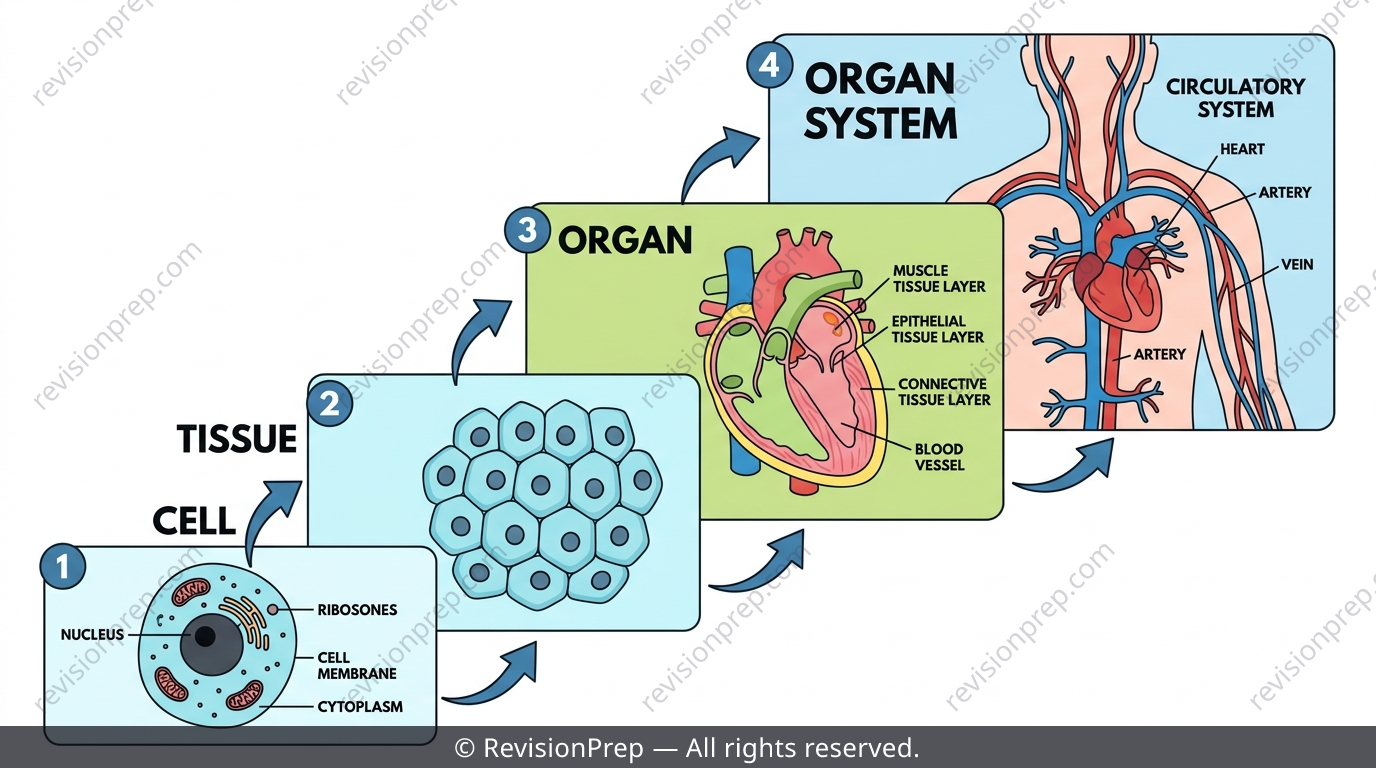
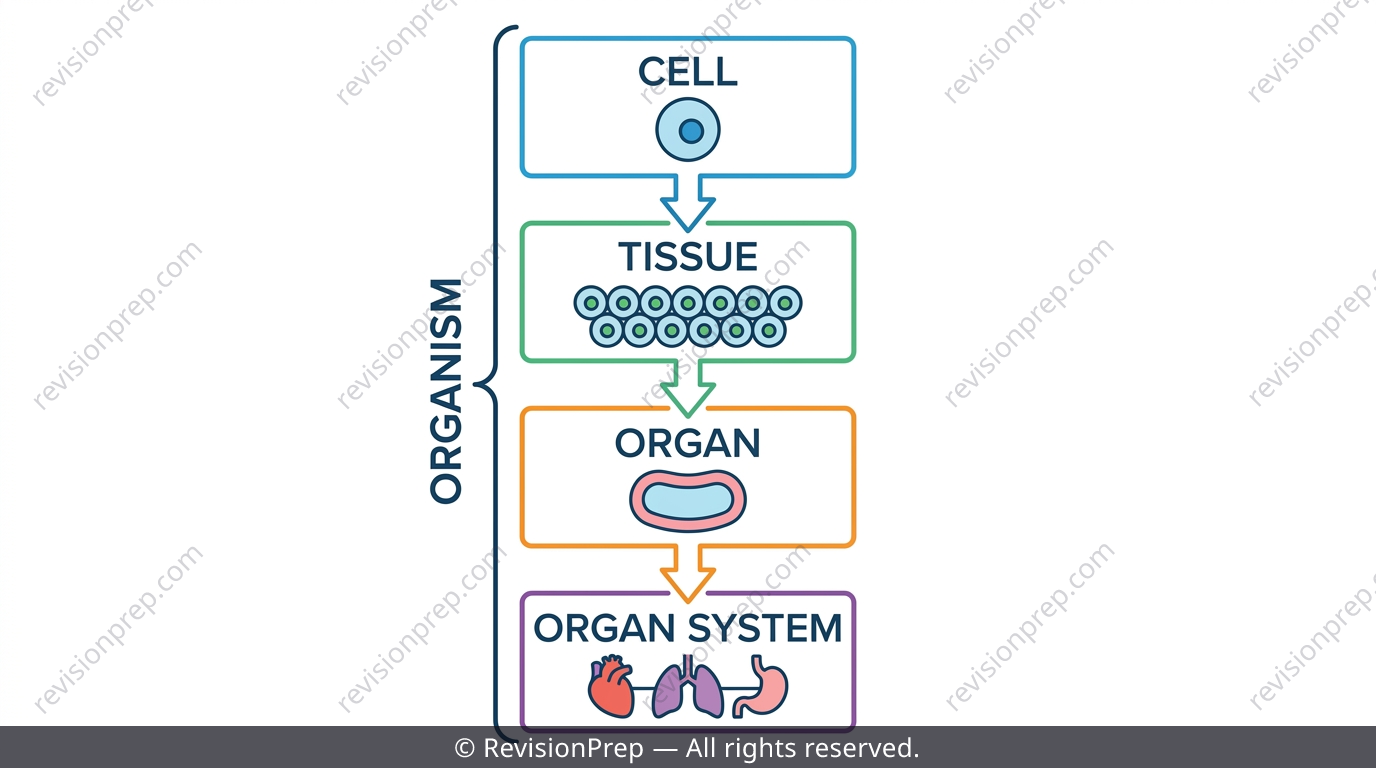
Living things are built in a fixed sequence: cell, tissue, organ, organ system, with the whole organism sitting on top as the finished product. A tissue is the SAME type of cell repeated for one job (like muscle tissue); an organ combines DIFFERENT tissues for one shared function (like the heart mixing muscle, connective and nerve tissue). The jump between levels always involves more than one unit of the level below combining together.
| Level | Made of | Example |
|---|---|---|
| Cell | The basic unit of life | A single muscle cell |
| Tissue | Same type of cell, one job | Muscle tissue |
| Organ | Different tissues, one shared function | The heart |
| Organ system | Different organs, one big task | Circulatory system |
Exam tip
For a 1-mark 'identify' question, a single word like 'Tissue' earns full marks — don't waste time writing a paragraph.
Common mistake
Adding 'organism' into the four-level list. Organism is the whole living thing built FROM these four levels — it isn't one of them.
Mini summary
Tissue = same cells, one job. Organ = different tissues, one shared function.
Specialized Cells and the Structure-Function Link
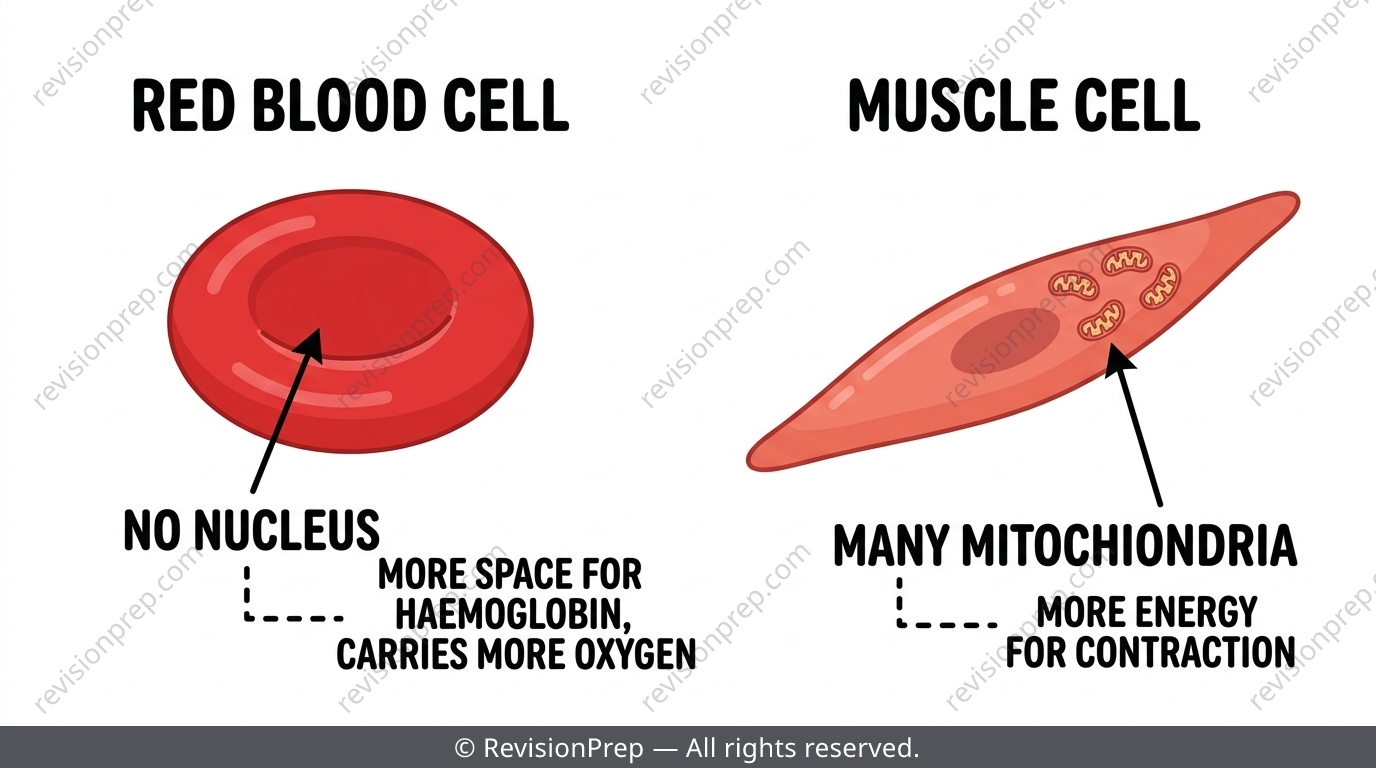
A specialized cell develops a specific structural feature so it can do one job extremely well, usually at the cost of doing other jobs. Unspecialised stem cells can still differentiate into many cell types, but once a cell differentiates, its structure is reshaped permanently around its one function. Every structure-function answer needs a named feature joined to a reason with 'so' or 'because' — the link itself is where the mark lives, not just naming the feature.
Exam tip
Use the exact wording from any data table given (e.g. 'biconcave disc', not 'round-ish') — vague paraphrasing can lose marks on strict mark schemes.
Common mistake
Repeating the function already given in the question (e.g. 'red blood cells carry oxygen') instead of explaining HOW the structure enables it.
Mini summary
Never describe a structure without linking it to its function — that link is the mark.
Plant vs Animal Cell Differences
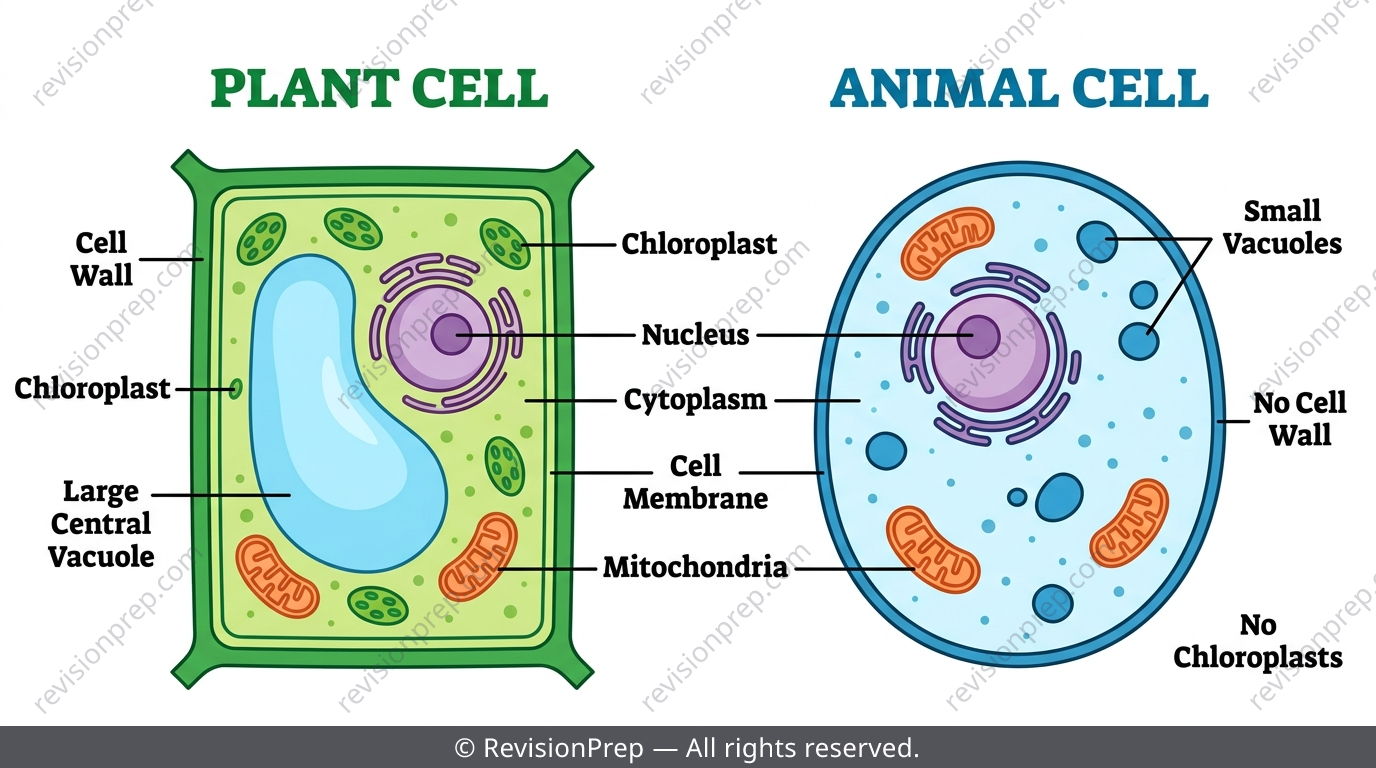
Plant and animal cells share the core organelles — nucleus, cytoplasm, cell membrane, mitochondria, ribosomes — because both do the same basic jobs of living. The exam differences are a short, fixed list: a rigid cellulose cell wall outside the membrane (plant only, gives shape and support), chloroplasts containing chlorophyll for photosynthesis (plant only), and a large permanent central vacuole in plant cells versus several small temporary vacuoles in animal cells. These features also explain shape: plant cells are regular and box-shaped because the wall constrains them, while animal cells are irregular and rounded.
| Feature | Plant cell | Animal cell |
|---|---|---|
| Cell wall | Present (cellulose) | Absent |
| Chloroplast | Present in green cells | Absent |
| Vacuole | One large, permanent | Several small, temporary |
| Shape | Regular, box-shaped | Irregular, rounded |
Common mistake
Inventing extra 'differences' that aren't on the fixed exam list — stick to wall, chloroplast, and vacuole.
Mini summary
Learn exactly three real differences: cell wall, chloroplast, and vacuole size/permanence.
Unicellular vs Multicellular Organisms
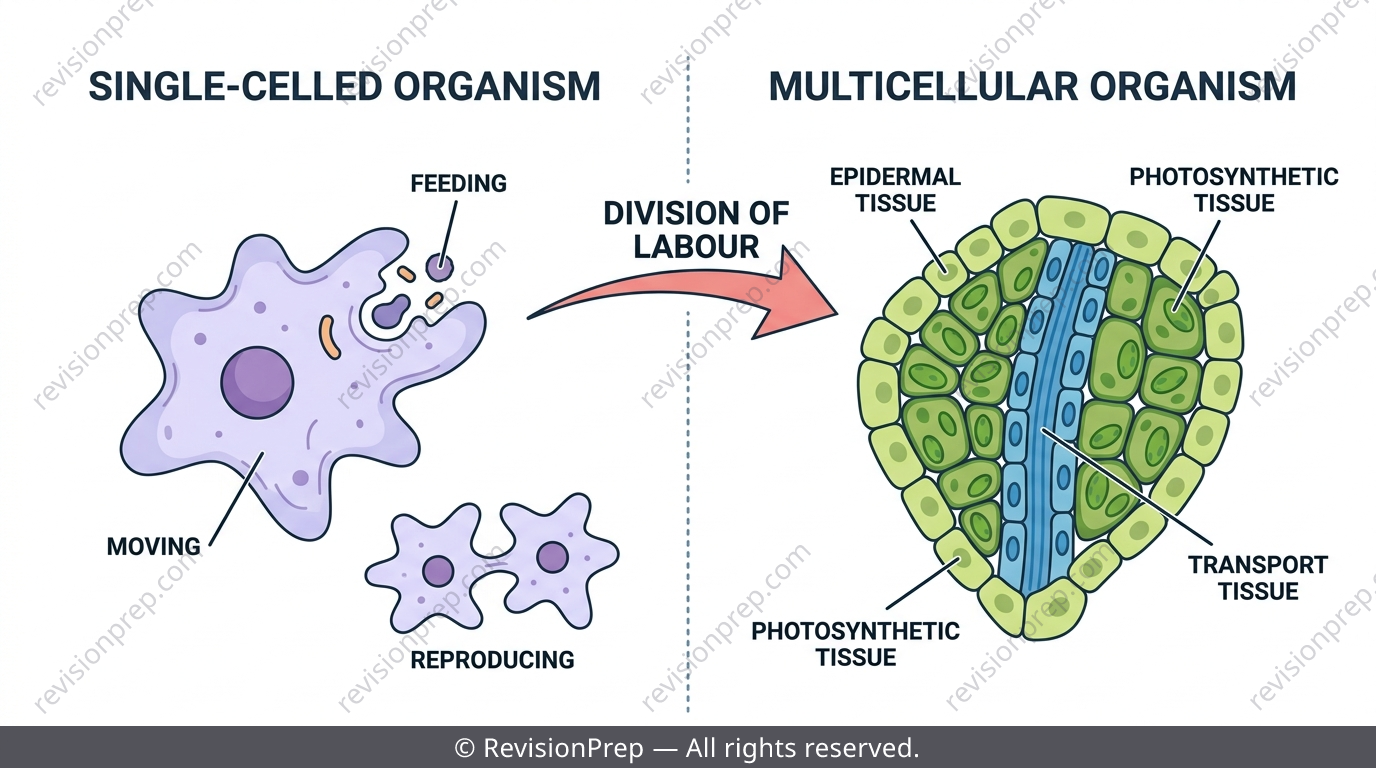
A unicellular organism does every job of life — feeding, moving, reproducing — inside just one cell. A multicellular organism trades that flexibility for division of labour: different cells specialize in different jobs, working together through the levels of organization. This trade-off between flexibility and efficiency is the angle examiners like to test when comparing simple and complex organisms.
Mini summary
One cell does everything vs many cells sharing the workload — that's the trade-off to explain.
Microscopes: The Measuring Tool Behind It All
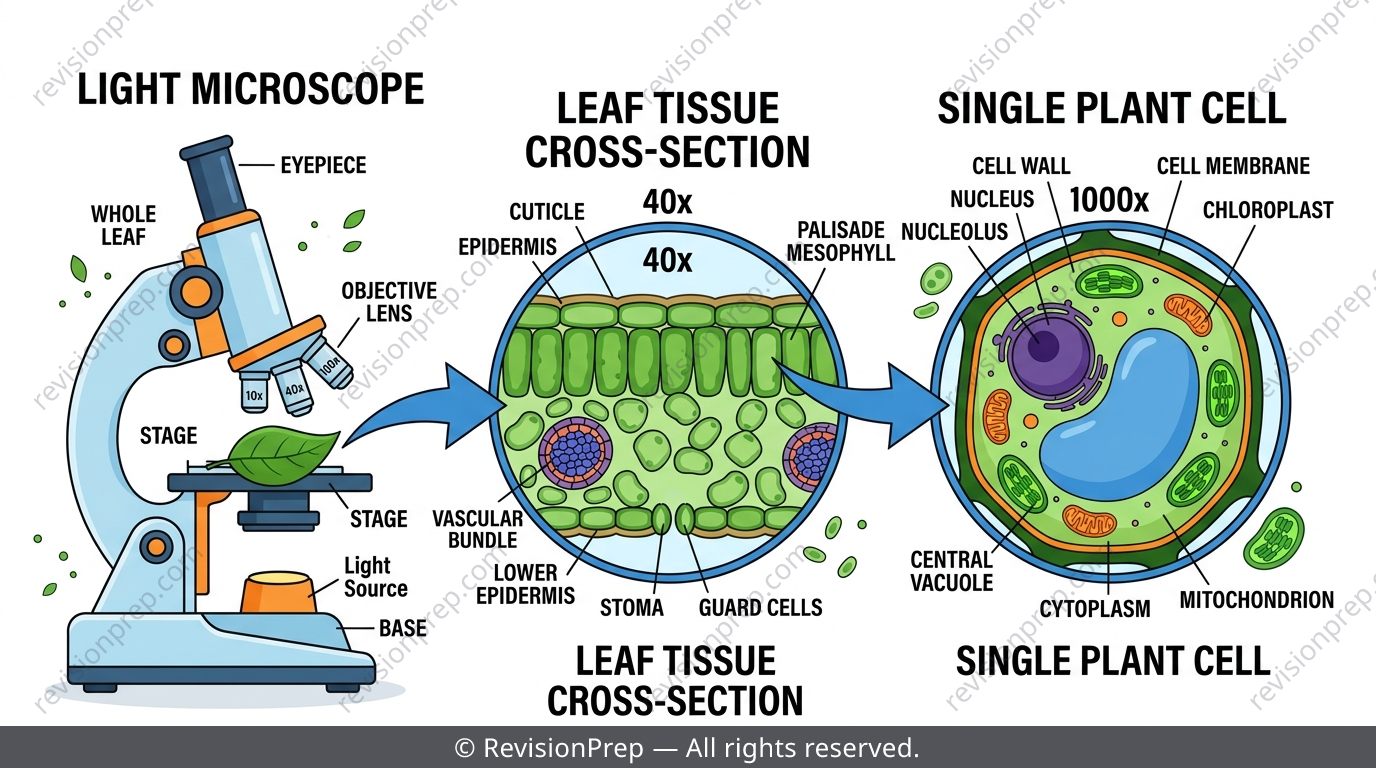
Microscopes are simply the tool used to see the levels and structures covered in this unit at the right scale. Magnification questions are essentially careful measurement and unit-conversion practice dressed up as biology, so read scale information on any diagram or micrograph carefully before answering.
Mini summary
Magnification questions test measurement skills, not new biology content.
Quick formula sheet
Practice questions
- Name the four levels of biological organization examined in this unit, in order.
- State one structural difference between a plant cell and an animal cell.
- Define the term 'differentiation'.
- Explain how the structure of a red blood cell relates to its function of carrying oxygen.
- A leaf contains a single palisade cell, a layer of palisade cells, and the whole leaf. Explain how this shows organization from cell to organ level.
- Describe one reason why a group of muscle cells working together is more effective than a single muscle cell alone.
- A jellyfish is more complex than a Hydra (which has cells and tissues) but less complex than an Earthworm (which has cells, tissues, and organs). Predict which levels of organization the jellyfish has, and justify your answer.
- Evaluate the use of a patient's own stem cells, rather than a donor's, to grow a replacement organ.
- Explain why multicellular organisms rely on specialized cells and division of labour instead of one cell doing every job, using the terms specialization and organization.
Frequently asked questions
What are the four levels of biological organization in IB MYP 3?+
Cell, tissue, organ, and organ system — with the whole organism built from all four but not counted as one of them.
What's the difference between a tissue and an organ?+
A tissue is made of the SAME type of cell working on one job; an organ combines DIFFERENT tissues working together for one shared overall function.
Why doesn't a red blood cell have a nucleus?+
It leaves more space in the cell for haemoglobin, which lets it carry more oxygen — the structure directly supports its function.
What are the real differences between plant and animal cells?+
Only three matter for exams: the cellulose cell wall, chloroplasts for photosynthesis, and the size/permanence of the vacuole. Both cell types share the same core organelles otherwise.
Why do multicellular organisms have specialized cells instead of one cell doing everything?+
Multicellular organisms trade the flexibility of a unicellular organism for division of labour — different specialized cells each do one job very efficiently.
Does RevisionPrep provide past exam papers for this topic?+
No — RevisionPrep provides original mock papers and exam-style practice questions, plus full revision notes, rather than official past papers.
Ready to master Cells and Living Systems for MYP 3?
Related articles