
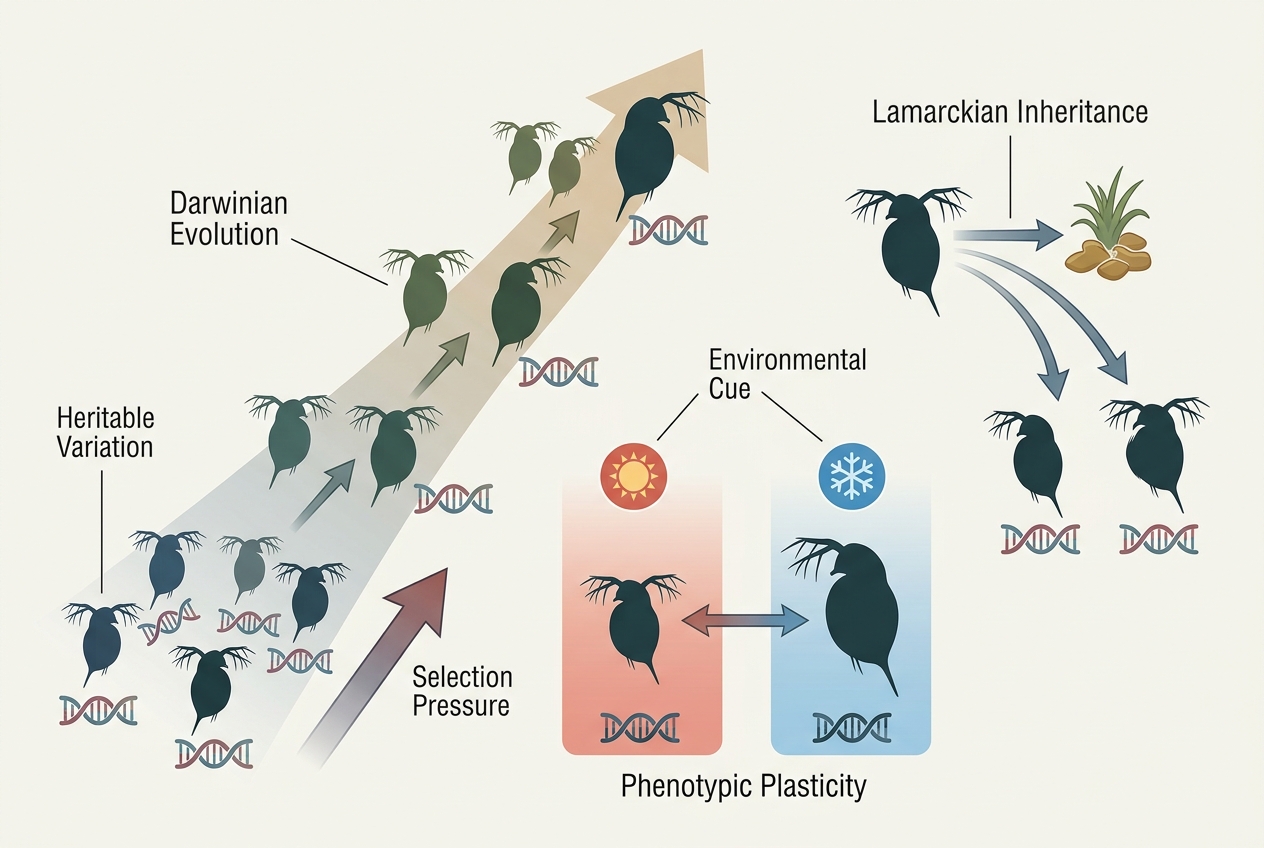
Biology: Evolutionary Adaptation: Daphnia Case Study
Evolutionary adaptation is often misunderstood as organisms simply “changing to fit” their environment—but in reality, it is a measurable, generation-by-generation shift in heritable traits driven by natural selection. In this case, a population of Daphnia pulex facing a gradual temperature drop from 20°C to 12°C over 50 generations shows an increase in average carapace length, from 2.4 mm to 3.1 mm. The core question is: how much of this change is genetic (evolutionary) versus environmental (plastic)? To separate these, researchers use the breeder’s equation, R = h² × S, where S is the selection differential (the difference between the original and selected population means) and h² is heritability—here, 0.65. This tells us that 65% of the size variation has a genetic basis, so the expected response to selection is only part of the observed shift. Crucially, offspring of generation 50 raised at 20°C revert toward 2.5 mm, proving that the large size acquired in the cold pond is not fully inherited—contradicting Lamarck’s idea of acquired traits being passed on. Meanwhile, the same genotype produces different sizes at different temperatures (3.0 mm at 12°C vs. 2.5 mm at 20°C), demonstrating phenotypic plasticity. Yet because the pond population exceeds even the cold-reared lab offspring, a heritable genetic component remains—showing that both plasticity and natural selection act together
Start practising IB questions today
150,000+ IB-styled questions, criteria-mapped and instantly accessible.