
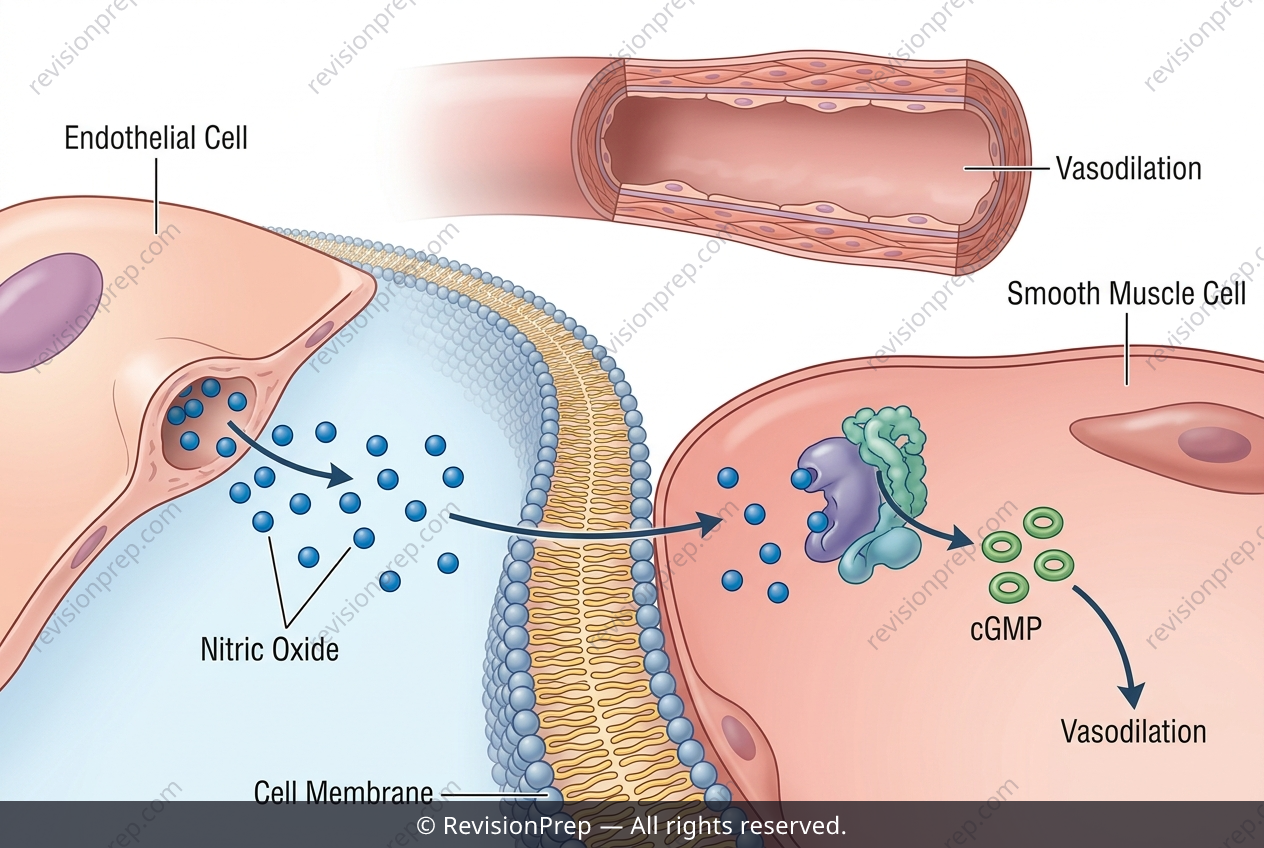
Biology: Fick’s Law Meets a 5-Second Signal
Paracrine signaling is how cells talk to their immediate neighbors—no bloodstream required. In the cardiovascular system, nitric oxide (NO) diffuses from endothelial cells lining a blood vessel directly into adjacent smooth muscle cells, triggering a cascade that relaxes the muscle and dilates the vessel. This local, short-range communication is fundamental to regulating blood flow and pressure, and it stands in stark contrast to endocrine signaling, which relies on hormones traveling through the blood to distant targets. The movement of NO across the cell membrane is a physical process governed by Fick’s law, J = -D(ΔC/Δx), where flux depends on the diffusion constant (D), the concentration gradient (ΔC), and membrane thickness (Δx). Once inside the smooth muscle cell, NO activates guanylyl cyclase to produce cGMP, the second messenger that drives relaxation. However, this elegant model has a biological catch: NO degrades rapidly (half-life ~5 s), so the concentration gradient—and thus the flux—is not constant over time. The steady-state assumption of Fick’s law holds only as an instantaneous snapshot, not for sustained signaling, making the relationship between diffusion physics and cellular biochemistry both powerful and time-sensitive.
Start practising IB questions today
150,000+ IB-styled questions, criteria-mapped and instantly accessible.