
Biology: FRAP Reveals the Membrane's Fences
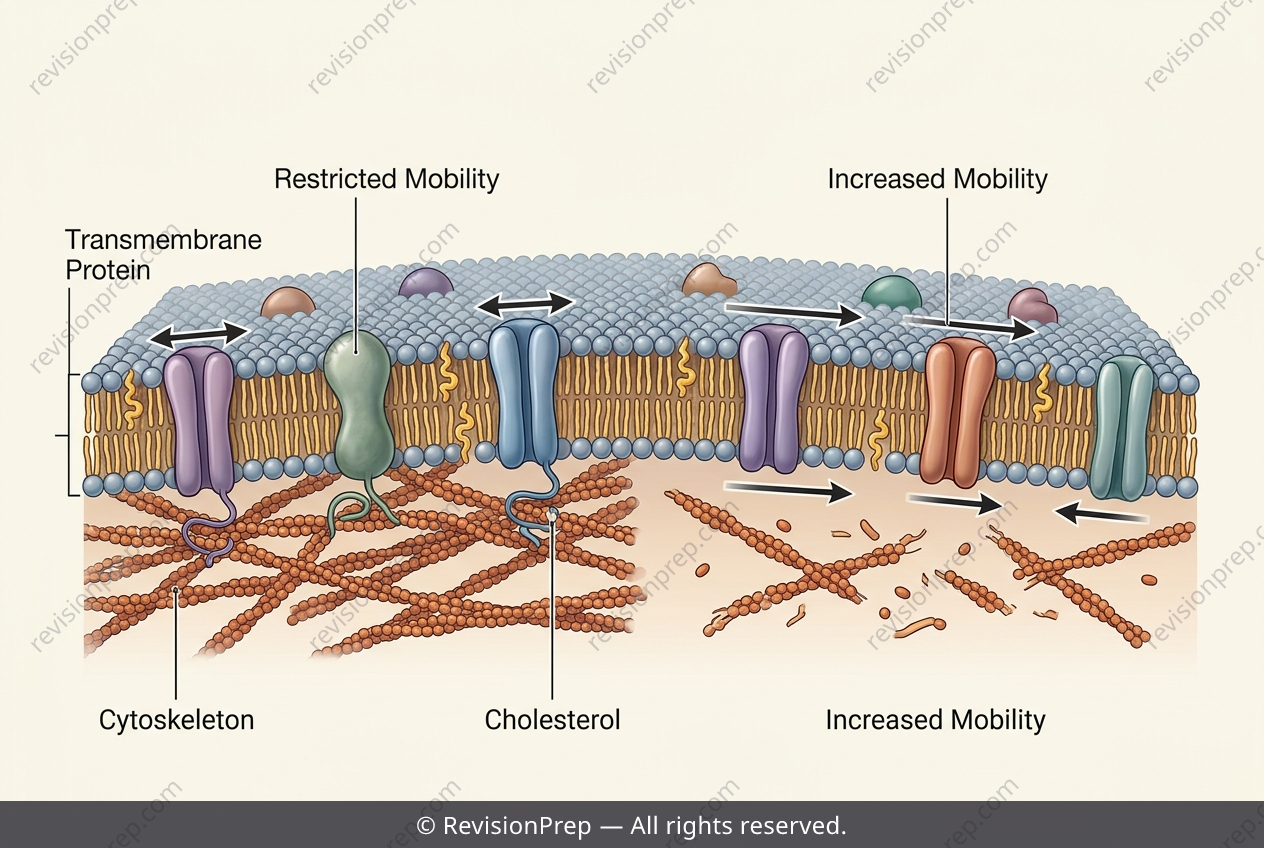
The fluid mosaic model describes the cell membrane not as a rigid barrier, but as a dynamic, two-dimensional fluid where lipids and proteins drift laterally. This movement is not random; it is governed by the membrane’s viscosity and, crucially, by interactions with the underlying cytoskeleton. Understanding this dynamic behaviour is essential for grasping how cells compartmentalise functions, regulate signalling, and maintain structural integrity. At the heart of this topic is the relationship between molecular motion and membrane architecture. Using fluorescence recovery after photobleaching (FRAP), researchers measure the lateral diffusion coefficient, D, via D = 0.224 × r² / t₁/₂, where r is the bleached spot radius and t₁/₂ the half-time of recovery. This technique reveals that the cytoskeleton acts as a fence or anchor, confining proteins within corrals. When the cytoskeleton is disrupted, D increases dramatically, showing that the membrane’s fluidity is balanced by protein–cytoskeleton tethering. However, the model’s simplicity—a uniform fluid—underestimates real complexity, as cholesterol-rich lipid rafts and cytoskeletal microdomains create heterogeneous protein mobility across the membrane.
Start practising IB questions today
150,000+ IB-styled questions, criteria-mapped and instantly accessible.