
Biology: Glomerular Filtration & Selective Permeability for IB Biology
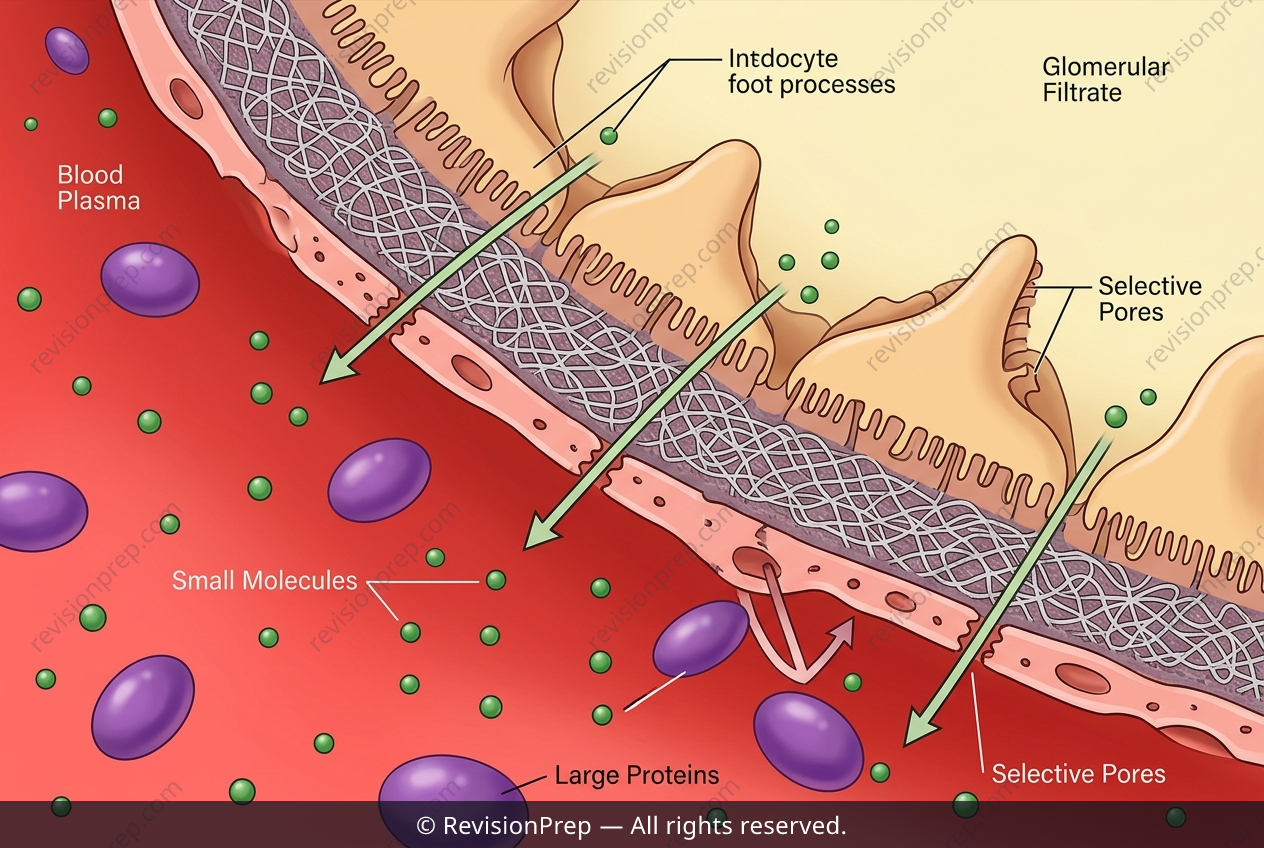
The kidney’s nephron is where blood first meets the demands of homeostasis—not by sorting chemicals by type, but by size. At the glomerulus, a knot of capillaries under high blood pressure, fluid and small dissolved substances like water, glucose, urea, and salts are forced through tiny pores into Bowman’s capsule, forming the filtrate. This process, glomerular filtration, is the kidney’s opening move: it creates a raw, unfiltered version of blood plasma, stripped of cells and large molecules, which the rest of the nephron will then refine. The critical rule here is selective permeability—the capillary walls act as a physical sieve. Only molecules smaller than the pore diameter pass through; anything larger is blocked and stays in circulation. This explains why proteins, despite being dissolved in blood, never appear in urine: solubility is irrelevant to filtration, size is everything. Understanding this single mechanism clarifies why the kidney can retain vital macromolecules while eliminating metabolic waste, and why disruptions to pore size—or blood pressure—can tip the entire body’s fluid and solute balance out of equilibrium.
Start practising IB questions today
150,000+ IB-styled questions, criteria-mapped and instantly accessible.