
Biology: Homeostasis: Unicellular vs Multicellular in Extreme Environments
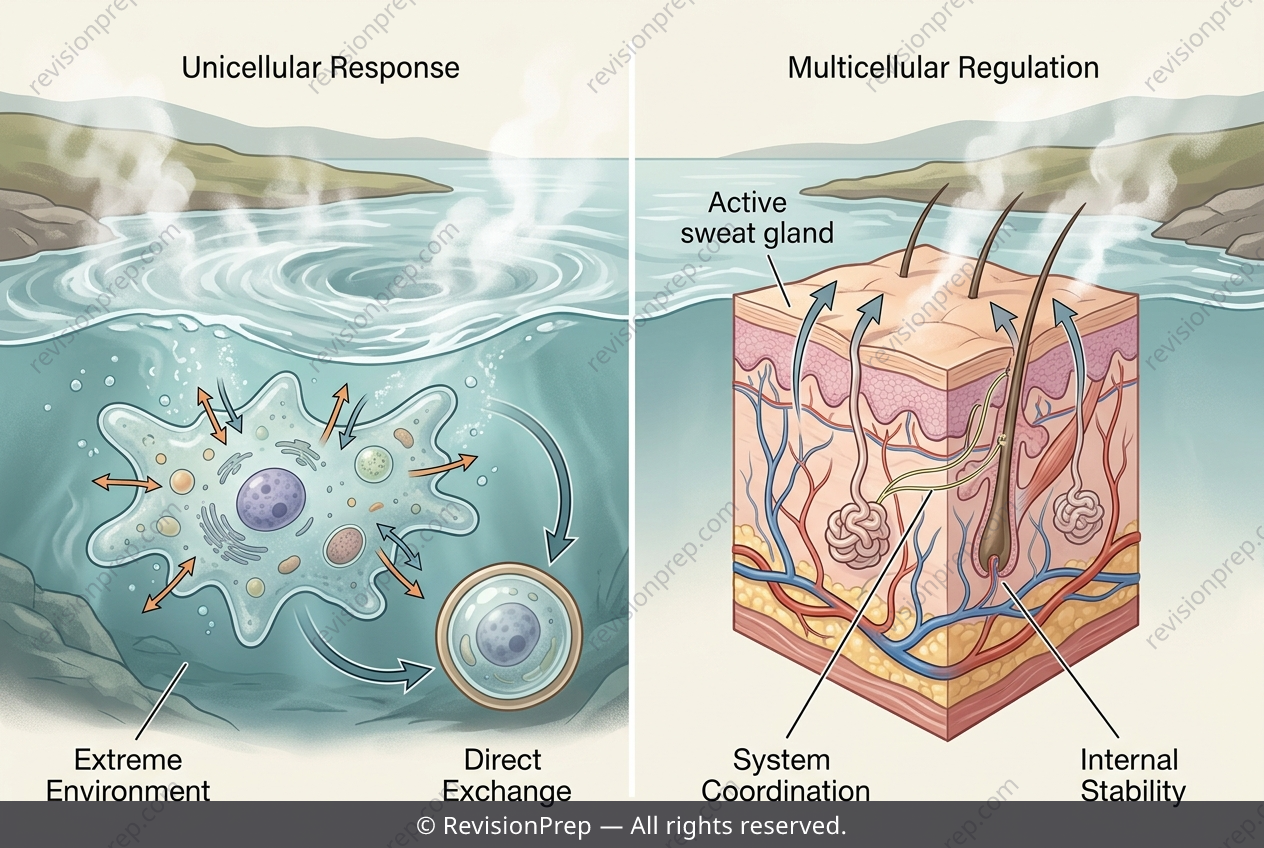
Life on Earth is a study in scale, and the difference between a single cell and a trillion working in concert defines how an organism survives. At its core, this topic contrasts the unicellular organism—where one cell is the entire body—with the multicellular organism, built from countless specialised cells that depend on each other for survival. The key to understanding this difference lies in homeostasis: the ability to maintain a stable internal environment despite external chaos. In an extreme environment like a hot spring, the contrast becomes stark. A unicellular organism like an amoeba must perform every life function—nutrient uptake, waste removal, and response to stimuli—within that single cell. This means the entire organism can rapidly adjust its internal chemistry to tolerate the heat. A multicellular organism like a human, however, has cells with narrow tolerance ranges; a muscle cell or nerve cell cannot simply adapt on its own. Because these specialised cells are interdependent, the failure of one type—such as proteins denaturing under heat—cascades into harm for the whole body. The relationship is clear: the more integrated the system, the more vulnerable it becomes to extremes that a single, flexible cell can simply absorb.
Start practising IB questions today
150,000+ IB-styled questions, criteria-mapped and instantly accessible.