
Biology: Interdependence: When Circulation Fails to Deliver Glucose
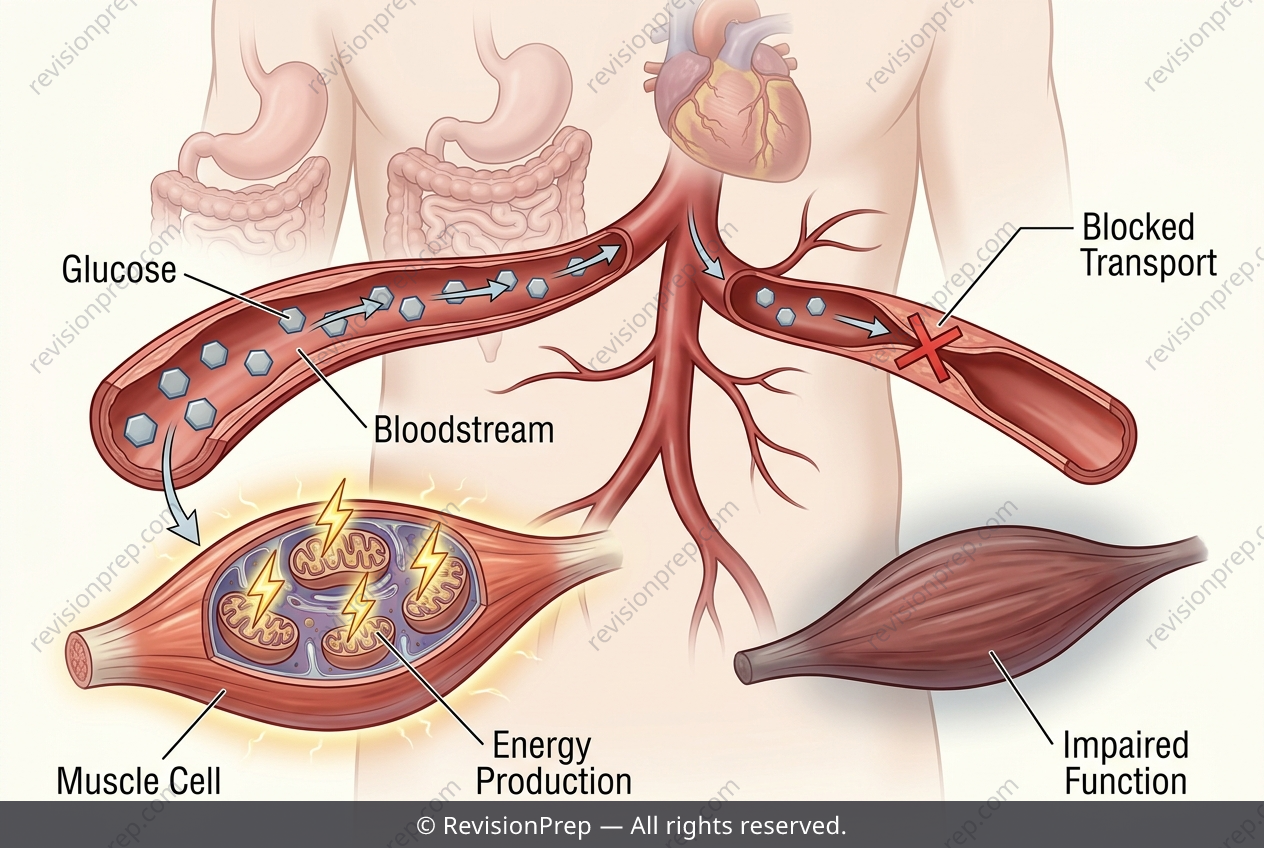
Every bite of food you eat sets off a remarkable chain of events, one that ultimately powers every move you make. The digestive system breaks down complex meals into simple molecules, most notably glucose, which serves as the primary fuel for cellular respiration. This process transforms glucose into usable energy (ATP) via the formula C₆H₁₂O₆ + 6O₂ → 6CO₂ + 6H₂O + energy, but that transformation only happens inside your cells. The critical link in this chain is the circulatory system, which acts as the delivery network carrying glucose from the gut to tissues like skeletal muscle. When this transport fails, the muscles are starved of their energy source. Without glucose arriving at the cells, the mitochondria cannot run aerobic respiration, leaving muscles without ATP. The immediate consequence is a loss of contractile power—muscles become weak, fatigue quickly, and struggle to sustain movement. This interdependence highlights how digestion, circulation, and cellular respiration are not isolated events but a tightly coordinated system where a single broken link compromises the entire body’s ability to function.
Start practising IB questions today
150,000+ IB-styled questions, criteria-mapped and instantly accessible.