
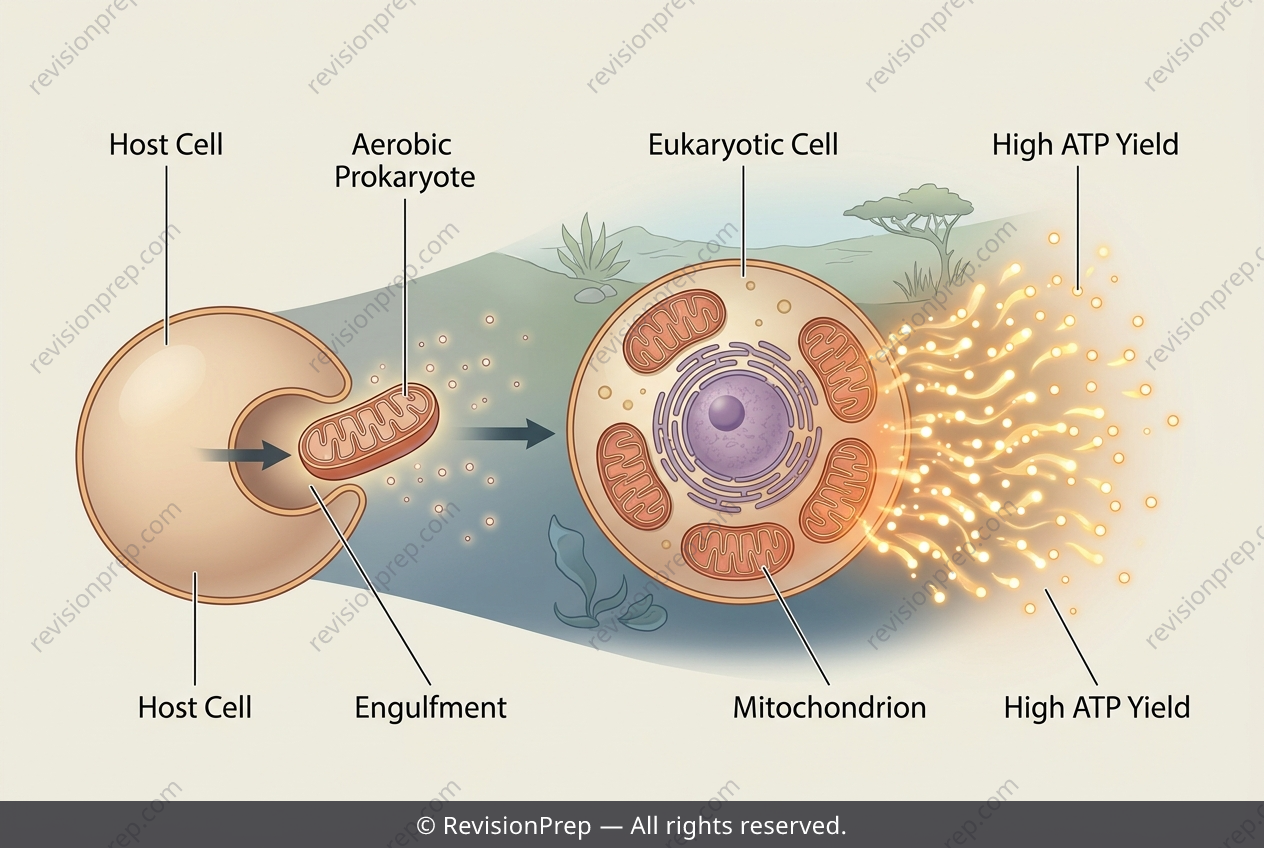
Biology: Mitochondrial Endosymbiosis and ATP Evolution
The endosymbiotic theory reshapes how we view the origin of eukaryotic life: mitochondria were once free-living aerobic prokaryotes, engulfed by a host cell roughly 1.5 billion years ago. This single partnership transformed the energy landscape of biology, shifting ATP production from a meagre 2 molecules per glucose in anaerobic prokaryotes to 36 in aerobic eukaryotes. That 34-ATP difference is not just arithmetic—it represents a metabolic revolution, a surplus of chemical energy that fuelled the evolution of larger cells, complex organelles, and ultimately multicellular organisms. This concept matters because energy dictates biological possibility. Without mitochondria, early eukaryotes would have remained tiny, slow, and simple, constrained by inefficient fermentation. The endosymbiotic event created a sustained energy surplus, which in turn powered cellular differentiation, movement, and the diversification of all complex life. By connecting the molecular mechanism (aerobic respiration) to its evolutionary consequence (energetic headroom), you see how a single engulfment event catalysed the entire trajectory of eukaryotic complexity—from single-celled ancestors to animals, plants, and fungi.
Start practising IB questions today
150,000+ IB-styled questions, criteria-mapped and instantly accessible.