
Biology: Reflex Arcs: Involuntary Control in IB Biology
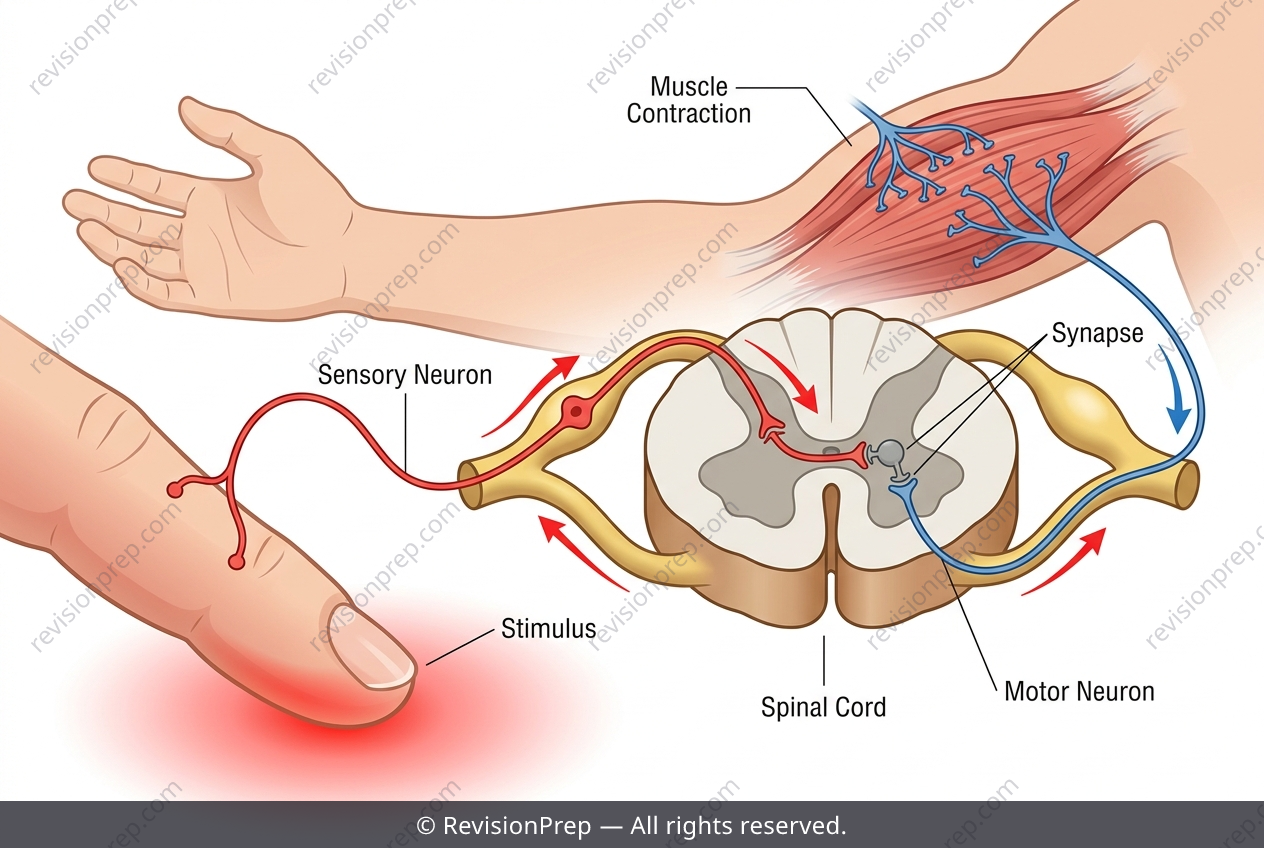
A reflex arc is the body’s fastest, most automatic response to a dangerous stimulus—a hardwired shortcut that bypasses conscious thought to protect you from harm. When your hand touches a hot surface, the sequence begins with sensory receptors in the skin detecting the heat or pain stimulus. These receptors trigger sensory neurons, which carry the signal to the spinal cord—not the brain. There, interneurons process the information and immediately relay it to motor neurons, which send a command to the arm muscles. The muscles contract, pulling your hand away before you even feel the burn. This involuntary control is possible because the signal is processed entirely within the spinal cord, skipping the brain’s slower deliberative pathways. By rerouting the response locally, the reflex arc cuts reaction time dramatically, ensuring a protective withdrawal occurs before conscious awareness catches up. The entire chain—stimulus → receptor → sensory neuron → spinal cord → interneuron → motor neuron → muscle contraction—works as a coordinated loop, demonstrating how the nervous and muscular systems interdepend to maintain homeostasis and prevent tissue damage. Understanding this mechanism reveals why reflexes are both faster and more reliable than voluntary actions in emergencies.
Start practising IB questions today
150,000+ IB-styled questions, criteria-mapped and instantly accessible.