
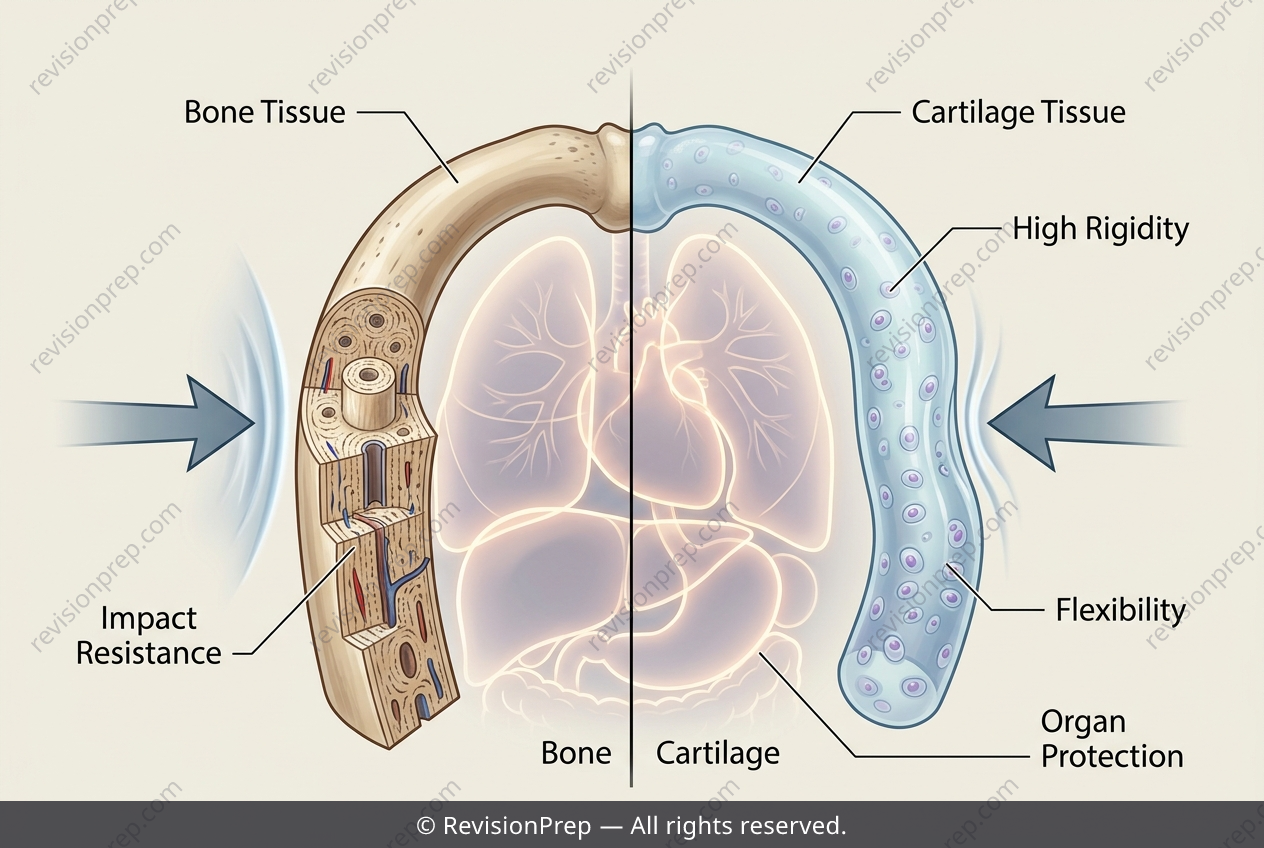
Biology: Ribcage Biomechanics: Bone vs Cartilage in Protection
The human ribcage is far more than a passive cage—it is a dynamic structure where biology meets engineering. At its core, this system demonstrates the biomechanical principle that form dictates function: the curved, overlapping bones of the ribs are not arbitrary shapes but precise adaptations that balance flexibility with rigidity. While the ribcage’s primary role is to shield the heart and lungs from external impact, it also participates actively in ventilation, rising and falling to change thoracic volume and drive airflow. This dual function—protection and motion—highlights why skeletal tissues are not uniform; different materials serve different mechanical demands. Bone, unlike cartilage, is a composite material rich in calcium salts, making it harder, stronger, and more resistant to bending under sudden force. Cartilage, though flexible and useful in joints, would deform too easily under a blunt blow, transmitting that energy to the delicate organs behind it. The ribcage’s design thus connects material strength to functional protection: the rigidity of bone absorbs and deflects impacts, while its slight curvature allows for the elastic recoil needed during breathing. Understanding this relationship—between tissue properties, structural shape, and physiological outcome—explains why evolution chose bone for this critical shield.
Start practising IB questions today
150,000+ IB-styled questions, criteria-mapped and instantly accessible.