
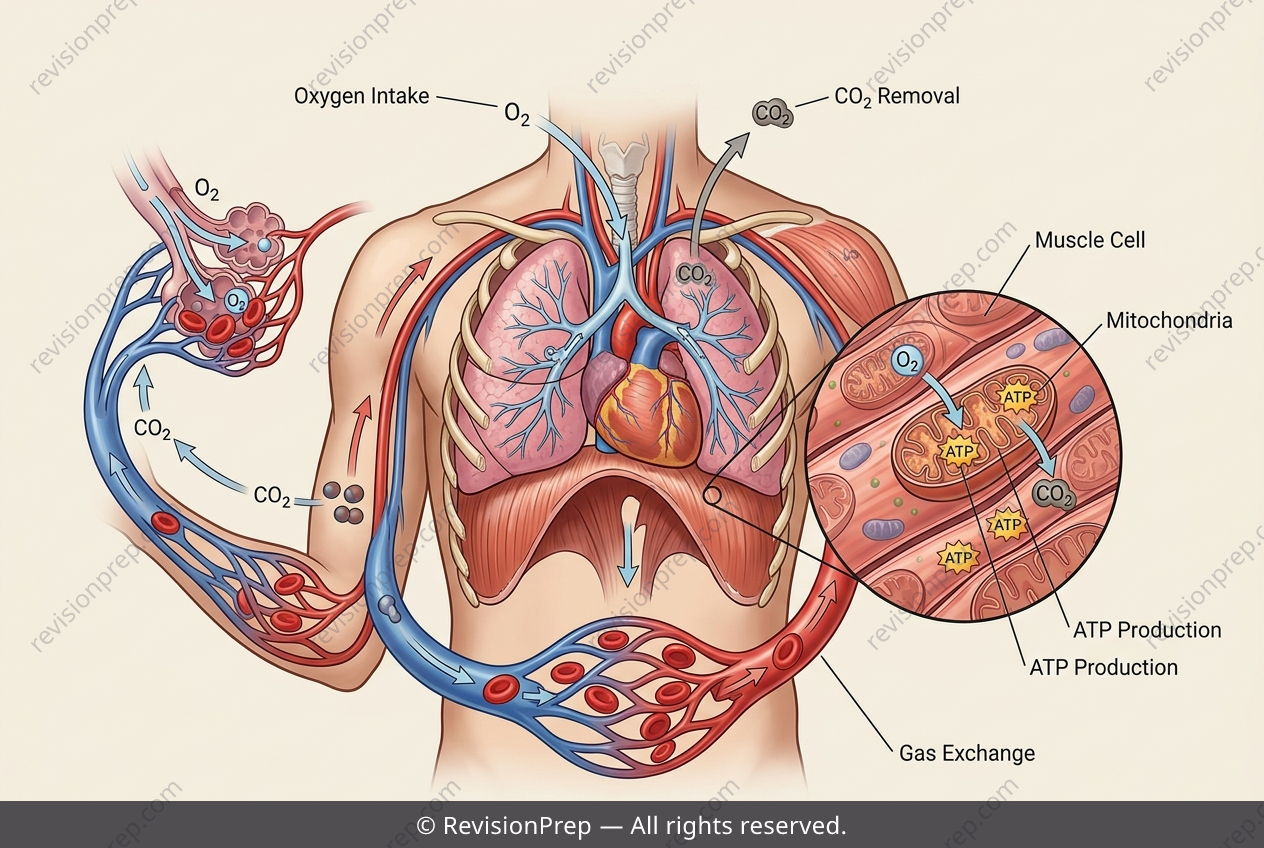
Biology: Why Breathing Rate Rises During Exercise: Gas Exchange and Cellular Respiration
When you sprint after a bus or dash up a flight of stairs, your breathing rate climbs almost instantly. This isn’t just a reflex—it’s a precise physiological response to a sudden surge in energy demand. At the heart of this lies cellular respiration, the process by which your muscle cells convert glucose and oxygen into usable energy (ATP), releasing carbon dioxide as a waste product. The equation C₆H₁₂O₆ + 6O₂ → 6CO₂ + 6H₂O + ATP captures the core exchange: as running intensifies, muscles require more oxygen to sustain ATP production, and they generate more CO₂ that must be expelled. The respiratory and circulatory systems work as a coupled delivery-and-removal network. Faster breathing increases the rate of gas exchange in the alveoli, raising blood oxygen levels while simultaneously flushing out excess CO₂. This maintains a stable internal environment—preventing blood pH from dropping—so that cellular respiration can continue efficiently. Without this rapid adjustment, energy production would stall, and muscle fatigue would set in almost immediately. Understanding this dynamic explains not just why you pant, but how every breath fuels your movement.
Start practising IB questions today
150,000+ IB-styled questions, criteria-mapped and instantly accessible.