
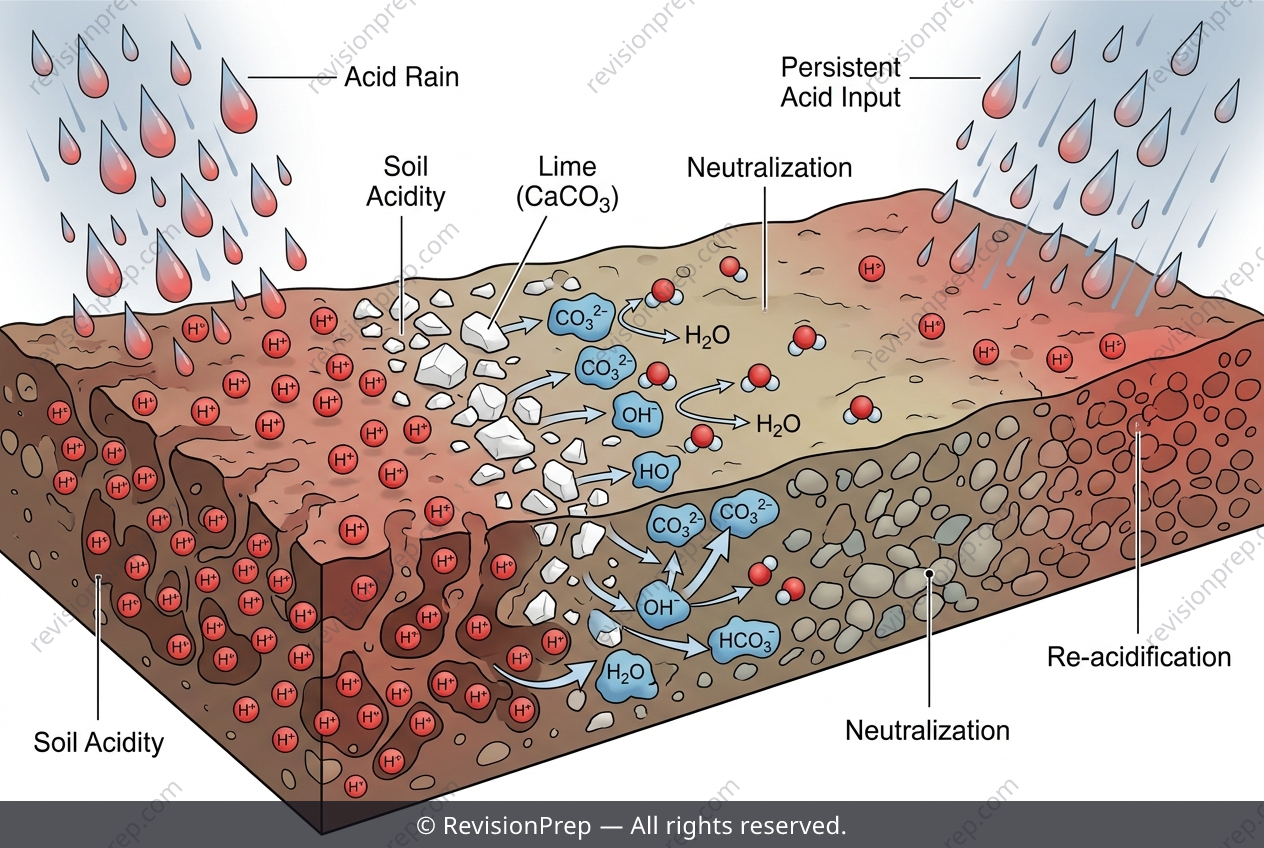
Chemistry: Acid-Base Equilibrium: Lime and Soil pH Remediation
Acid rain and air pollution are far more than atmospheric issues—they are chemical disturbances that ripple through ecosystems, and nowhere is this more tangible than in the soil beneath our feet. At the heart of this topic lies environmental acid-base equilibrium: the delicate balance of hydrogen ions (H⁺) that governs soil health, nutrient availability, and agricultural productivity. When acidic pollutants like sulfur dioxide and nitrogen oxides dissolve in rainwater, they lower soil pH, shifting this equilibrium toward acidity and triggering a cascade of consequences for plants and microorganisms. The pH scale itself is the key to understanding the severity of this shift. Because pH is logarithmic, each whole-number drop represents a tenfold increase in H⁺ concentration—so a difference of just two pH units means a hundredfold change in acidity, not a simple doubling. This exponential relationship explains why seemingly small pH differences demand large corrective measures. Lime (CaCO₃) is the classic remediation tool, neutralizing acidity by consuming H⁺ ions and raising pH. However, its effectiveness is not permanent: ongoing acid deposition and natural soil processes continuously regenerate acidity, while over-application can overshoot into alkaline conditions, locking up essential nutrients like iron and causing deficiencies. Thus, managing soil acidity is a dynamic balancing act—one that requires understanding both the logarithmic nature of pH and the relentless, cyclical forces that drive acidification.
Start practising IB questions today
150,000+ IB-styled questions, criteria-mapped and instantly accessible.