
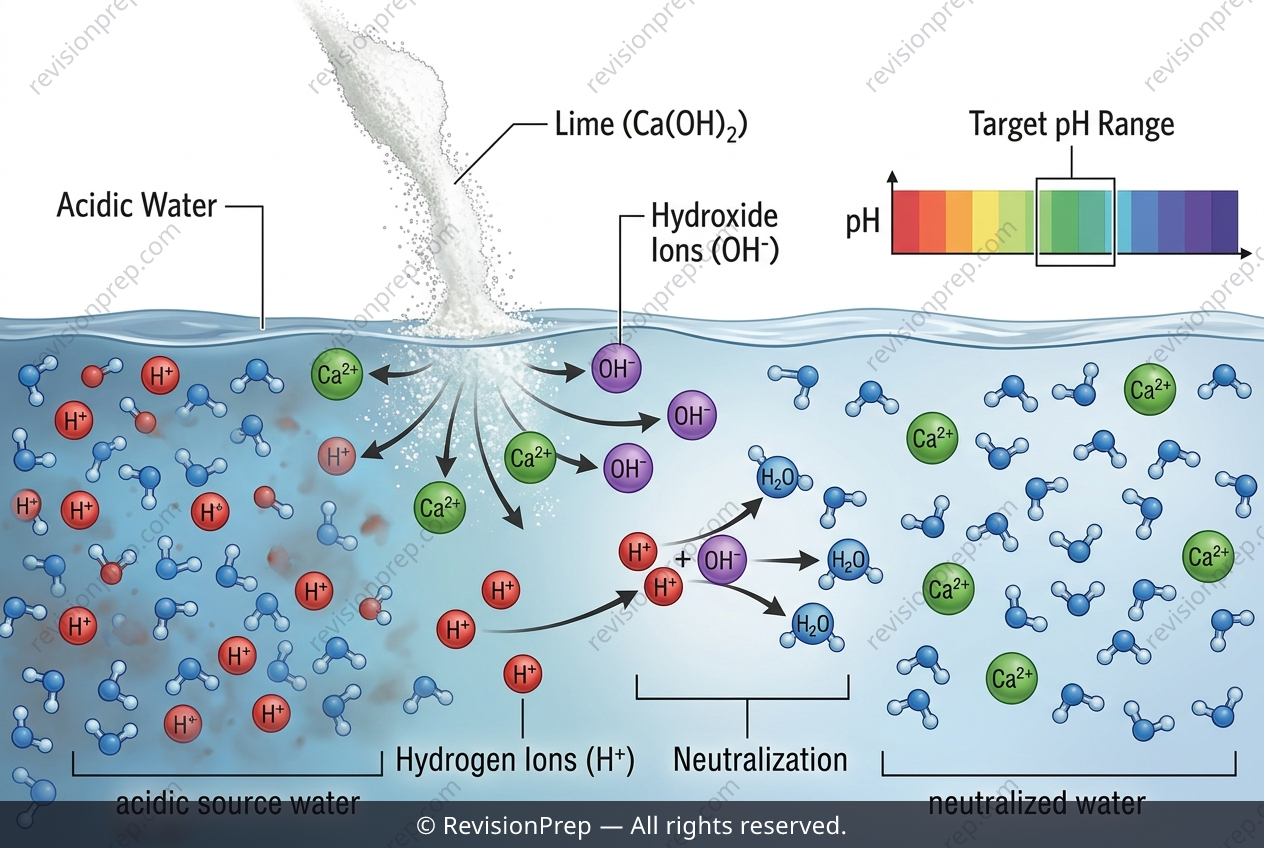
Chemistry: Acid-Base Neutralization for Safe Drinking Water
When acidic source water flows into a treatment plant, it carries more than just a low pH—it brings the risk of corroding metal pipes and dissolving harmful ions like lead and copper into the drinking supply. The core concept here is acid-base neutralization, applied through pH control. Lime (Ca(OH)₂), a base, dissolves to release hydroxide ions (OH⁻), which react with excess hydrogen ions (H⁺) in the water. This neutralization reaction shifts the equilibrium, raising the pH from acidic levels into the safe range of 6.5–8.5, where water is no longer aggressive toward distribution infrastructure. The relationship between dose and outcome is delicate. While lime effectively neutralizes acidity, its action is not self-limiting—over-addition pushes pH above 8.5, triggering calcium carbonate (CaCO₃) precipitation. This scale coats pipes, reduces flow, and imparts a bitter taste, trading one safety problem for another. Understanding this balance—where the base’s OH⁻ supply meets the acid’s H⁺ demand—is central to water chemistry, because the goal is not just to make water less acidic, but to keep it stable, non-corrosive, and palatable for residential use.
Start practising IB questions today
150,000+ IB-styled questions, criteria-mapped and instantly accessible.