
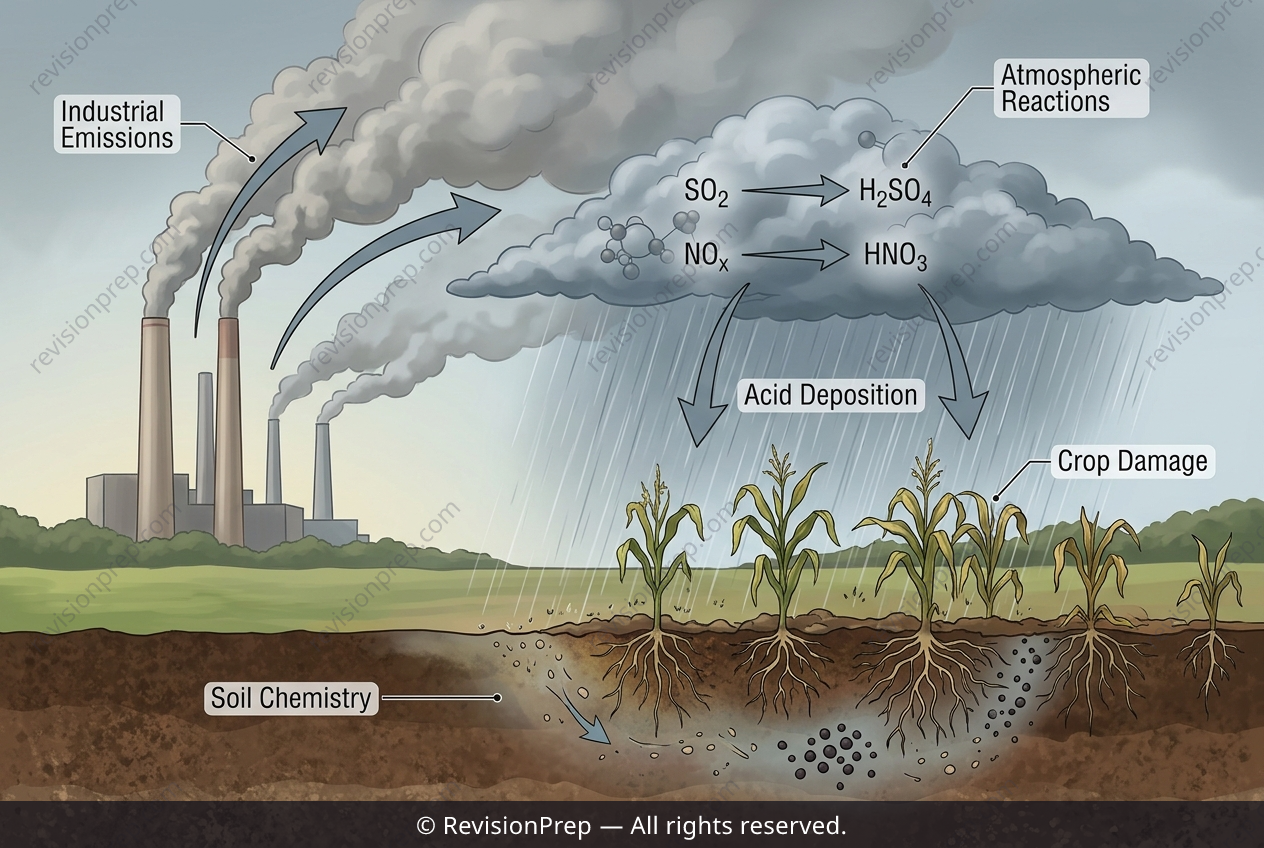
Chemistry: Acid Rain pH Calculations and Soil Impacts
Acid rain is one of the most tangible ways atmospheric chemistry reaches the ground, and for IB Chemistry students, it’s a perfect case study of how pollutants like sulfur dioxide (SO₂) and nitrogen oxides (NOₓ) transform into weak acids in cloud water. The core idea is simple: when these gases dissolve in rainwater, they form sulfuric and nitric acids, lowering the pH far below the natural baseline of about 5.6. Because the pH scale is logarithmic, each whole-number drop represents a tenfold jump in acidity—so even small numerical changes hide dramatic shifts in chemical behaviour. This matters because acid rain doesn’t just wet the soil; it actively rewrites soil chemistry. The excess hydrogen ions displace essential cations like calcium, magnesium, and potassium from soil particles, leaching them away and starving crops of nutrients. Simultaneously, the acidic conditions mobilise toxic aluminium and manganese, which attack root membranes and stunt growth. Crucially, the actual damage depends on more than pH alone—soil buffering capacity, rainfall frequency, and the specific pollutant mix all modulate the outcome. Understanding these interconnected mechanisms—from emission to ion exchange to biological impact—turns a simple pH reading into a story about ecosystem vulnerability.
Start practising IB questions today
150,000+ IB-styled questions, criteria-mapped and instantly accessible.