
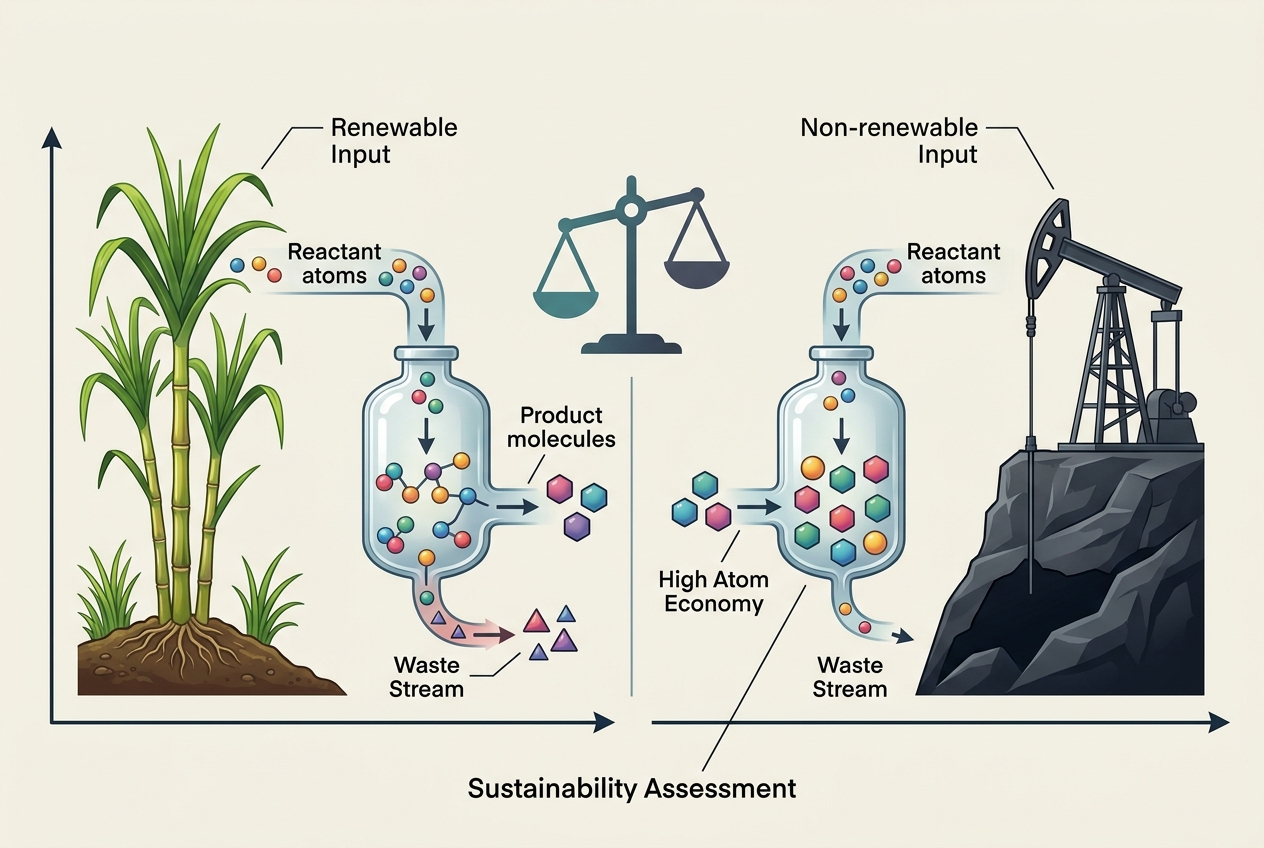
Chemistry: Atom Economy: Comparing Ethanol Production Routes
Atom economy is a measure of how efficiently a chemical reaction uses the atoms in its reactants, calculated as the molar mass of the desired product(s) divided by the total molar mass of all reactants, multiplied by 100%. Unlike percentage yield, which tells you how much product you actually obtained, atom economy tells you how much waste is designed into the reaction itself—before any practical losses occur. This makes it a central tool for evaluating the sustainability of industrial processes, where minimising byproducts reduces both material costs and environmental burden. The concept becomes clearer when comparing two routes to the same chemical. In fermentation, glucose is broken down into ethanol and carbon dioxide, meaning a significant fraction of the reactant atoms end up in a byproduct rather than the target molecule. In direct hydration, ethene and water combine to form ethanol as the sole product, so every atom from the reactants appears in the desired substance. However, atom economy alone does not settle the sustainability debate: a 100% atom-economical process may still depend on a non-renewable feedstock, while a lower-atom-economy process might use renewable biomass and integrate more favourably with the carbon cycle. Thus, atom economy is one piece of a larger puzzle that also includes feedstock renewability, energy inputs, and waste management.
Start practising IB questions today
150,000+ IB-styled questions, criteria-mapped and instantly accessible.