
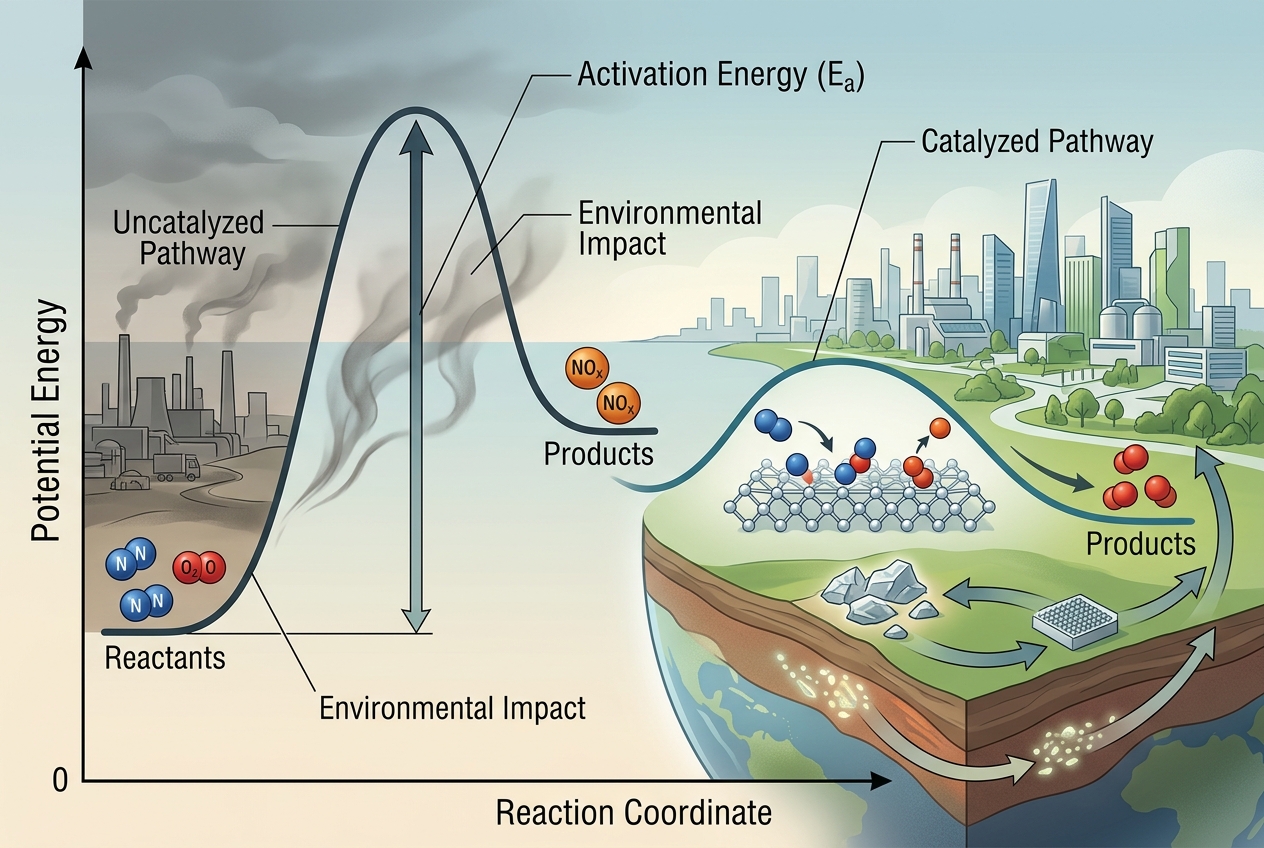
Chemistry: Catalysis vs. Pollution: Collision Theory & Sustainability Trade-offs
In chemical kinetics, the rate of a reaction depends on how often particles collide with sufficient energy to overcome the activation energy barrier (Eₐ). Collision theory tells us that only collisions where the combined kinetic energy meets or exceeds Eₐ lead to a successful reaction. This concept is crucial when evaluating real-world trade-offs, such as replacing a high-temperature industrial process—which generates NOₓ pollutants through thermal fixation of N₂ and O₂—with a catalytic alternative using rare-earth elements. The catalyst works by lowering Eₐ, allowing the reaction to proceed effectively at a significantly lower temperature. At this lower temperature, the Maxwell–Boltzmann distribution of molecular energies shifts to lower values; however, because Eₐ is reduced, a larger fraction of molecules now possess energy ≥ Eₐ than would be the case for the original higher barrier. This maintains the rate of successful collisions while reducing fossil fuel combustion and avoiding the threshold temperature for NOₓ formation. Yet, the sustainability trade-off is clear: mining rare-earth elements causes land degradation and toxic waste, and improper disposal of spent catalysts may leach harmful metals—linking chemical mechanisms directly to environmental impact.
Start practising IB questions today
150,000+ IB-styled questions, criteria-mapped and instantly accessible.