
Chemistry: Colloidal Destabilization: How Flocculation Purifies Water
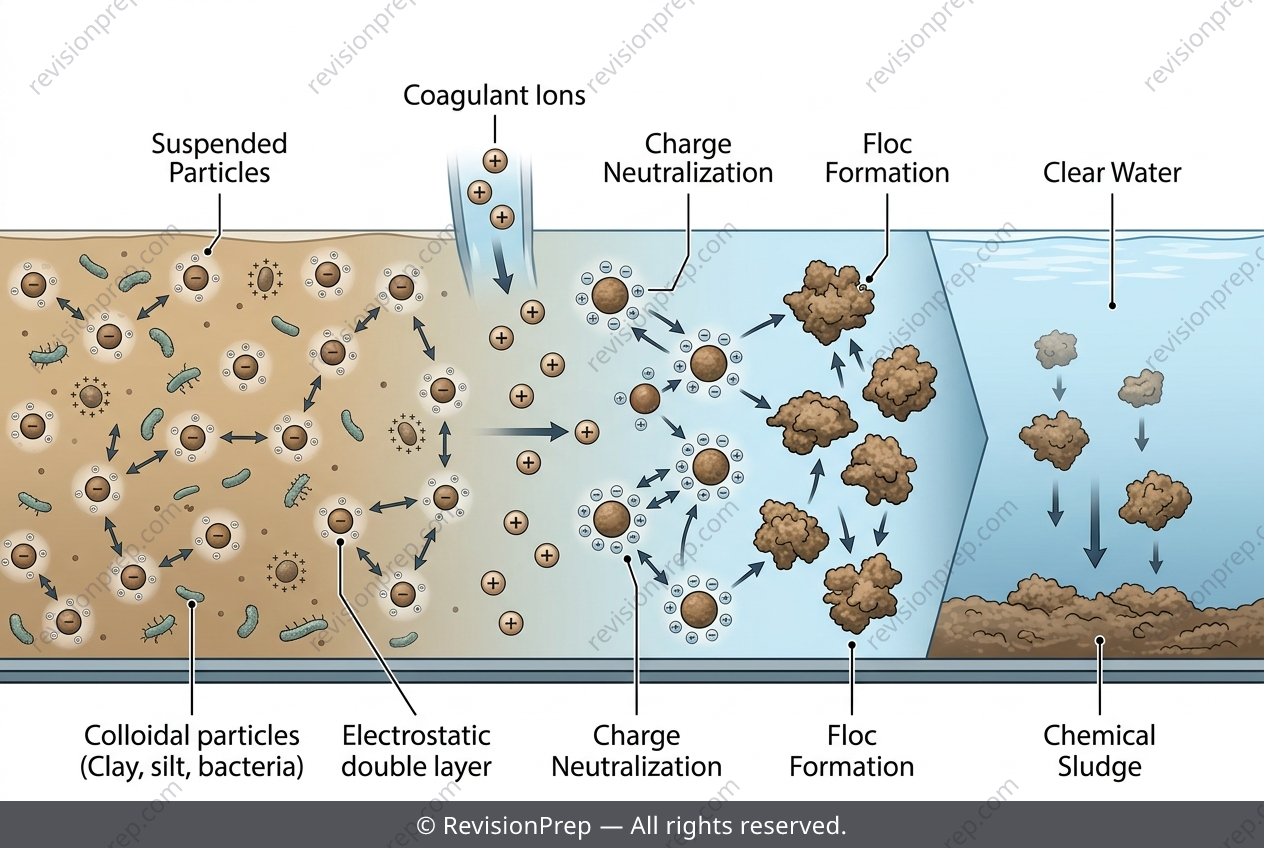
Raw river water looks muddy for a reason: it is a colloidal suspension, where fine particles like clay and bacteria carry negative surface charges that repel each other, keeping them suspended indefinitely. The core challenge of water purification is destabilizing this system—forcing these microscopic particles to clump together so they can be physically removed. This is where coagulation and flocculation come in, and the chemistry hinges on charge neutralisation. When aluminium sulfate, Al₂(SO₄)₃, is added to water, it dissociates to release Al³⁺ ions. These highly charged cations are the key players: they neutralise the negative charges on the suspended particles, removing the electrostatic repulsion that keeps them apart. Once destabilised, the particles can collide and bind, forming larger aggregates called flocs. These flocs are dense enough to settle out via sedimentation and are then caught by filtration. The process is elegant—a simple ionic interaction solves a massive practical problem. However, the chemical sludge left behind is not harmless; it contains residual aluminium and trapped impurities, and improper disposal can leach toxic ions into soil and waterways, disrupting ecosystems. Understanding this balance between purification efficiency and environmental cost is central to modern water treatment.
Start practising IB questions today
150,000+ IB-styled questions, criteria-mapped and instantly accessible.