
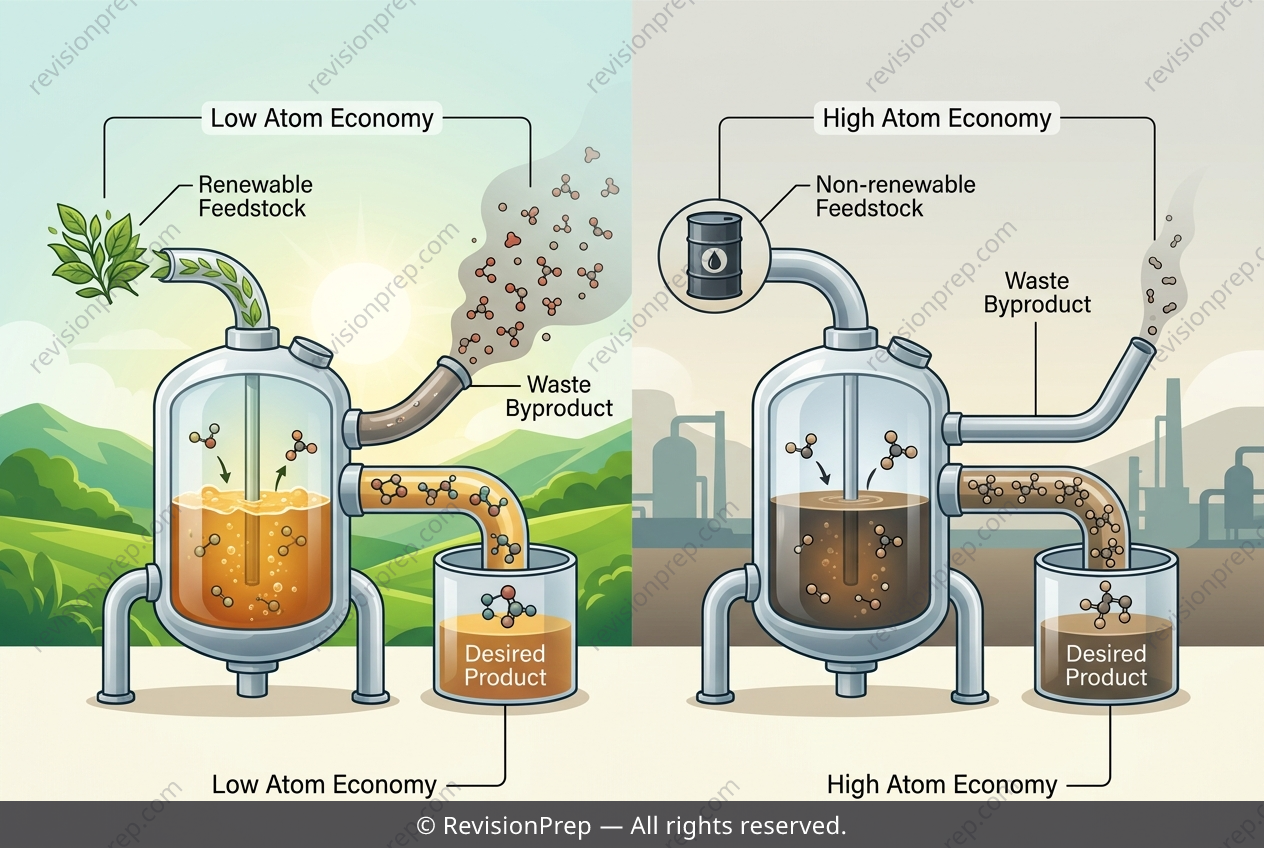
Chemistry: Ethanol's Two Paths, One Trade-Off
Atom economy is a measure of how efficiently a chemical reaction uses the atoms in its reactants, calculated as the molar mass of the desired product divided by the total molar mass of all reactants, multiplied by 100%. In industrial chemistry, this percentage reveals how much raw material ends up in the useful product versus being discarded as waste—a core principle of green chemistry that directly impacts both cost and environmental footprint. The contrast between two routes to ethanol illustrates this perfectly. Fermentation of glucose produces ethanol alongside carbon dioxide as a byproduct, meaning a substantial fraction of the reactant atoms are lost. Direct hydration of ethene, by contrast, combines water and ethene into a single product, so every atom from both reactants is retained in ethanol, giving it a theoretical atom economy of 100%. However, sustainability is not solely determined by atom economy. While direct hydration avoids byproduct waste, it relies on ethene from crude oil—a finite, non-renewable feedstock. Fermentation uses renewable glucose from crops, and its carbon dioxide byproduct is part of a closed biological carbon cycle. Thus, the higher atom economy of direct hydration must be weighed against feedstock renewability, making the “greener” choice context-dependent rather than absolute.
Start practising IB questions today
150,000+ IB-styled questions, criteria-mapped and instantly accessible.