
Chemistry: Gibbs Free Energy: Predicting Spontaneity in Chemistry
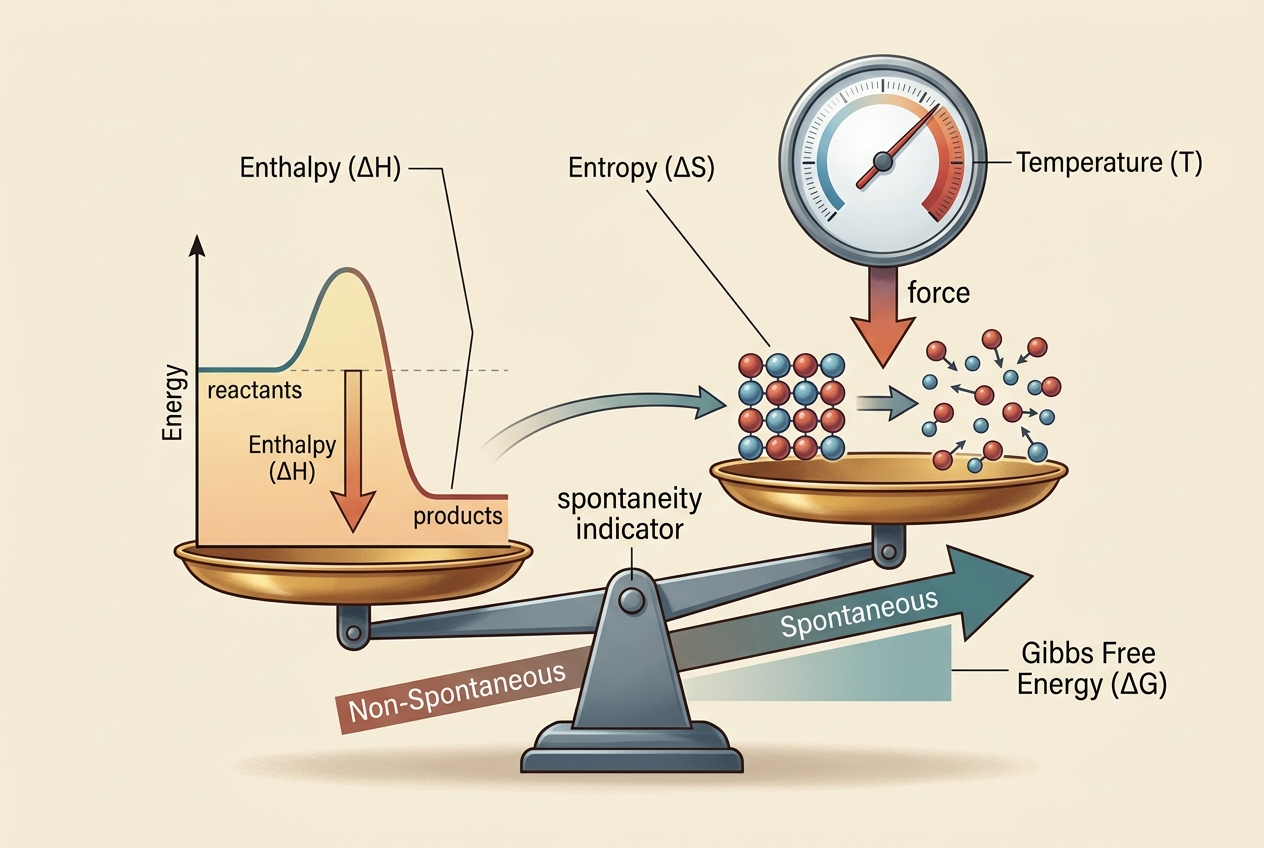
Spontaneity in chemistry isn’t about speed—it’s about direction. A spontaneous reaction is one that proceeds without continuous external energy input once initiated, even if it takes centuries (like diamond turning to graphite) or happens explosively (like sodium in water). The real question is: what decides this direction? The answer lies in Gibbs free energy, ΔG = ΔH − TΔS, which balances the tug-of-war between enthalpy (heat absorbed or released) and entropy (disorder). When ΔG is negative, the process is spontaneous; when positive, it requires outside work to occur. This balance explains why some endothermic reactions—like the dissolution of ammonium nitrate in cold packs—still happen. Here, ΔH is positive (heat is absorbed, making the pack cold), but ΔS is also positive (ions spread into solution, increasing disorder). At room temperature, the entropy term (TΔS) outweighs the enthalpy cost, giving a negative ΔG. However, because temperature multiplies ΔS, there’s a threshold where TΔS equals ΔH and ΔG = 0. Below that temperature, the entropy advantage shrinks, and the reaction flips to non-spontaneous. This single equation thus links energy, disorder, and temperature into one predictive framework—explaining why cold packs work on a hot day but would fail in deep freeze.
Start practising IB questions today
150,000+ IB-styled questions, criteria-mapped and instantly accessible.