
Chemistry: How Nitrate Turns Rivers Breathless
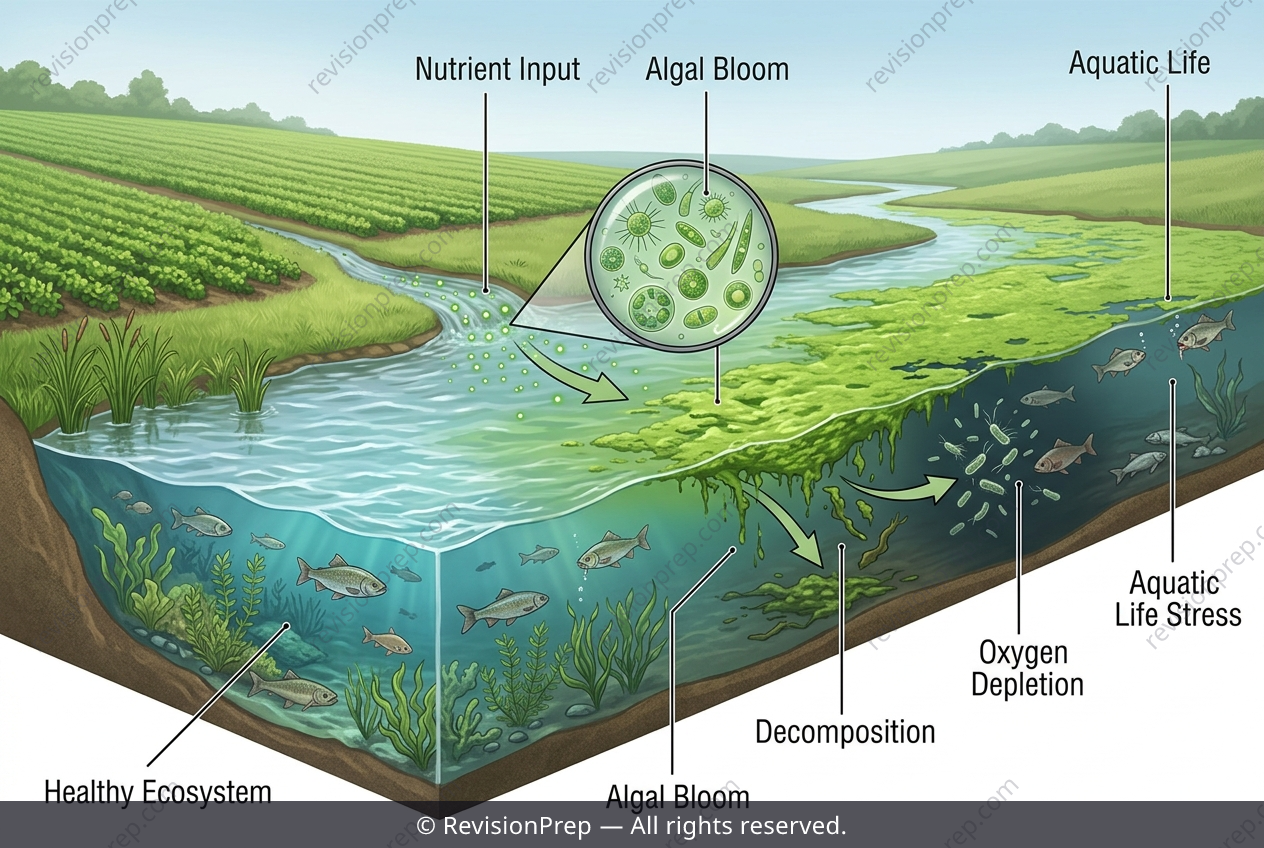
Nutrient pollution might sound like a problem of abundance, but in aquatic ecosystems, it is a quiet killer. When a concentrated solution of ammonium nitrate—a common liquid fertilizer—leaks into a river, its complete dissociation releases nitrate and ammonium ions that fundamentally alter the water’s chemistry. The core relationship here is simple: moles = concentration × volume, and because each formula unit of ammonium nitrate yields one nitrate ion, the total moles of nitrate entering the river can be traced directly from the spill’s volume and molarity. Why does this matter? Because nitrates are potent plant nutrients. In a river, they trigger explosive algal growth, or an algal bloom, which blankets the surface. When that algae dies, aerobic bacteria swarm to decompose it, and in doing so, they consume dissolved oxygen at a staggering rate. This oxygen depletion—hypoxia—leaves fish and other aerobic organisms gasping for the oxygen they need to respire, ultimately leading to mass die-offs. The ecological chain is tight: nutrient input → algal bloom → bacterial decomposition → oxygen crash → fish death. Understanding this mechanism is essential for predicting how a single agricultural accident can ripple through an entire river system.
Start practising IB questions today
150,000+ IB-styled questions, criteria-mapped and instantly accessible.