
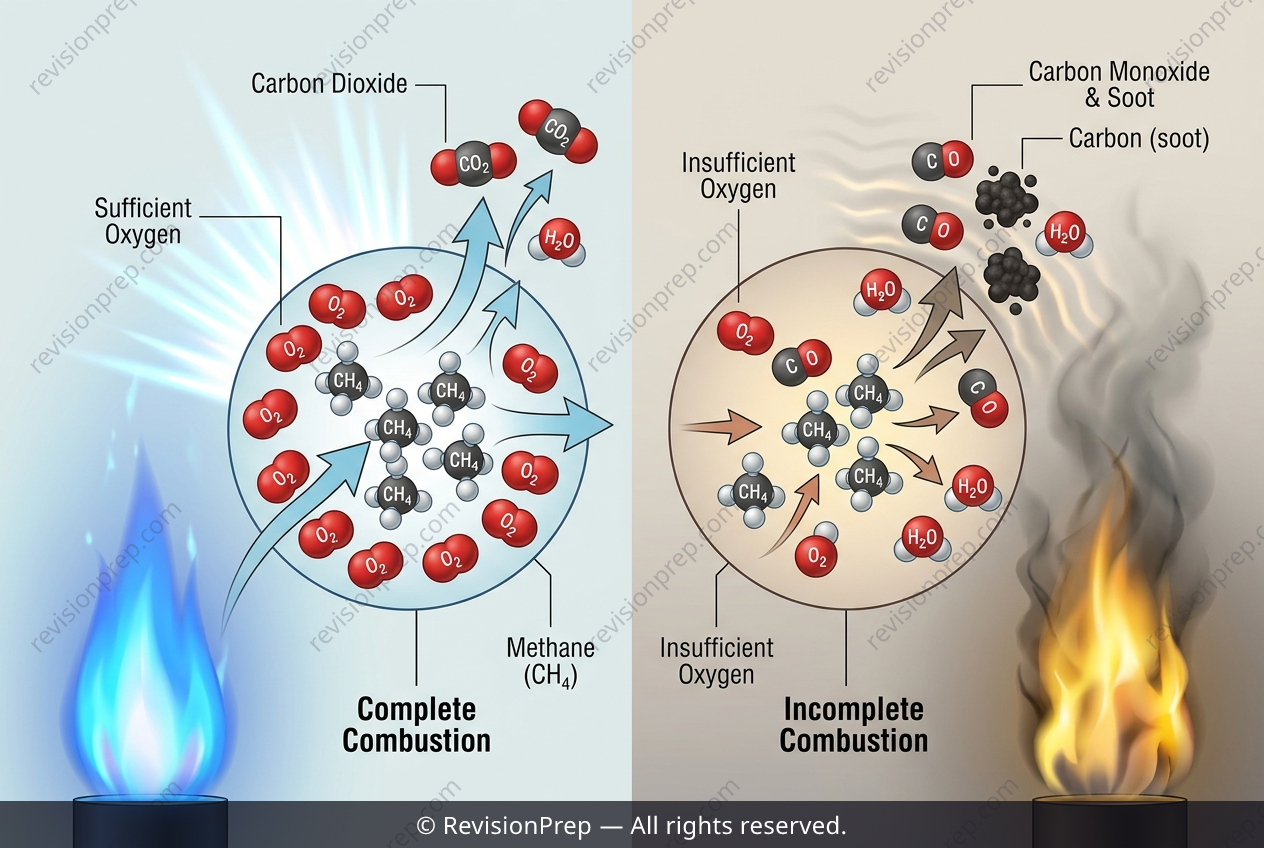
Chemistry: Incomplete Combustion: Soot, CO, and Oxygen Stoichiometry
When a Bunsen burner’s air hole is closed, the familiar blue flame turns yellow and smoky—a visible sign that methane is not burning cleanly. This is the essence of incomplete combustion, where a fuel reacts with insufficient oxygen, producing carbon (soot) and carbon monoxide (CO) instead of carbon dioxide (CO₂). For methane, the key relationship is stoichiometric: two molecules of CH₄ require only three molecules of O₂ to yield two atoms of solid carbon, two molecules of CO, and four molecules of water vapour—a balance that reflects the limited oxidiser available. Understanding this matters because combustion is central to energy production, yet its by-products directly impact health and the environment. CO is toxic, while soot contributes to air pollution. The mechanism hinges on oxygen supply: with enough O₂, carbon is fully oxidised to CO₂; with too little, oxidation stops partway, leaving carbon in lower-oxidation states. State symbols also matter—soot is solid, while all gases remain gaseous. Recognising how reactant ratios dictate product identities helps you predict real-world emissions from any fuel, not just methane.
Start practising IB questions today
150,000+ IB-styled questions, criteria-mapped and instantly accessible.