
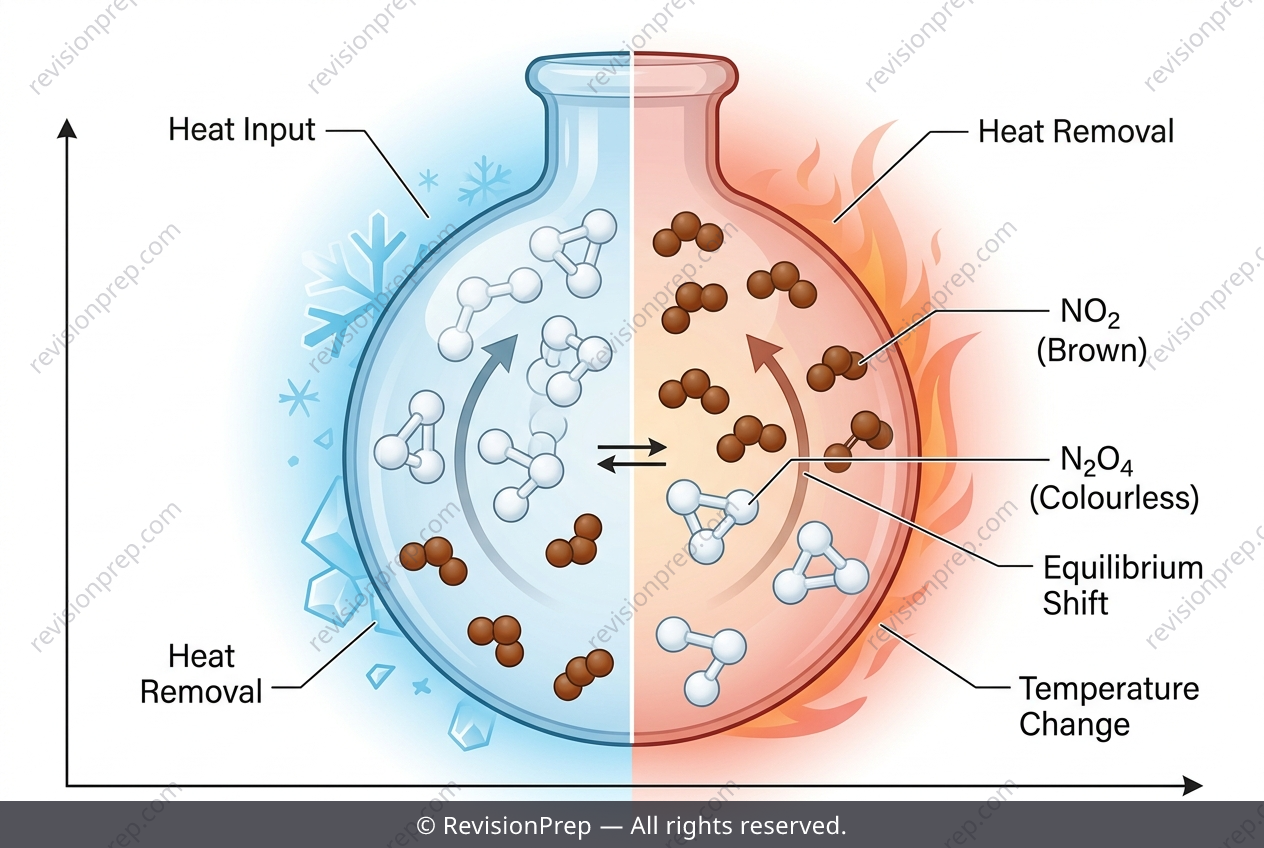
Chemistry: Le Chatelier’s Principle with NO₂ and N₂O₄ Equilibrium
Equilibrium is a dynamic balancing act: in a sealed flask, the forward and reverse reactions of nitrogen dioxide (NO₂) and dinitrogen tetroxide (N₂O₄) continue at equal rates, so the concentrations of brown NO₂ and colourless N₂O₄ remain constant. But this balance is not rigid—it responds to external changes, and that responsiveness is the heart of Le Chatelier’s Principle: when a system at equilibrium is stressed, it shifts to counteract that stress. For this reaction, the key stress is temperature, and the observable signal is colour: more brown NO₂ means the equilibrium has shifted toward the reverse reaction, while a paler mixture indicates a shift toward the colourless N₂O₄. The connection between temperature and direction reveals the reaction’s energy profile. Cooling a flask (as in an ice bath) removes heat, so the system shifts to produce heat—favouring the forward reaction, which converts brown NO₂ into colourless N₂O₄. Heating the other flask adds heat, so the system shifts to absorb it—favouring the reverse reaction, which regenerates brown NO₂. Because cooling favours the forward direction, that direction must release heat; therefore, the forward reaction (NO₂ → N₂O₄) is exothermic. This simple colour change is a direct window into how equilibrium systems self-correct, linking macroscopic observation to the microscopic tug-of-war between enthalpy and entropy.
Start practising IB questions today
150,000+ IB-styled questions, criteria-mapped and instantly accessible.