
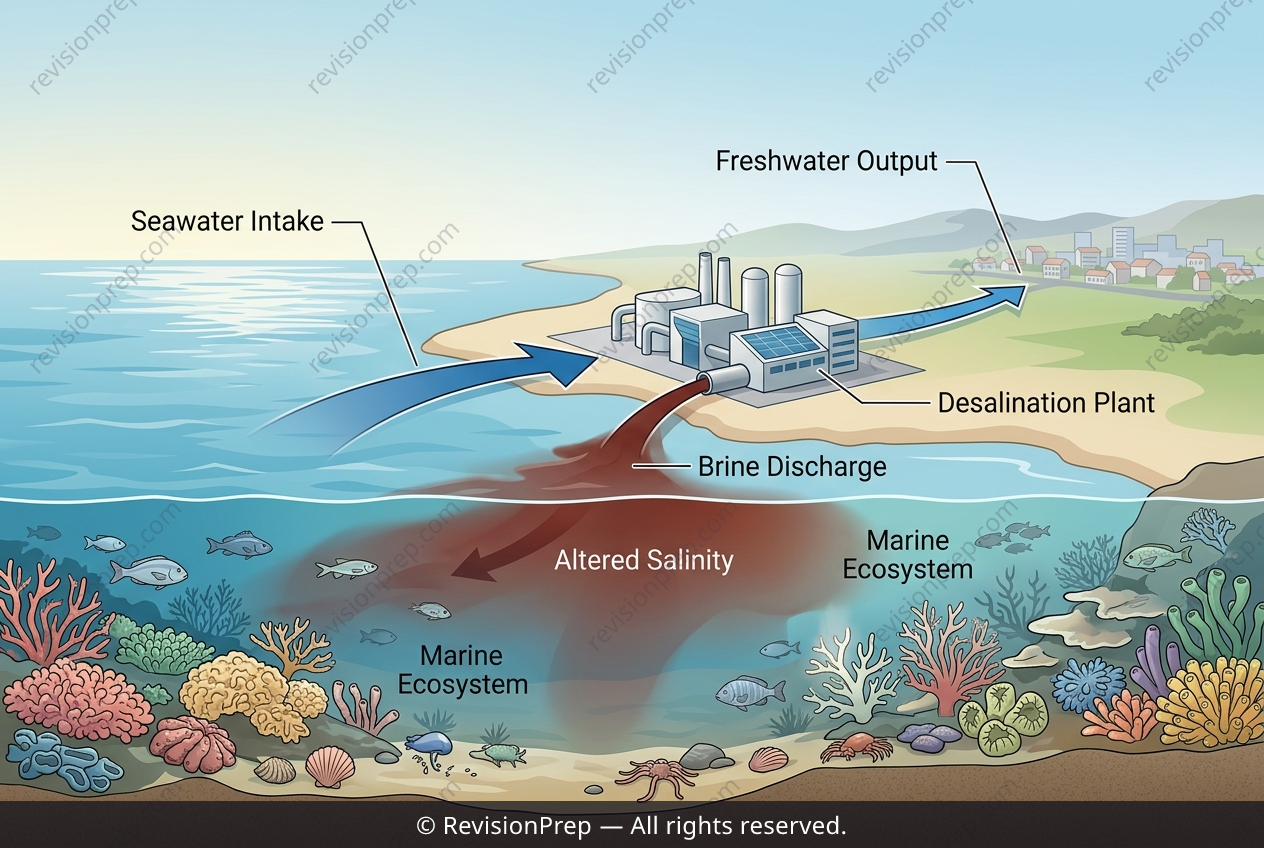
Chemistry: Solar Desalination and Marine Impact
Desalination by solar-powered evaporation turns an abundant resource—seawater—into fresh drinking water, offering a lifeline to coastal towns facing water scarcity. By heating seawater, collecting the water vapour, and condensing it, the process separates pure water from dissolved salts, reducing dependence on limited freshwater sources and easing pressure on groundwater reserves. This matters increasingly as climate change intensifies drought and water insecurity in many regions. Yet the same separation that produces clean water also concentrates what remains. The leftover brine, now far saltier than the original seawater, is discharged back into the ocean, where it raises local salinity and creates a sharp concentration gradient. This disrupts the osmotic balance of marine organisms, forcing water out of their cells and damaging ecosystems near the discharge point. Understanding this trade-off—between securing freshwater and protecting marine environments—is central to evaluating desalination as a sustainable solution.
Start practising IB questions today
150,000+ IB-styled questions, criteria-mapped and instantly accessible.