
Chemistry: How Intermolecular Forces Affect Solubility
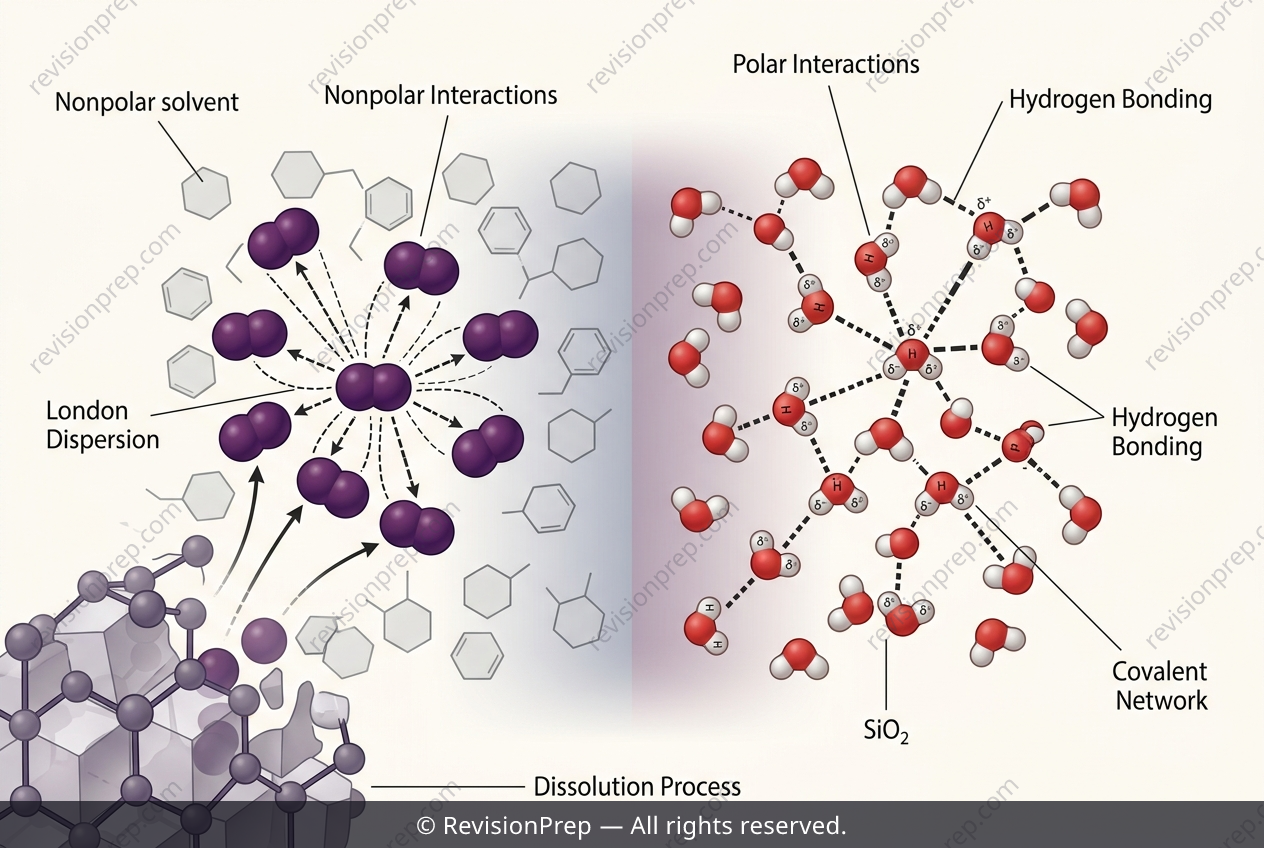
Why does iodine dissolve in cyclohexane while sand settles untouched at the bottom? The answer lies in the interplay between bonding, intermolecular forces, and polarity. Iodine molecules (I₂) are held together by weak London dispersion forces, while silicon dioxide (SiO₂) exists as a giant covalent lattice in which each silicon atom bonds covalently to four oxygen atoms — no discrete molecules exist to separate. This distinction matters because dissolving is never simply about mixing: it requires solute–solvent interactions strong enough to compete with the forces holding a substance together. Nonpolar cyclohexane interacts only through London dispersion forces, which match iodine's own intermolecular forces in strength, so "like dissolves like" applies and dissolution is energetically favourable. Sand offers no such match — breaking its covalent network demands far more energy than weak dispersion forces can supply. Even water, polar and hydrogen-bonding, cannot overcome those bonds.
Start practising IB questions today
150,000+ IB-styled questions, criteria-mapped and instantly accessible.