
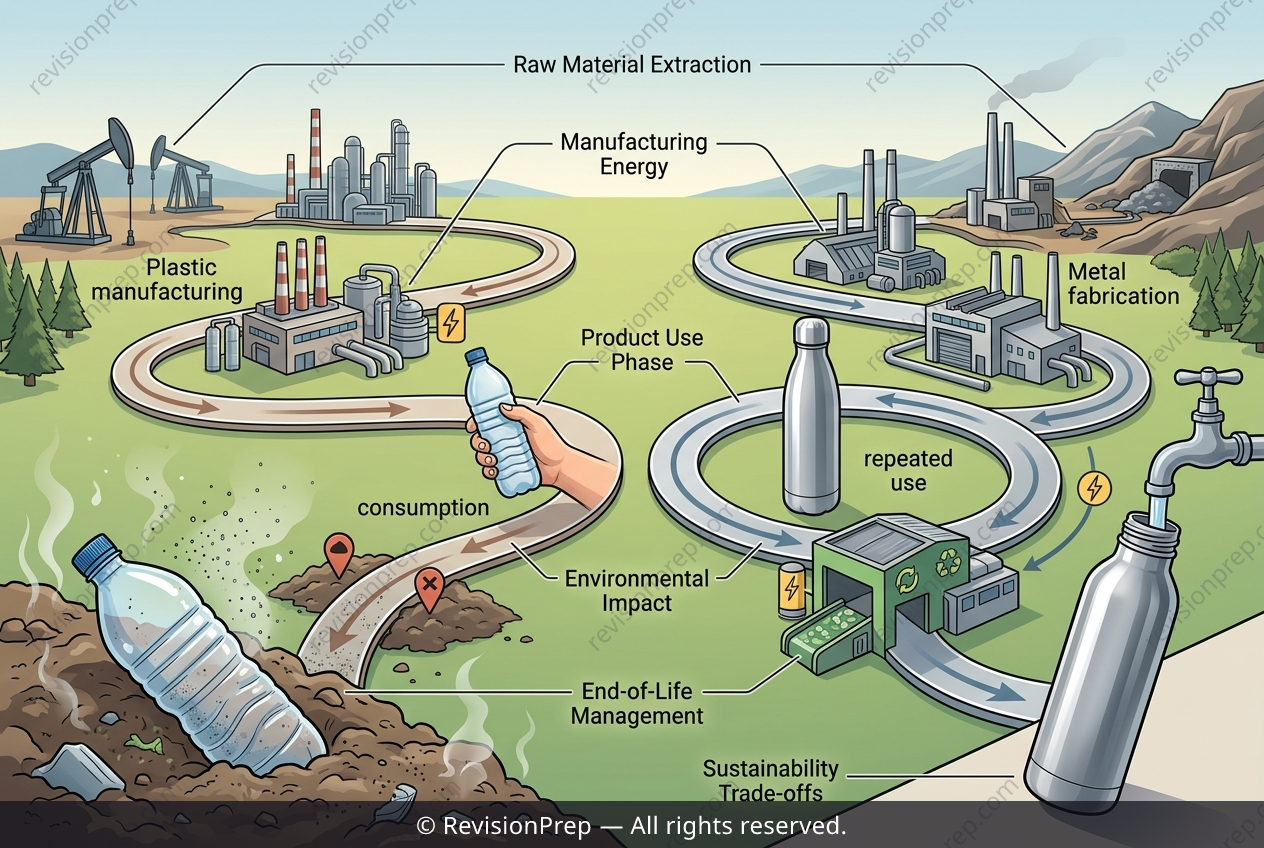
Chemistry: Life Cycle Assessment: Plastic vs. Steel Bottles
Life Cycle Assessment (LCA) is a systematic framework used to evaluate the environmental burden of a product from raw material extraction, through manufacturing and use, to its final disposal or recycling. Rather than focusing on a single stage, LCA connects the entire lifespan of a material, weighing inputs like energy and water against outputs such as emissions, waste, and pollution. This holistic view is essential for making informed choices about sustainability, because a product that appears “green” at one stage may carry hidden costs elsewhere. The comparison between a single-use plastic bottle and a reusable stainless steel bottle illustrates this complexity perfectly. While the plastic bottle’s impact is dominated by its end-of-life—where it fragments into microplastics that persist in soil and groundwater for centuries—the steel bottle’s burden is front-loaded, requiring significant energy during manufacture. The key relationship is a trade-off: the high initial energy input (and associated carbon emissions) of steel must be “paid back” through repeated use. If the steel bottle is used only a few times, its production footprint may never be offset by the avoided plastic waste. Thus, LCA reveals that sustainability is not an intrinsic property of a material, but a function of its entire life cycle and the user’s behaviour.
Start practising IB questions today
150,000+ IB-styled questions, criteria-mapped and instantly accessible.