
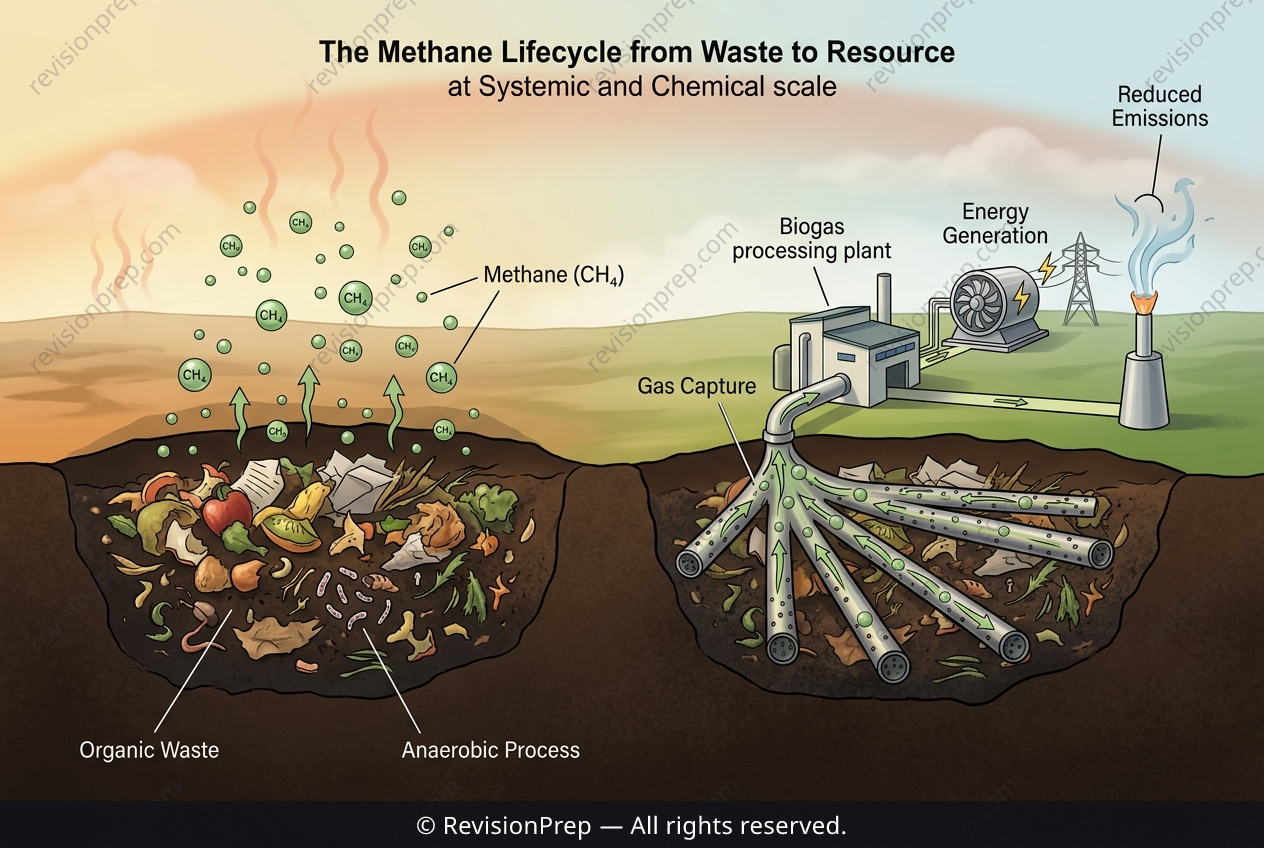
Chemistry: Methane Capture and Biogas Valorization in Landfills
Modern landfill sites are far more than simple holes in the ground—they are engineered bioreactors where buried organic waste slowly decomposes in the absence of oxygen. This anaerobic process produces a mixture of gases, most notably methane (CH₄) and carbon dioxide (CO₂). The structure that manages this output is the gas extraction well, a vertical or horizontal network of perforated pipes that draws the gas upward to the surface for collection. Without this system, the methane would simply escape into the atmosphere. Why does this matter? Methane is a potent greenhouse gas, roughly 25 times more effective at trapping heat than CO₂ over a century. Capturing it serves a dual purpose: it prevents a major contributor to climate change from being released, and it turns a waste product into a resource. The collected methane can be burned as a fuel to generate electricity or heat, effectively valorizing what would otherwise be a liability. This connection between waste management, atmospheric chemistry, and energy recovery lies at the heart of sustainable material cycling—where the by-products of decomposition are no longer seen as pollution, but as a stored form of energy waiting to be harnessed.
Start practising IB questions today
150,000+ IB-styled questions, criteria-mapped and instantly accessible.